
 Deutsch
 English
 中文
中文
 Danish
 Eesti
Eesti
 Español
 Suomi
Suomi
 Français
 Italiano
 日本語
日本語
 한국
한국
 Nederlands
 Norge
Norge
 Polski
 Portugues
 Русский
 Svenska
 Türkçe
 العربية
 Română
 български
Sunrises and sunsets
At the Schneller Graben weir on the Leine River
The trees on the opposite bank are reflected in countless shades of green on the gently rippling water’s surface, lapping around a few paddlers; the increasingly warm sunlight transforms the brick house by the weir into a water castle in Tuscany, and the evening sky slowly shifts from a soft blue to a pale yellow.
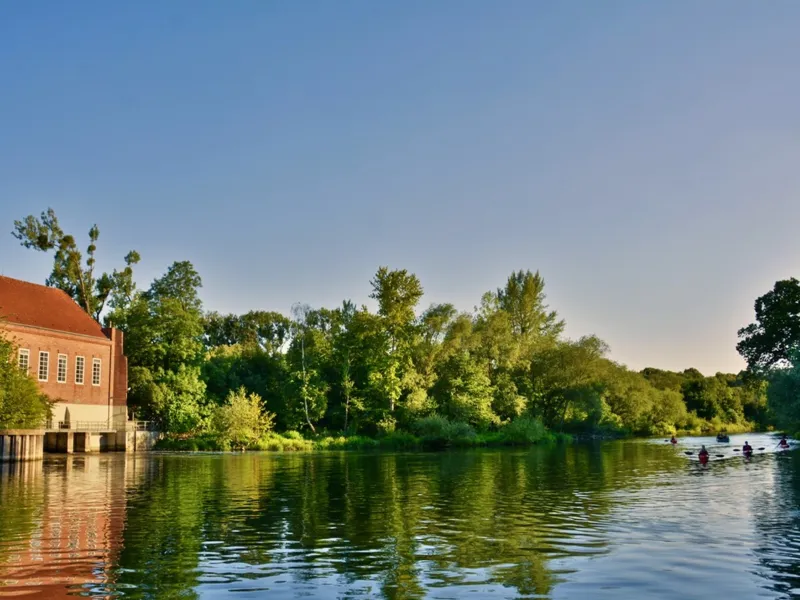
At the Schneller Graben weir
Soon, tufts of purple clouds will drift silently by. A summer symphony of colors. And everything flows.
The Evening Gala on the Leine River
This tranquil little spot on the lawn for the heavenly evening show at Schneller Graben is somewhat hidden away in the Leinemasch behind the stadium. If you’re driving there to catch the sunset, take the Ferdinand-Wilhelm-Fricke-Weg past the back of the HDI Arena and the Gilde Parkbühne to the parking lot in front of the Sports Performance Center at the Lower Saxony Olympic Training Center, and from there, you can leisurely walk toward the setting sun on the nearby bank of the Leine. Pedestrians and cyclists are best advised to take the bridge over the Leine on the west side of Maschsee, behind the Hannoverscher Ruder-Club von 1880 e.V., and then walk along the left bank to the prime viewing spot on the sunbathing lawn. There, everyone has a front-row seat overlooking the Leine, which “performs” on two “stages” over a 600-meter stretch, separated by a gentle slope at the weir. The Schnelle Graben becomes a 20-meter-long orchestra pit, from which the never-ending melody of the flowing water softly drifts across.
Three meters for three million
We owe this (enchanting) relaxing music to the foresight of Hanover’s city leaders, who in 1742 commissioned the construction of the weir to divert the Leine River over the neighboring Ihme River (which joins the Leine just a few meters further west) during floods, thereby channeling it around Hanover—a practice that continues to this day. When the facility went into operation three years later, it was the city’s most expensive structure to date, costing 51,000 talers. It wasn’t until 140 years later that the idea arose to harness the three-meter drop in water level to generate electricity. With an annual output of around three million kilowatt-hours, the Schneller Graben hydroelectric power plant—which went into operation on November 3, 1921 (the imposing brick building on the left bank, which seems to transform into a Tuscan water castle in the ever-warmer sunlight)—can supply approximately 1,500 households in Hanover with naturally generated electricity. You can also see all of this up close on a canoe tour. Boats can be rented individually or booked as a group tour through Kanuverleih Hannover; the meeting point and launch site are on the right bank, directly below the weir.