
 Deutsch
 English
 中文
中文
 Danish
 Eesti
Eesti
 Español
 Suomi
Suomi
 Français
 Italiano
 日本語
日本語
 한국
한국
 Nederlands
 Norge
Norge
 Polski
 Portugues
 Русский
 Svenska
 Türkçe
 العربية
 Română
 български
Sunrises and sunsets
At the Leine Weir in Döhren
Some oases of tranquility reveal their special charm early in the morning during the blue hour. The weir on Leineinsel in Döhren is one of those refreshing spots where you can recharge and take a deep breath before the day really gets going.
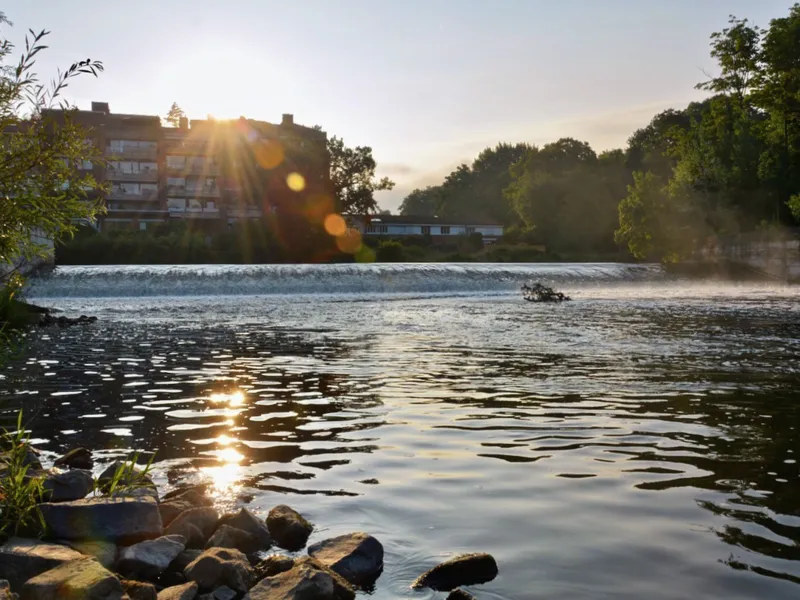
View of the Leineinsel at the Wollewehr.
When everything is still quiet all around and the city is slowly waking up, that’s exactly the right time to sit dreamily on the rough stones along the banks of the Leine and watch the sun rise. And suddenly, it becomes crystal clear once again why strength lies in stillness.
In the past, people used to wash wool at the weir
It wasn’t always so peaceful and quiet in this area around Leine Island. Just over 45 years ago, the industrial buildings of the Döhren Wool Washing and Combing Plant—known locally in Hanover as “Döhrener Wolle”—stood where these pretty houses stand today. Starting in the 1870s, raw sheep’s wool from Australia, New Zealand, and South America was cleaned and combed at the weir in the river—which had been built in 1667 and at that time still powered a watermill on the Döhren Leine Island. Thanks to its prime location directly on the Leine River, which always provided sufficient water for washing the wool, “Döhrener Wolle” quickly developed into a large-scale operation with 2,000 employees. The boom lasted a full century; in 1973, the plant was shut down. After the buildings were demolished, the residential neighborhood that stands today was built on the former factory grounds. At least a few historical landmarks have survived: the clock tower from 1909, for example, with its picturesque corner towers and battlements (it once served as a hose tower for the factory fire department), as well as the workers’ housing complex “Döhrener Jammer” and the ram sculpture at the corner of Am Uhrturm andAm Leinewehr, which was originally erected in 1893 as a symbol of the merger of the four German wool-combing mills into the “Deutsche Kämmerkonvention.”
Three spots left for breakfast by the water
But even the former Wolle Weir was not to last: In 2004, the city of Hanover had the dilapidated structure demolished and installed a flat concrete weir in the riverbed, over which the waters of the Leine now swirl. From the “balcony” at the roadside near the bridge, you can watch the turbulent activity in the river in peace and quiet. Much more idyllic and even quieter—both at sunrise and at dusk—is the small spot with a bench on the Wiehegraben upstream along the Leine, reached by a path that runs along the houses above the weir. In contrast, the narrow sandy beach visible on the opposite bank is accessible only by a footpath that winds through the bushes behind the nearby bridge on Johann-Duve-Weg along the Leine.