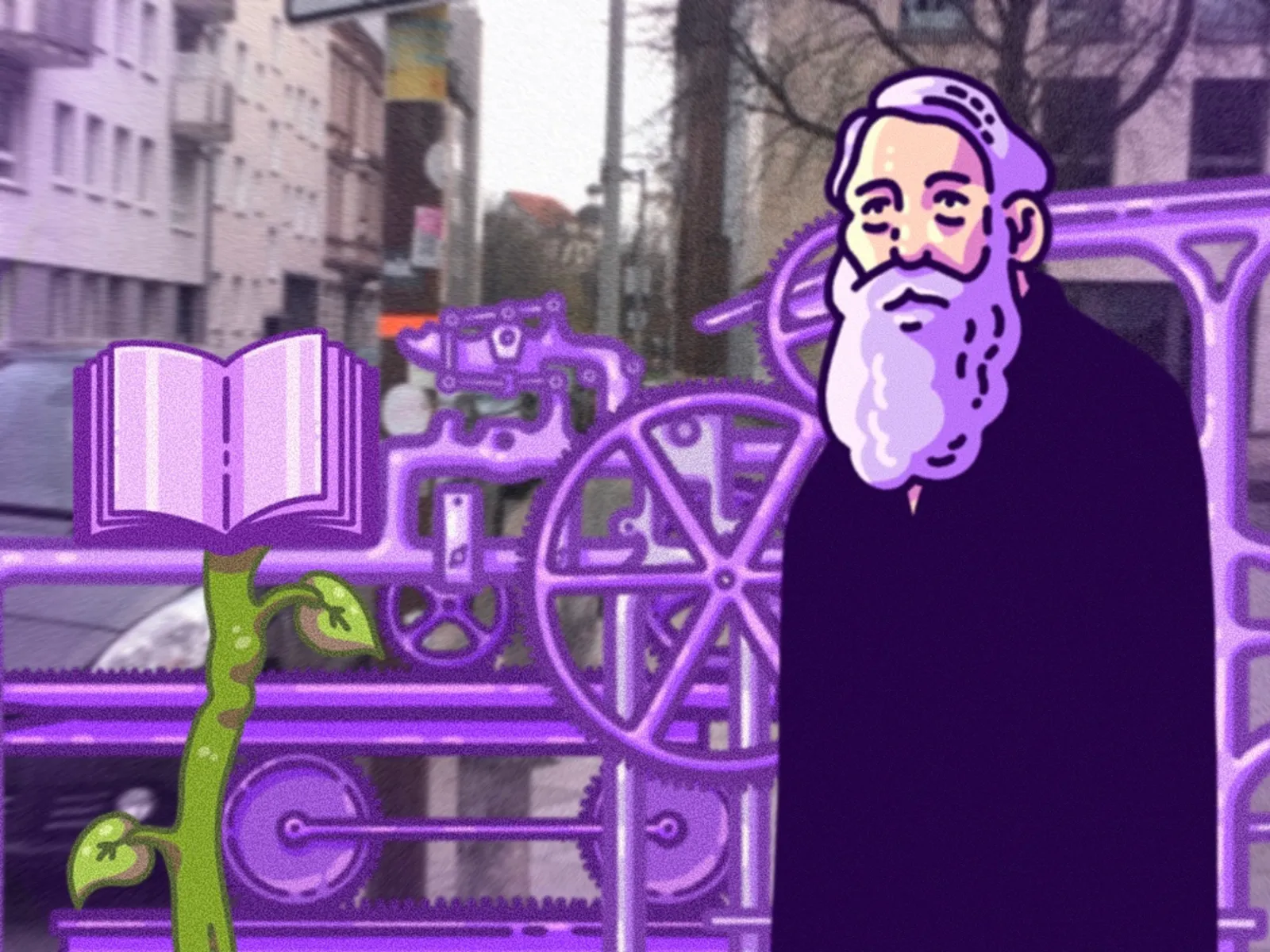
Heinrich Ebhardt, as the inventor of the commercial ledger, is a key figure in the advancement of printing in Hanover and around the world. This is his stage.
In hand-drawn and partially animated 2D scenes, the printer and manufacturer Heinrich Ebhardt is presented with a stage that combines mechanical elements with the naturalistic features of the emerging Art Nouveau movement in the 19th century.
Ebhardtstraße, named after the printer and manufacturer Georg Heinrich Ebhardt, branches off from Friedrichswall in Hannover Mitte. Its namesake lived in Hannover from 1808 to 1899 and, together with his business partner, founded the J. C. König & Ebhardt ledger factory there in 1845, which is considered one of the world’s first ledger factories. Originally intended solely for printing labels, the factory soon gained prominence through the use of new inventions, such as the two-color high-speed letterpress, the wire-stitching machine, and the high-speed ruling machine. Ebhardt is also credited with inventing the ledger—also known as a business or accounting book—for which his factory would become famous. Later, he donated the Gutenberg Fountain and the Gutenberg statue to the city of Hanover. His grave, featuring a bust, can be found today at the Engesohde City Cemetery.

 Deutsch
 English
 中文
中文
 Danish
 Eesti
Eesti
 Español
 Suomi
Suomi
 Français
 Italiano
 日本語
日本語
 한국
한국
 Nederlands
 Norge
Norge
 Polski
 Portugues
 Русский
 Svenska
 Türkçe
 العربية
 Română
 български