 Deutsch
 English
 中文
中文
 Danish
 Eesti
Eesti
 Español
 Suomi
Suomi
 Français
 Italiano
 日本語
日本語
 한국
한국
 Nederlands
 Norge
Norge
 Polski
 Portugues
 Русский
 Svenska
 Türkçe
 العربية
 Română
 български
Place of remembrance
Cemetery of Honor Maschsee-Nordufer
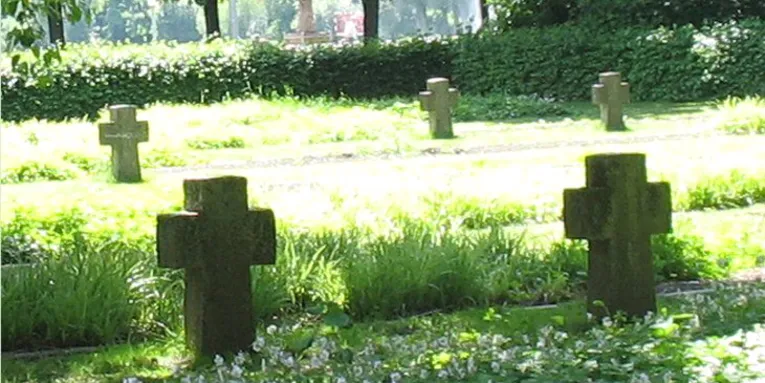
Cemetery at the Maschsee North Shore Memorial Cemetery
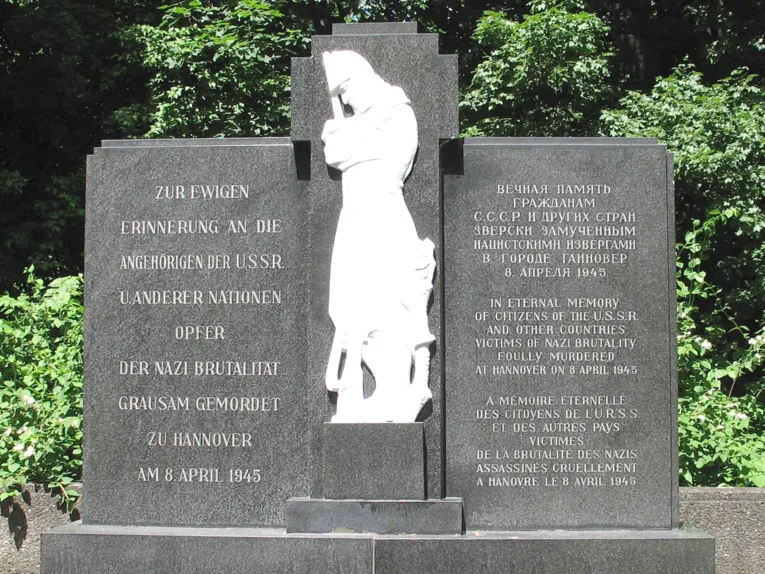
The memorial was designed by the sculptor Mykola Muchin-Koloda and opened to the public on October 16, 1945.
Since its founding in 2010, the Municipal Remembrance Culture Office of the State Capital of Hanover has provided scholarly oversight of the memorial at the Maschsee-Nordufer Cemetery of Honor. In recent years, new forms of remembrance have been developed here. The Maschsee-Nordufer Cemetery of Honor is increasingly recognized as a site of European remembrance. Numerous organizations and individuals are committed to remembrance at the Maschsee North Shore Cemetery of Honor: Since the 1980s, the IG Metall labor union has also supported remembrance efforts. Members of the IG Metall Youth enrich the commemorative events on Anti-War Day with their reflections and contributions. The St. Ursula School and the Bertha von Suttner School have taken on sponsorships for the memorial site. Through regular maintenance work, the students contribute to the preservation of the Memorial Cemetery and engage with the history and remembrance of World War II. Thanks to this commitment, numerous projects have been realized in recent years: In 2008 and 2010, two historical and commemorative plaques were erected on-site to educate visitors about the history of the Memorial Cemetery.
Since 2011, the State Capital’s Municipal Remembrance Culture Office, in collaboration with the Maschsee Working Group, has been organizing International Youth Encounters, which take place every two years in early May. For example, in May 2015: “From the Past to the Future—Youth Moves Europe.” Students from Russia, Poland, France, Latvia, and Greece joined young people from Hannover to reflect on the history of the Cemetery of Honor and on forms of a shared European culture of remembrance. They presented their findings at the commemorative events marking Liberation Day on May 8.
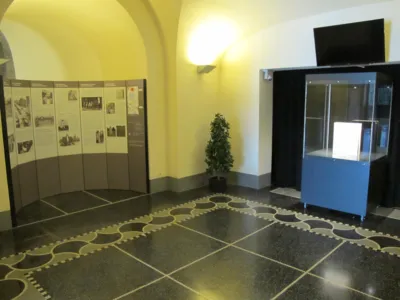
Grotto in the New City Hall
On May 8, 2012, the memorial book for the Cemetery of Honor was presented to the public. On behalf of the City’s Office of Remembrance, an extensive name search identified over 160 of the 386 people buried at the Cemetery of Honor. These names were included in the book according to the principle “One page, one name, one fate,” and the book is on permanent display in the grotto in the New City Hall. The grotto serves as a space for remembrance and reflection, as well as a place of information through an exhibition.
After decades of being pushed aside, these names have found their place: at the heart of urban life.
Cemetery of Honor Maschsee-Nordufer
Cemetery of Honor Maschsee-Nordufer
Information on the History of the Maschsee North Shore Memorial Cemetery
File type: pdf Size: 3,21 MB
War cemetery at Lake Maschsee, north shore, Hanover
War cemetery at Lake Maschsee, north shore, Hanover
Information on the memorial site in English
File type: pdf Size: 3,31 MB