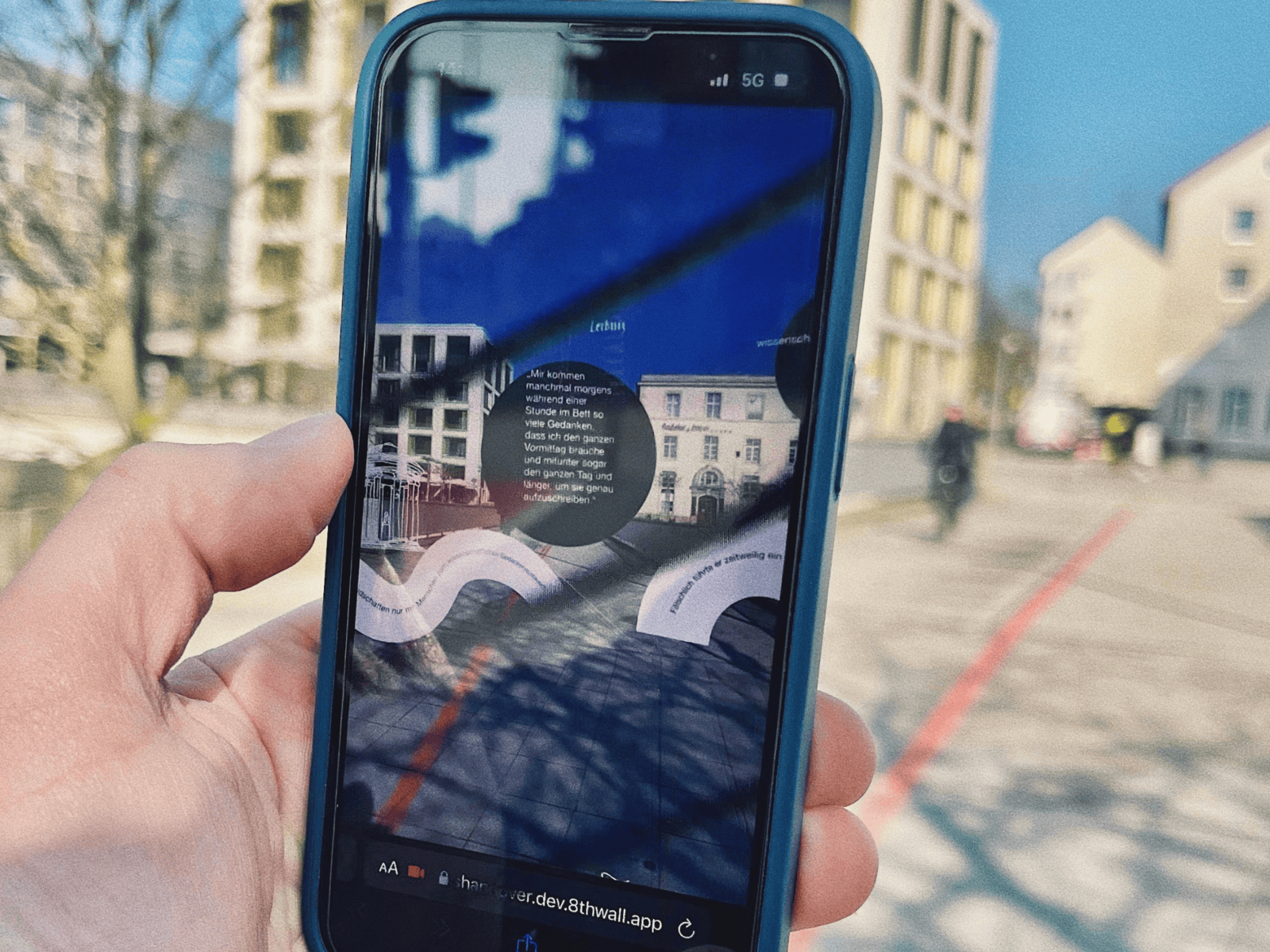
The app focuses on Gottfried Wilhelm Leibniz, after whom Leibnizufer is named. The scene has a museum-like feel, making it easy for users to find their way around without having to move around much. I didn’t focus so much on general facts and Leibniz’s titles, but rather on what kind of person he was—how he felt, interacted, and perceived himself.
The app is designed to give users an impression of Leibniz through the illustrations and text, one that can be formed even with limited time and information.
Leibnizufer marks the old city boundary of Hannover and is now a designated historic site. As early as the Nazi era, the street was planned in 1938 by Hannover city planner Karl Elkart to divert long-distance traffic away from the city center. In the past, the area around the Leine River and Calenberger Neustadt was a red-light district with a seedy reputation. It was not a place where people liked to spend time. Later, the street was named after Gottfried Wilhelm Leibniz. Today, public art can be found along Leibnizufer, such as Niki de Saint Phalle’s Nanas. It is also known as the “Sculpture Mile.”

 Deutsch
 English
 中文
中文
 Danish
 Eesti
Eesti
 Español
 Suomi
Suomi
 Français
 Italiano
 日本語
日本語
 한국
한국
 Nederlands
 Norge
Norge
 Polski
 Portugues
 Русский
 Svenska
 Türkçe
 العربية
 Romanesc
 български