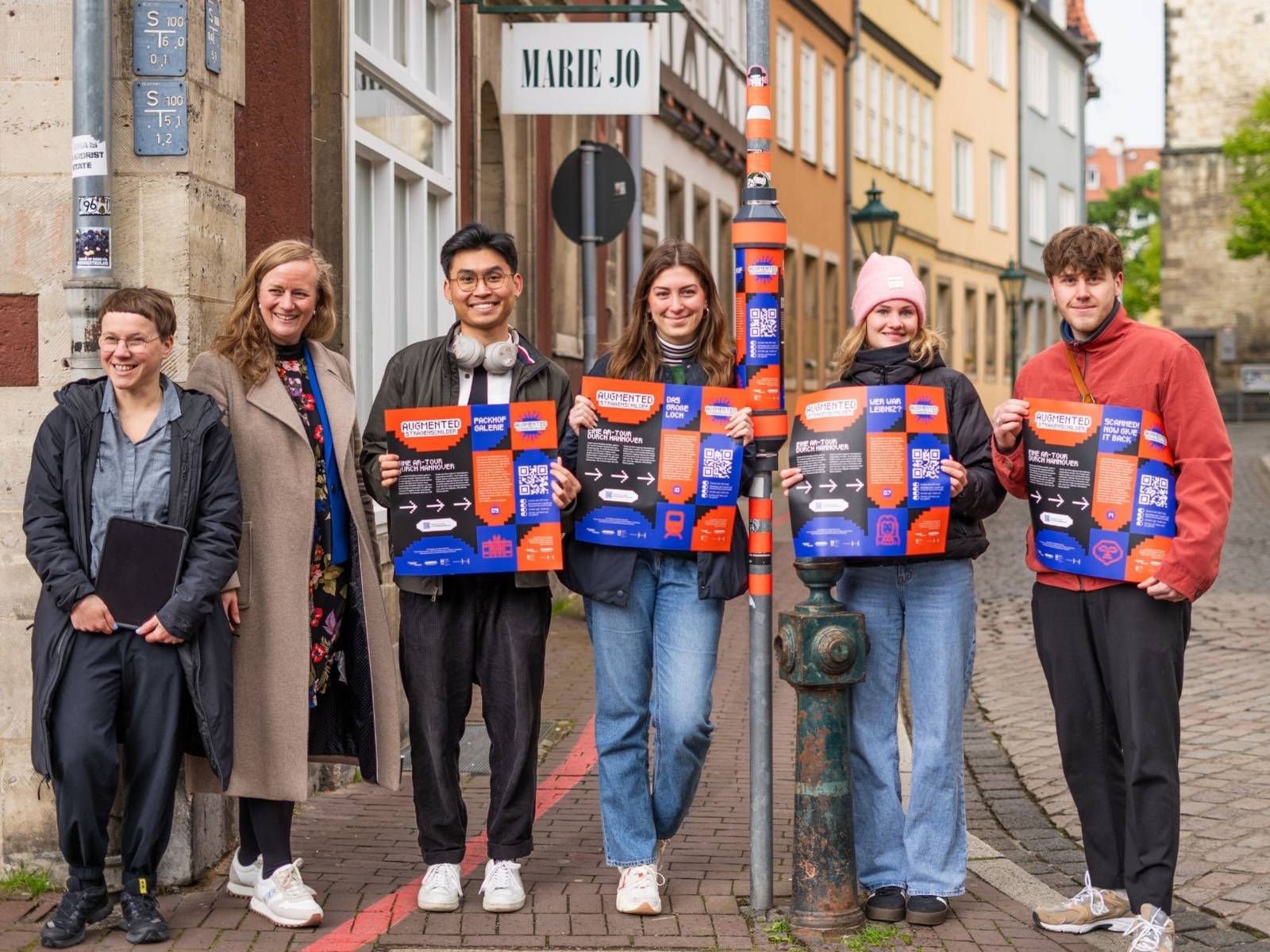
14 new augmented reality installations bring the city’s history to life: What is the story behind the “Man with Horse” sculpture on the Hohe Ufer? Why was there a “big hole” in Hannover for nearly 30 years? And what connection did Große Packhofstraße once have to wolves?
Augmented road signs launched in 2023
Augmented Street Signs launched in 2023 as a pilot project unique worldwide and has now been expanded with additional works in close collaboration with the Hannover Historical Museum. Under the guidance of Prof. Maiken Laackmann, students in the Visual Communication program at Hanover University of Applied Sciences and Arts have developed augmented reality works that explore the stories and events hidden behind the street names and place names in Hanover’s historic center. As part of the “History on the Go” program, the museum provided the students with historical information about these locations.
The 14 augmented reality street signs are now on display in downtown Hanover and can be “implanted” from the virtual space into reality using a QR code and your smartphone. The movements of the phone are transferred in real time to the display of the virtual content, so that the added digital layer merges with the camera image. No app is required for this, as the “augmented” street signs can be used like a website in a browser.
From a journey through the history of the Ballhof to the reconstruction of Schuhstraße, which was destroyed during the war: these augmented reality projects bring street signs to life. Users can listen to the hustle and bustle of the market in 1900, explore Hannover’s sister cities, or experience the atmosphere of the old Marstall. One virtual exhibition explores Hannover’s colonial history, while another focuses on the life of Gottfried Wilhelm Leibniz. Using a smartphone, visitors can explore a digital reconstruction of Hannover’s oldest building and even try their hand at composing music at Opernplatz.
The "Augmented road signs" project
As the performance of technical devices continues to improve at a rapid pace, augmented reality is becoming increasingly integrated into everyday life. The “Augmented Street Signs” project calls on society to explore and occupy the city’s digital spaces and to grapple with the question of who owns the digital public sphere. In this way, the project ties in with the urban smart city concept #HANnovativ, which focuses on digital urban development.
“The society of the future should have the right to help shape the digital public space—which will be so important in the future—and, in part, to secure it. With projects like Augmented Street Signs, we not only empower students to engage with this crucial development—it’s also about the city’s population participating in non-commercial digital projects,” says Prof. Maiken Laackmann.
Four works were recognized by the Hannover Historical Museum and will each receive a cash prize of 150 euros. The winning projects are “Das große Loch” by Maraia Jakimov at Kröpcke, “Landesmuseum” by Paul Rothe at the Landesmuseum, “Packhof Galerie” by Tuan Nguyen on Große Packhofstraße, and “Wer war Leibniz” by Victoria Niemann on Leibnizufer.
Detailed descriptions of the individual projects, as well as a map showing their locations, can be found at www.arstrassenschilder.de.
The 18 installations from the 2023 pilot phase are located in the neighborhoods of Linden, Nordstadt, Mitte, and List and remain available for use.
The project is supported by Hanover University of Applied Sciences and Arts, the City of Hanover, the Historical Museum, and Hannover Marketing und Tourismus GmbH.
How the augmented road signs work
In the immediate vicinity of the virtual artworks, mainly on the street signs, there are signs with a brief explanation and the QR codes for the respective project:
1. scan the QR code with your smartphone
2. allow access to the motion sensor and the camera
3. switch on audio
4. press Start
All applications are web-based and work via the smartphone browser. No additional app is required. Tip: Charge your cell phone and bring a power bank if necessary.
 Deutsch
 English
 中文
中文
 Danish
 Eesti
Eesti
 Español
 Suomi
Suomi
 Français
 Italiano
 日本語
日本語
 한국
한국
 Nederlands
 Norge
Norge
 Polski
 Portugues
 Русский
 Svenska
 Türkçe
 العربية
 Romanesc
 български