 Deutsch
 English
 中文
中文
 Danish
 Eesti
Eesti
 Español
 Suomi
Suomi
 Français
 Italiano
 日本語
日本語
 한국
한국
 Nederlands
 Norge
Norge
 Polski
 Portugues
 Русский
 Svenska
 Türkçe
 العربية
 Romanesc
 български
Ten Secrets from Hannover
The hidden Masonic symbols in Hinübers' garden
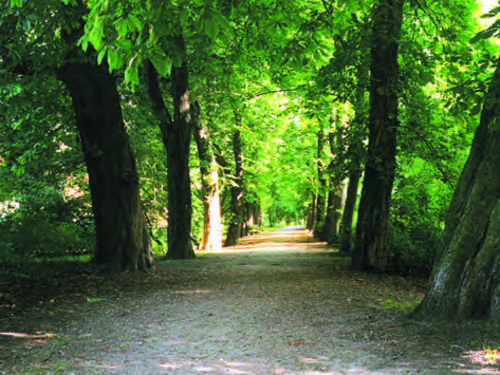
The Hinüber Garden in Marienwerder, on the northwestern outskirts of Hanover, was laid out around 1767 according to plans by Jobst Anton von Hinüber and is one of the earliest landscape parks in Germany. Idyllically situated between the monastery and the banks of the Leine River, the park was designed by the former chairperson of the Masonic lodge “Friedrich zum weißen Pferde,” founded in Hanover in 1746, modeled after English landscape gardens, and adorned with meaningful mottos and Masonic symbols. Not all of them have survived, and some are still waiting to be discovered.

Obelisk
Who or what are the Freemasons?
Freemasons see themselves as a community of people who guide their own actions and their interactions with themselves and the world around them according to the moral principles of liberty, equality, fraternity, tolerance, and humanity. "The goal here is to develop a strong character and, in both a figurative and concrete sense, to become a better person," as the Brotherhood of Freemasons e.V., based in Berlin, explains on its website, adding: "The symbols used in Freemasonry are linked to the recurring call to constantly reflect on oneself and one’s relationship with others."
Aphorisms describe the purpose of human life

Memorial stone in the Hinüber Garden.
Where better to engage in self-reflection than in nature or in a park specifically designed for that purpose? At more than 30 special locations in “his” garden—which at the time covered about 40 hectares—Jobst Anton von Hinüber had Masonic plaques inscribed with aphorisms erected. From the Brochure "The Hinübersche Garden" According to the Department of Environment and Urban Greenery of the state capital of Hanover, many of them were written in English. A pamphlet written by an anonymous author in 1777 reveals a little more about the aphorisms in Hinüber's Garden: "Just as this garden is designed in accordance with the English conception of nature, so too is it in the choice, style, and tone of its inscriptions. These are brief mottos that reflect on the human condition, the fleeting nature of time, the relationship between time and eternity, moderation in sensual pleasures, and the value of genuine wisdom; in short, they convey a serious, philosophical, and moral message.." Nine of these aphorisms have been on display in the park again since 2013, mounted on pedestals made especially for them. We’ll leave it to the observant hiker to find them.
Symbols guide the seeker's path

"Humanity" art installation by Atelier LandArt
The Masonic symbols in the Hinüber Garden, on the other hand, immediately catch the eye—though not always and everywhere. The historic memorial urns near the former bailiff’s house at the monastery (in honor of Gerlach Adolph Baron von Münchhausen, 1688–1770) are impossible to miss, on the path to the “Hexenturm” (in memory of Julius Melchior Strube, 1725–1777, a legal scholar in the service of the former Principality of Calenberg), and on a small hill at the edge of the forest (in memory of Burchard Christian von Behr, 1714–1771, Privy Councilor and Minister of State in Hanover).

Monument to Gerhard von Hinüber.
The monument to Gerhard von Hinüber, nestled among maple and ash trees, is just as photogenic as the art installation “Humanity” by the LandArt studio, situated in the middle of a green meadow. Less obvious, however, are the three field stones of the so-called Druid Altar beneath an old oak tree in the southwestern neighborhood. According to Masonic interpretation, this is where the seeker’s path of initiation begins, a symbolic journey in which the apprentice develops into a journeyman and ultimately a master.
Well hidden, yet unmistakable
Visible from a distance is the so-called “Witches’ Tower”—an artificial ruin situated on a hill in the woods in the northeastern part of the Hinüber Garden. This is where the initiatory path of the seekers ends upon reaching the Master’s degree, with the ruin serving as a symbol of transience and one’s own mortality. Out of sight stands the obelisk on the 65-meter-high Glockenberg in the northern part of the garden, on the other side of Garbsener Landstraße. "Freemasonry sees the obelisk as a symbol of life. Without the sun, there would be no life on Earth. In Freemasonry, the obelisk represents the connection between the ‘Great Architect of the Universe’—as Freemasons refer to the divine principle—and the Earth. The line of sight from the obelisk to the Hexenturm thus also symbolizes that death awaits at the end of life,” as explained in the brochure “Der Hinübersche Garten” published by the City of Hannover’s Department of Environment and Urban Greenery. We’ll leave it to the curious explorer to discover what other Masonic symbols can be found in the Hinüberschen Garten. However, we’d like to share one final hidden symbol here: the obelisk, the Hexenturm, and the Amtmannhaus together form an equilateral triangle—the distinctive symbol of Freemasonry.
An audio walk through the Hinüber Garden in Hannover-Marienwerder
The Hinübersche Garden in Hannover-Marienwerder is one of the earliest English landscape gardens in Germany
readHinüberscher Garden
30419 Hannover
.jpg)