
 Deutsch
 English
 中文
中文
 Danish
 Eesti
Eesti
 Español
 Suomi
Suomi
 Français
 Italiano
 日本語
日本語
 한국
한국
 Nederlands
 Norge
Norge
 Polski
 Portugues
 Русский
 Svenska
 Türkçe
 العربية
 Romanesc
 български
Theories of power
Hannah Arendt
Hannah Arendt's writings and theories are taught today in lecture halls around the world. The famous theorist was born in Hannover.

Hannah Arendt
Hannah Arendt was born on October 14, 1906, in Hannover-Linden. After completing her schooling in Königsberg, she studied philosophy—primarily under Martin Heidegger and Karl Jaspers—as well as theology and classical philology at the universities of Marburg, Freiburg, and Heidelberg. In 1928, she earned her doctorate under Jaspers with a dissertation on the concept of love in Augustine. In 1929, she married Günther Stern (Günther Anders), from whom she separated in 1937.
Escape from Germany and return to Europe
In 1933, Arendt was arrested for illegal activities for the "Zionist Association for Germany" in Berlin, but was released after a short prison sentence. She then fled via Prague to Paris, the first station of her exile. In Paris, she finished her book about Rahel Varnhagen. Among other things, Arendt worked for the "Youth Aliyah" to save Jewish children. In 1941, she managed to escape to the USA with Heinrich Blücher, her second husband.
In 1951, Arendt became an American citizen. She worked as a journalist and took on teaching positions, became known as a columnist for the German-Jewish weekly *Aufbau*, served as an editor at Schocken Books, and acted as executive director of the Commission on European Jewish Cultural Reconstruction. In 1949–50, Arendt traveled throughout Europe. She was reunited with Jaspers, with whom she had always maintained a correspondence. She also had her first postwar encounter with Heidegger, with whom she had broken off contact after 1933 due to his support for the Nazis.
Author and scientist
In 1951, her book "The Origins of Totalitarianism" was published in the USA and Great Britain (1955: "Elements and Origins of Totalitarianism"), which made her world-famous. This was followed by further publications in English and German on topics at the interface between political theory and practical philosophy. Her main work on this subject appeared in 1958: "The human condition" (1960: "Vita activa"). In 1961, she followed the trial of Adolf Eichmann on behalf of "The New Yorker" magazine. The resulting book "Eichmann in Jerusalem" (1963) sparked a controversial debate. After years of teaching as a visiting professor at various American universities, she took up a professorship in political science at the University of Chicago in 1963 and subsequently (1967) at the New School for Social Research in New York. Hannah Arendt died at the age of 69 on December 4, 1975 in New York.
Awards
In addition to numerous other awards, she received the "Lessing Prize" from the Free and Hanseatic City of Hamburg in 1959, the "Sigmund Freud Prize" for scientific prose from the German Academy for Language and Poetry in 1967 and the "Sonning Prize" for contributions to European culture from the Danish government in 1975.
Many places of remembrance
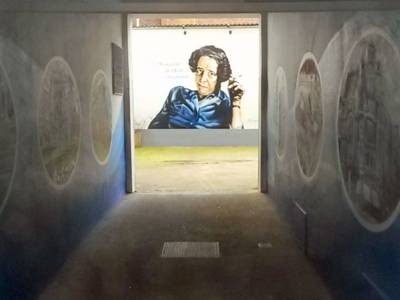
Hannah Arendt picture at the Hannah Arendt Birthplace
The state capital of Hanover commemorates the city’s illustrious daughter in many ways: a commemorative plaque has been installed at her birthplace in Hanover-Linden, and the city library features the Hannah Arendt Room, which houses exhibits from her personal collection. A school and a street near City Hall and the State Parliament are named after her—and since 2015, the prominent square in front of the State Parliament has honored the political theorist and philosopher. The Hannah Arendt Scholarship is awarded annually, and in cooperation with Leibniz University Hannover and the Volkswagen Foundation, the state capital hosts the annual Hannah Arendt Days.
The website www.hannah-arendt-hannover.de contains all the key information about Hannah Arendt and the related events. And with the establishment of a Hannah Arendt Student Chair at the Helene Lange School under the patronage of Mayor Stefan Schostok, the next generation is committed to preserving Hannah Arendt’s legacy in this city