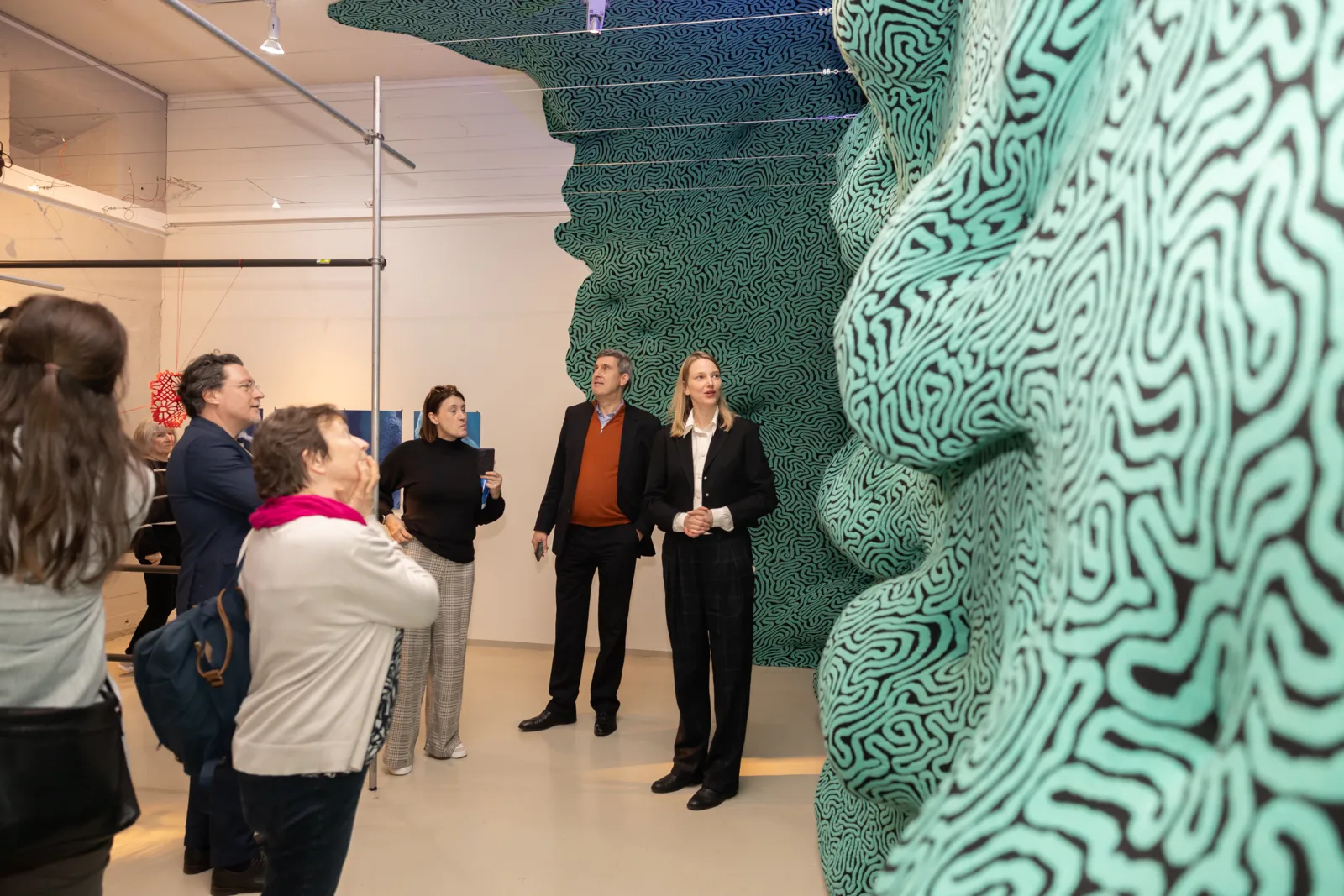
For the first time in Germany, an exclusive exhibition of works by the French artist and founder of the “Corail Artefact” project. Jérémy Gobé, born in 1986, is one of the most internationally renowned artists in the field of “environmental art.” Through “Corail Artefact,” he combines art, science, innovative technologies, and education in a series of projects aimed at restoring coral reefs. The permanent exhibition “Textile World Tour” remains open.
Coral Reef in the Bunker
Blue light reminiscent of the ocean’s shallows, paired with fabric draped over thick walls and ceilings that resemble rocks, creates the illusion of a coral reef for visitors. The museum’s unique location—a bunker built during World War II—contrasts with the delicate aesthetics of Jérémy Gobé’s artworks while simultaneously drawing a connection to the often relentless reality of the human-impacted environment. The Paris-based artist is known for placing traditional craft techniques within a contemporary context. He is particularly fascinated by bobbin lace, a delicate craft that he links to current issues such as climate change. He has also long been drawn to corals, with their sculptural forms and vibrant colors. The exhibition was initiated by the museum’s founder and fashion designer Erika Knoop. Since its founding in 2007, the MFTK has been committed to the environmentally sustainable use of textiles and aims to demonstrate through this exhibition the enormous potential inherent in the development of new fibers in combination with traditional craft techniques. Workshops and readings will accompany the special exhibition. The MFTK has secured the support of renowned sponsors for this special exhibition
Gobé Discovers: Corals Love Lace
Gobé was introduced to the craft of bobbin lace-making in 2017 at a factory in Le Puy-en-Velay, in southern France, that was about to close. He discovered the traditional pattern of this delicate net lace, made from organic materials such as silk or cotton. It struck Gobé like a bolt of lightning: the lace pattern immediately reminded him of the structure of coral. He had been exploring these unique marine creatures in his artistic work for some time. The vibrant colors and diverse forms of the critically endangered coral reefs fascinate him. The striking resemblance between bobbin lace and coral inspired him to conduct an experiment in a marine aquarium—and indeed, the coral larvae settled on the lace due to its coral-like structure.
The “Corail Artefact” Project
Based on the positive results achieved with bobbin lace, Jérémy Gobé founded the “Corail Artefact” project in 2019 to help save the coral reefs. This interdisciplinary initiative brings together art, science, and research, innovative technologies, and companies in the marine aquatics industry. The focus is on developing an eco-friendly concrete and an eco-friendly biopolymer that can be used to 3D-print coral-shaped structures and mounts for coral cuttings. The materials, called CCA and BCA (short for Concret Corail Artefact and Biopolymer Corail Artefact), are 100% environmentally compatible with the oceans, and BCA is even biodegradable. The goal is to develop sustainable, biodegradable support structures that facilitate the growth and reintroduction of corals. In doing so, Gobé combines textile art with marine biology: the lace is now made from bio-based BCA threads. The exhibition showcases, for the first time, samples developed using these threads. “Corail Artefact” collaborates with various marine and environmental protection organizations.
Successful tests
The first tests took place at the French marine center “Nausicaá.” There, various coral species are thriving on the structures developed by “Corail Artefact.” What began as an artistic experiment has evolved into a scientifically sound, ecologically effective solution. He is convinced that art should serve society, not the other way around. That is why educational programs are also part of his initiative’s concept. The “Corail Artefact” project is an example of how artists can use their creativity to help solve the problems of our time, such as climate change.
About Jérémy Gobé
Jérémy Gobé, born in 1986, lives and works in Paris. He is a graduate of the French art schools Beaux-Arts in Nancy and Arts Décoratifs in Paris. He is among the artists who believe that art can contribute to solving humanity’s major challenges, such as climate change. His exhibitions are in high demand internationally. His works have received numerous awards. His interest in the environment has brought his artistic practice closer to science. He is the founder of the “Corail Artefact” project, which contributes to the preservation of coral reefs www.jeremygobe.info .
About the Museum of Textile Art (MFTK) e.V.
The Museum of Textile Art is committed to a mindful, socially responsible, and environmentally friendly approach to clothing. The permanent exhibition showcases precious and unique textiles from around the world. The venue is also unique: housed in a renovated World War II bunker is the valuable textile collection assembled over 40 years by fashion designer and museum founder Erika Knoop, which is open continuously as the permanent exhibition “Textile World Tour.” Guided tours are available during opening hours and by appointment.
You can find the opening hours and prices at:
https://museum-fuer-textile-kunst.de/oeffnungszeiten-preise/
 Deutsch
 English
 中文
中文
 Danish
 Eesti
Eesti
 Español
 Suomi
Suomi
 Français
 Italiano
 日本語
日本語
 한국
한국
 Nederlands
 Norge
Norge
 Polski
 Portugues
 Русский
 Svenska
 Türkçe
 العربية
 Română
 български