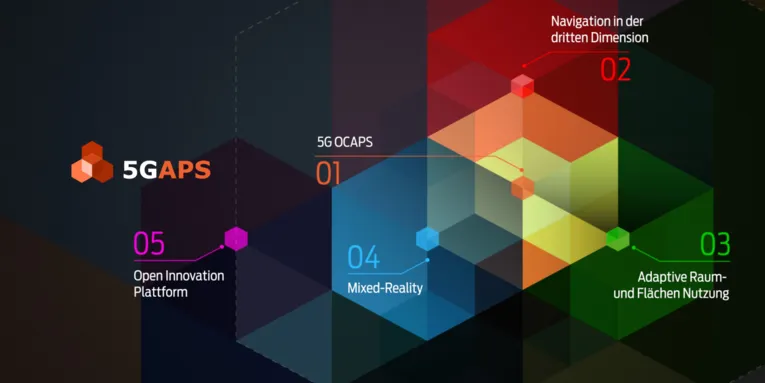
The acronym “5GAPS” stands for “5G Access to Public Spaces.” The long-term goal of the project is to digitally replicate Hanover in real time within a multidimensional space-time coordinate system. This will create, so to speak, a dynamic digital twin of urban outdoor areas as well as indoor spaces in buildings or commercial halls. The project was officially launched at a press conference on February 14 by Mayor Belit Onay, Managing Director Doris Petersen of the economic development agency hannoverimpuls, Dr. Jochen Köckler, Chairman of the Executive Board of Deutsche Messe AG, and Professor Monika Sester from the Institute of Cartography and Geoinformatics, representing Leibniz University and Hanover University of Applied Sciences and Arts.
Using and managing public spaces more intelligently
The virtual digital twin maps the environment in real time and predicts changes in status using machine-learning algorithms. The data platform will have a wide range of applications in the future: for example, for the highly precise operation of autonomous vehicles or for the localization and tracking of goods. The platform can assist with indoor navigation, optimize production processes, visualize plans, or even help with reserving spaces for market stalls or moving trucks. Tourism offerings such as guided tours through historic Hanover or the Herrenhausen Gardens are also conceivable. The platform is intended to benefit citizens, businesses, logistics providers, transportation service providers, planning firms, the city administration, as well as emergency services such as the fire department.
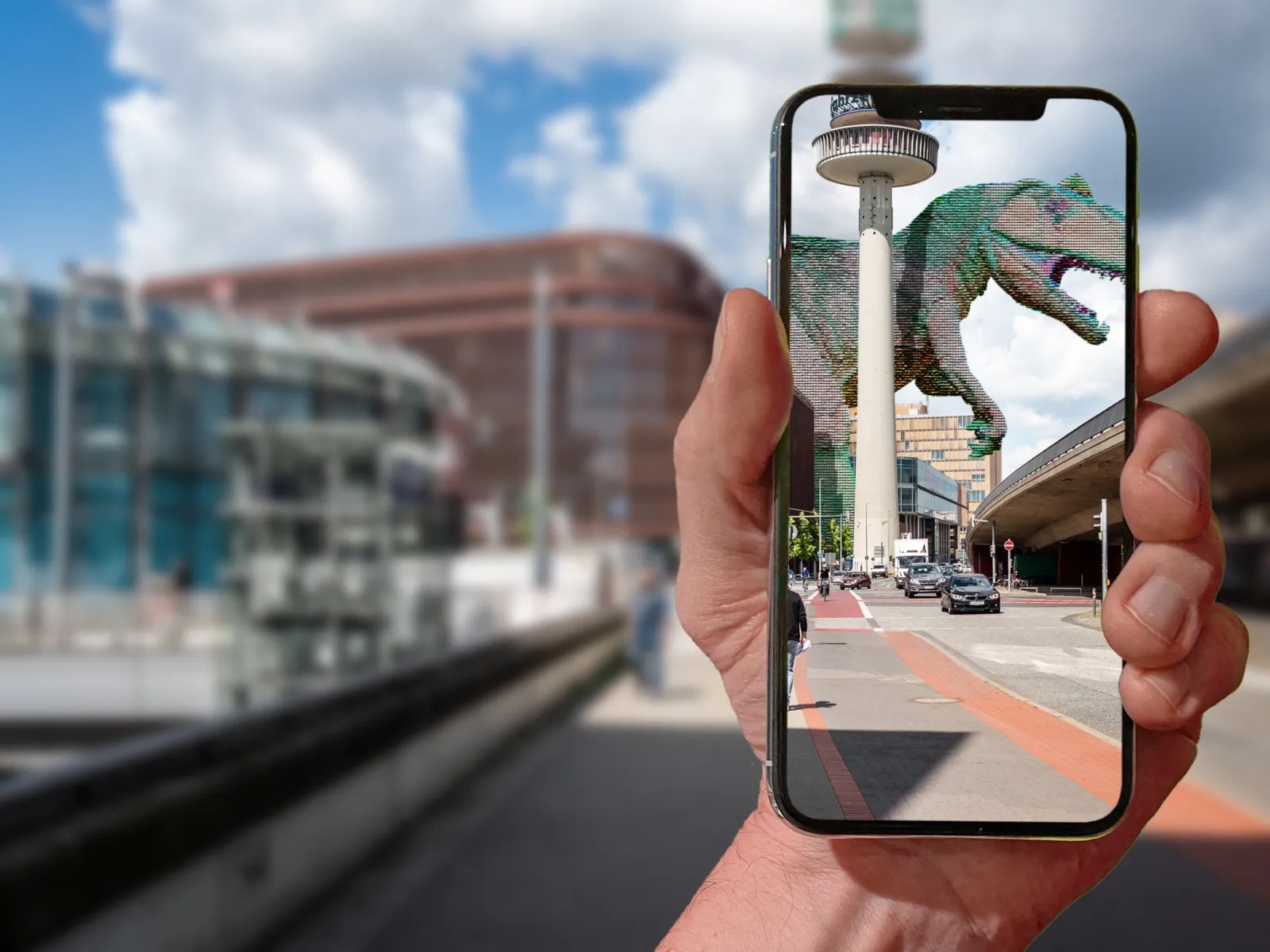
The range of applications for this concept is virtually endless. Some use cases—such as controlling a machine—require only three-dimensional coordinates and data on the current state of the environment. Other applications expand our perception of reality by adding location-based digital images and overlaying them onto reality. For this so-called augmented reality, you then need a smartphone, tablet, or special glasses. The digital twin is intended to be openly accessible and will provide interfaces for developers from the startup scene, established companies, and the research community.
For Mayor Belit Onay, the project is a boost for Hannover’s smart city initiative: “The development and expansion of digital infrastructure is a key factor in attracting business to our city. Together with our strong network, we want to test the possibilities of the key technology 5G right here in our city. This funded project will enable the state capital to further expand its expertise in digital urban development. This will benefit the business community, the academic sector, and the people of Hannover.”
Trade show as a real-world testing ground for an ambitious project
The first step will involve digitally mapping parts of the exhibition grounds to gain experience, develop the software for the digital twin, and test applications. If successful, later phases will involve digitally recreating the first parts of Hanover. Dr. Jochen Köckler, CEO of Deutsche Messe AG, expressly welcomes the fact that the trade fair will play a pioneering role as a test bed for 5GAPS. “As a partner from the very beginning, we are pleased to be able to provide the real-world testing environment for this ambitious project using the exhibition grounds’ infrastructure and our private 5G campus network. As of today, we have equipped a total of six halls, all roads, all parking lots, and the entire outdoor area on our grounds with Deutsche Telekom’s 5G standard. The rest of the fairgrounds, including all halls and buildings, will be gradually connected to this ultra-fast mobile network generation. Innovative applications developed through collaboration between science, business, and public administration are therefore a perfect fit for our 5G Smart Venue,” emphasizes Köckler.
Colleges and universities as key drivers
The key drivers of the project are the universities in Hanover. Leibniz University Hannover is represented through various research institutes, including L3S, the Department of Geodesy, and the Department of Business Informatics. Also involved are Hanover University of Applied Sciences and Arts and the Fraunhofer Institute for Experimental Software Engineering (IESE) in Kaiserslautern. “We are contributing our research and experience in the dynamic mapping of the environment to the project. This enables us to create a real-world laboratory for the benefit of citizens, where we can test more flexible management and use of spaces,” says Prof. Monika Sester from the Institute for Cartography and Geoinformatics.
Strengthening
the Local Digital Sector Doris Petersen from the economic development agency hannoverimpuls sees a key opportunity to strengthen the local digital sector: “5G is the gateway to new technologies and digital services in the Hanover region and makes the area ready for the future. The economic development team is working full steam ahead to build a community with 5G programming expertise in order to create substantial added value for everyone in the business community,” emphasizes Petersen.
The federal government is providing four million euros in funding
The 5GAPS initiative in Hanover is backed by federal funding totaling four million euros. The City of Hanover, hannoverimpuls, Deutsche Messe AG, and companies from Hanover participated in a 5G innovation competition organized by the Federal Ministry of Digital and Transport (BMDV) and submitted a project proposal in August 2020. The application was successful. The BMDV recently approved the funding retroactively effective January 1, 2022. In addition to Hanover, 70 other cities and regions participated in the competition, developing innovative concepts for 5G applications and business models. Approximately 50 projects were selected from across Germany and will now be implemented with federal funding. Hanover is among them. The 5GAPS project will run through December 31, 2024.
 Deutsch
 English
 中文
中文
 Danish
 Eesti
Eesti
 Español
 Suomi
Suomi
 Français
 Italiano
 日本語
日本語
 한국
한국
 Nederlands
 Norge
Norge
 Polski
 Portugues
 Русский
 Svenska
 Türkçe
 العربية
 Română
 български