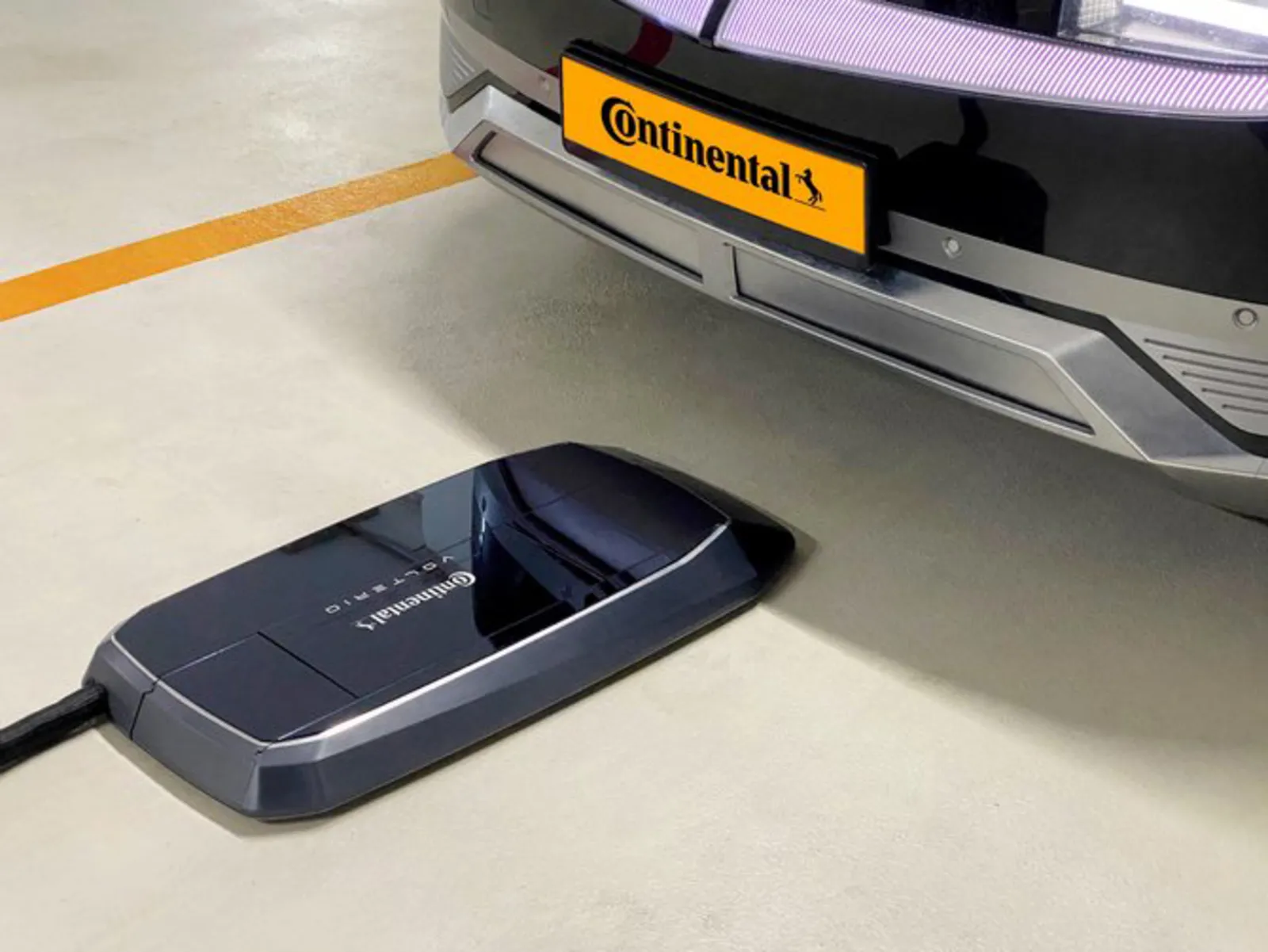
By mid-2022, CES will have developed the first near-production systems for the jointly designed loading robot. CES meets all the necessary certification criteria of the automotive industry. Series production of the system is scheduled for 2024 and will take place in Germany. This innovative development once again underscores Continental Engineering Services’ strategic focus on sustainable technology and service solutions. In particular, smart charging solutions for electric vehicles are crucial milestones on the path to fully environmentally friendly, sustainable mobility.
The fully automated charging solution consists of two components: a unit mounted on the vehicle’s underbody and a unit placed on the garage floor. As soon as the car is parked, the two components connect via a smart automated system that is controlled, among other things, by ultra-wideband—a radio-based communication technology for short-range data transmission. A practical advantage of this system is that The car does not need to be parked precisely. The charging robot corrects deviations of up to 30 centimeters from the ideal parking position. Furthermore, it does not matter at what angle a vehicle is positioned relative to the floor unit. A conical design of the physical connector between the floor and vehicle units allows for any positioning orientation within a full 360-degree radius
Advantages of the innovative loading robot
The new technology offers many advantages. For example, just like with conventional charging stations, the energy flows through a physical connection. The advantage: When charging with the charging robot—unlike with wireless inductive charging via a magnetic field—virtually no energy is lost. This makes this solution particularly sustainable and resource-efficient. Charging using robot technology is also very convenient. Unlike with charging stations, users no longer have to worry about anything—including fiddling with charging cables that may be dirty or wet from rain in cramped garages. The charging process is fully automatic. Furthermore, communication between the ground unit and the vehicle via ultra-wideband ensures that the vehicle and the charging robot align with centimeter-level precision—so the user can park relatively casually, as the technology accommodates minor deviations. The system is also simple and quick to install. The ground unit, for example, can simply be placed on the garage floor or screwed into place. The technology already offers what will be essential in the future: When vehicles drive fully autonomously and park themselves even in parking garages, automated charging solutions will be part of everyday automotive life.
The innovative charging solution will initially be made available for use in private households with a suitable output of 22 kW AC. The solution is a "retrofit," meaning it can also be installed in existing vehicle models. In a second phase, a retractable fast-charging solution for public spaces is being developed, which will be used, for example, in parking garages, gas stations, or on commercial premises with a charging capacity of more than 50 kW DC. This also includes corresponding variants for fleet management, such as for commercial vehicles.
(Published on January 26, 2022)

 Deutsch
 English
 中文
中文
 Danish
 Eesti
Eesti
 Español
 Suomi
Suomi
 Français
 Italiano
 日本語
日本語
 한국
한국
 Nederlands
 Norge
Norge
 Polski
 Portugues
 Русский
 Svenska
 Türkçe
 العربية
 Română
 български