 Deutsch
 English
 中文
中文
 Danish
 Eesti
Eesti
 Español
 Suomi
Suomi
 Français
 Italiano
 日本語
日本語
 한국
한국
 Nederlands
 Norge
Norge
 Polski
 Portugues
 Русский
 Svenska
 Türkçe
 العربية
 Romanesc
 български
Leibniz University
Green hydrogen for more climate-friendly aviation
The HyNEAT collaborative project is researching hydrogen supply concepts for the aviation industry and is receiving approximately three million euros in funding from the Federal Ministry of Education and Research.

Water is the focus of a series of events at Leibniz University.
Will hydrogen be the solution to achieving climate neutrality in the aviation industry? As promising as this approach is, the challenges the aviation industry faces in implementing it are just as great. Over the next three years, the collaborative project “HyNEAT – Hydrogen Supply Networks’ Evolution for Air Transport” will conduct research on supply networks for hydrogen-powered aviation. The focus is on green hydrogen and its cost-effective production and transport. The project is funded by the Federal Ministry of Education and Research with approximately three million euros and is a collaborative effort involving Leibniz University Hannover (lead institution), the Technical University of Braunschweig, Clausthal University of Technology, and the Technical University of Hamburg.
Alternatives for a more climate-friendly aviation industry
Propulsion systems based on green hydrogen for larger commercial aircraft are a promising alternative for more climate-friendly aviation. Only if the hydrogen is produced from renewable energy sources can its use contribute to climate protection. In addition to the need to develop new propulsion systems and aircraft designs, one of the greatest challenges is establishing an appropriate hydrogen infrastructure that enables competitive operating costs for these new types of aircraft. This is where the HyNEAT project comes in, investigating whether and in which countries renewable energy will be sufficiently available in the future and where international supply relationships should be established. The goal is to identify global and local potentials for the cost-effective production of green hydrogen for aviation. Particular attention is also being paid to ensuring that this aligns with the broader energy transition and the design of flight networks.
Support from the Industry Advisory Board
The research consortium is supported by an industry advisory board. Its members include Airbus, Deutsche Aircraft, MTU Aero Engines, the Lufthansa Group, the German Aerospace Center (DLR), Flughafen Hamburg GmbH, Flughafen München GmbH, FMO Flughafen Münster/Osnabrück GmbH, Linde GmbH, Siemens Energy, EWE, the German-African Business Association, and McKinsey & Company. Other interested companies and research institutions are cordially invited to get in touch.
Potential areas for renewable energies
Due to the vast potential for renewable energy and the resulting cost-effective production of green hydrogen, several countries—such as those in North Africa or the Middle East—are ideally suited to export hydrogen for the aviation sector. The development of hydrogen infrastructure could also benefit the local renewable energy supply in those regions. The HyNEAT project aims to thoroughly examine the role of selected regions—including those outside Europe—in supplying hydrogen to the aviation sector.
For more information about the project, visit www.hyneat.de
Videos

Leibniz University on wissen.hannover.de
Videos from Leibniz University Hannover in the media library of the Initiative Wissenschaft Hannover.
read(Published: February 10, 2023)
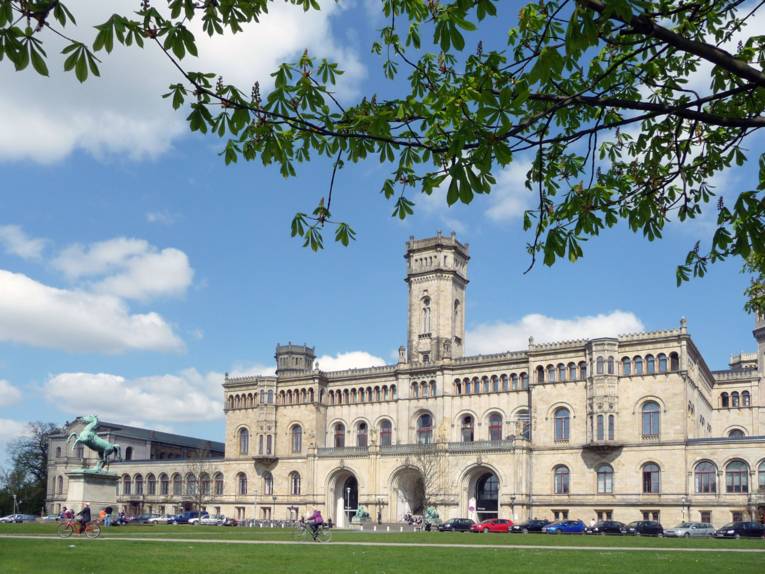
The campus of Leibniz Universität Hannover is located in the heart of the city center
30167 Hannover