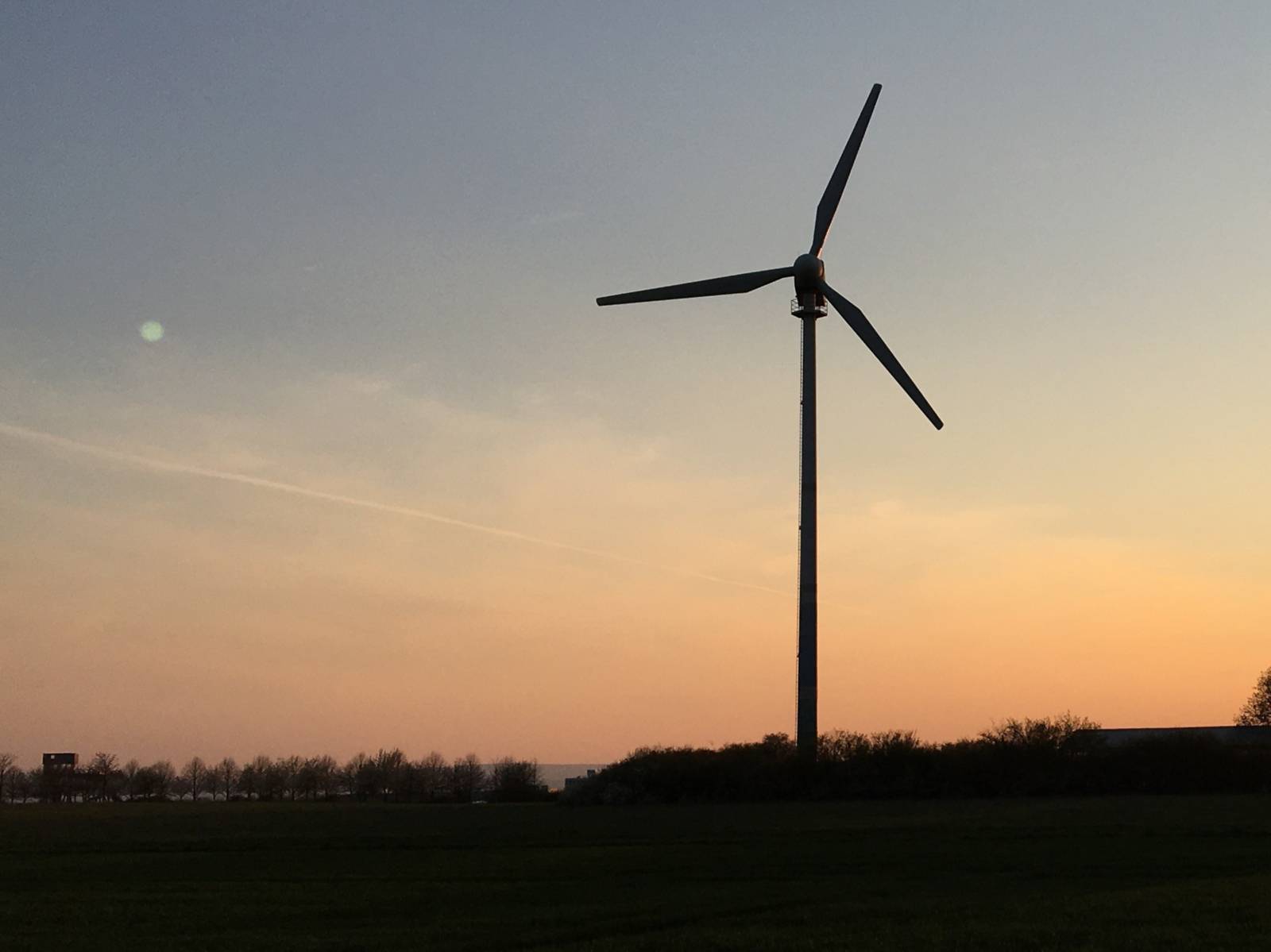
It is urgently necessary to accelerate the construction of wind turbines if the amount of wind energy produced in Germany is to be not only maintained but also increased. There are currently about 30,000 wind turbines across Germany. About half of these could be taken offline over the next ten years, for example because EEG subsidies are expiring or technical components have become obsolete.
"WindGISKI" Research Project
But which areas are suitable for repowering or building new wind turbines? Where is there not only enough space, but also sufficient public support to ensure that local wind energy expansion projects can succeed? A consortium of researchers and industry representatives aims to answer this question through the "WindGISKI" research project.
Geographic Information System for Assessing the Prospects of Wind Energy Expansion Projects
The goal is to develop a geographic information system that uses artificial intelligence to calculate, for every corner of Germany, how promising wind energy expansion projects will be in those areas. The forecast takes into account not only hard factors—such as distance from settlements or wind conditions—but also, for the first time, incorporates extensive demographic and sociological factors into the assessment. These include, for example, the political orientation of the region, the average age, the level of education, and much more. The number of existing wind turbines is also factored in.
Feasibility study
A feasibility study conducted by the Institute for Integrated Production Hannover (IPH) gGmbH and Nefino GmbH in the summer and fall of 2020 has shown that this approach is promising. The researchers analyzed data from past wind energy projects and identified correlations. However, these correlations are not necessarily linear. For example, in regions where some wind turbines already exist, the population is generally more open to additional construction projects—but if there are too many, the likelihood of resistance increases. Regions with a high proportion of environmentally conscious residents are generally more open to wind turbines, but even here, resistance can grow if, for example, species conservation concerns come into play.
Artificial Intelligence and Data Mining
The likelihood of implementation therefore depends on many different factors, which also influence one another. To identify complex interrelationships, the "WindGISKI" research project employs artificial intelligence and data mining methods. Data from past wind energy expansion projects serves as the foundation. This data is used to train the artificial intelligence until it can replicate the prospects of success and the duration of implementation. Subsequently, it can make future projections and predict the likelihood of implementation for wind energy projects in potential areas across every region in Germany—that is the scientists’ goal.
Identify promising sites for wind energy projects
The geographic information system to be developed as part of the research project is intended to address two issues. First, it should make it easier to identify promising sites for future wind energy projects. Second, the system can help identify the obstacles that are slowing expansion in other areas and determine how these hurdles can be overcome. Both of these efforts will help accelerate the expansion of wind energy in Germany.
Participating research institutions
A total of 8 research institutions, companies, and associations are participating in "WindGISKI":
- The Institute for Statics and Dynamics at Leibniz University Hannover is coordinating the project as the consortium leader,
- the Institute for Integrated Production Hannover (IPH) gGmbH,
- Nefino GmbH,
- fk-wind, the Institute for Wind Energy at Bremerhaven University of Applied Sciences,
- the LEE State Association for Renewable Energy Lower Saxony | Bremen, Inc.,
- ARSU Working Group for Regional Structural and Environmental Research, LLC,
- the Institute for Information Processing at Leibniz University Hannover and
- the Chair of Organization & Innovation at Carl von Ossietzky University of Oldenburg.
Three-year term
The collaborative project, which has received a total of two million euros in funding, began on December 1, 2021, and will run for three years. It is funded by the Federal Ministry for the Environment, Nature Conservation, Nuclear Safety, and Consumer Protection (BMUV) as part of the AI Lighthouses funding program. The project is managed by Zukunft – Umwelt – Gesellschaft (ZUG) gGmbH.
More information about the project can be found at windgiski.iph-hannover.de.
About the IPH
The Institute for Integrated Production Hannover (IPH), a nonprofit limited liability company, conducts research and development in the field of production engineering. The company was founded in 1988 as a spin-off from Leibniz University Hannover. The IPH offers research and development, consulting, and training services in the areas of process engineering, production automation, logistics, and XXL products. Its clients include companies from the tool and mold making, mechanical engineering and plant construction, aerospace, automotive, electrical, and forging industries.
The company is headquartered in the Science and Technology Park—Science Area 30X—in the northwest of Hanover and currently employs approximately 75 people, about 30 of whom are research staff.
(Published: January 13, 2022)
 Deutsch
 English
 中文
中文
 Danish
 Eesti
Eesti
 Español
 Suomi
Suomi
 Français
 Italiano
 日本語
日本語
 한국
한국
 Nederlands
 Norge
Norge
 Polski
 Portugues
 Русский
 Svenska
 Türkçe
 العربية
 Romanesc
 български