 Deutsch
 English
 中文
中文
 Danish
 Eesti
Eesti
 Español
 Suomi
Suomi
 Français
 Italiano
 日本語
日本語
 한국
한국
 Nederlands
 Norge
Norge
 Polski
 Portugues
 Русский
 Svenska
 Türkçe
 العربية
 Romanesc
 български
Leibniz University
Recycling rotor blades and plastic waste from industry
The Institute for Plastics and Recycling Technology at Leibniz University is launching a research project on mechanical recycling. The goal is to make fiber-reinforced plastics from old wind turbines recyclable.

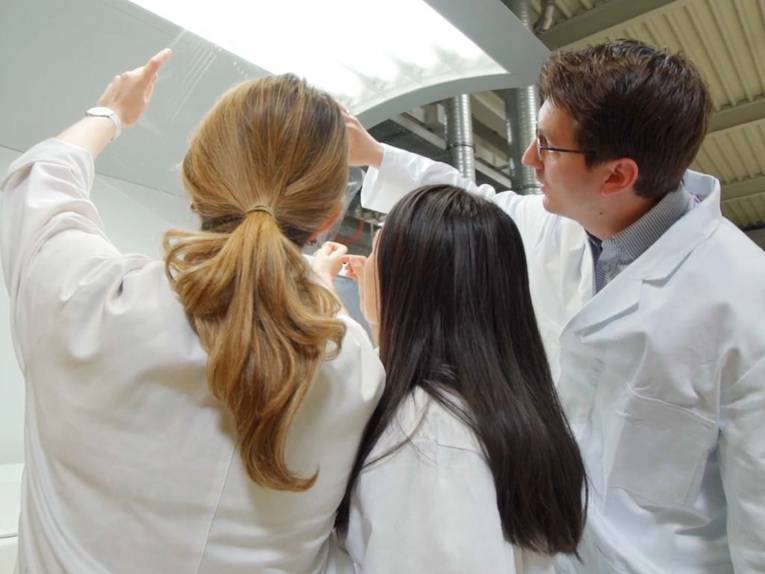
At Leibniz University, researchers are working on new methods for recycling plastics.
Good for the environment, but difficult to dispose of: Wind turbines last an average of 20 years, after which they must be replaced. However, recycling old turbines is difficult. The rotor blades, in particular, pose a problem due to their composition of fiber-reinforced plastics. Other plastic-based waste, such as trunk liners from cars and smaller parts—for example, from healthcare and pharmaceutical applications as well as electrical and electronic applications—cannot currently be recycled, or can only be recycled with great difficulty.
Recycling fiber-reinforced plastics
This is where a new research project at the IKK—the Institute for Plastics and Recycling Technology at Leibniz University Hannover (LUH)—in collaboration with KraussMaffei Extrusion (Laatzen) comes in; the project began on July 1, 2023. Under the direction of Prof. Dr.-Ing. Hans-Josef Endres, the scientists aim to develop a new process to recycle industrial waste from engineering plastic components—that is, from fiber-reinforced plastics and plastic-based composite materials. The Lower Saxony Ministry of Science and Culture is funding the ReKon project with approximately 550,000 euros; the funding period is two years.
Closed-loop recycling
The idea behind the project is that recycled plastics should be reused in industry wherever possible in the same applications from which they originated (closed-loop recycling). A trunk liner, for example, could later be turned back into a trunk liner—or at least into another automotive component. “The quality of a product increases with the highest possible purity and the lowest possible level of contamination in the input material. The pretreatment steps—sorting, separation, washing, and cleaning—therefore play a crucial role,” says Professor Endres. The advantages of having the manufacturer of the original part also handle the recycling are obvious: The exact composition of the plastic and the components is known, which makes sorting considerably easier. In addition, transport distances are short, avoiding long-distance shipments with high carbon footprints. Ultimately, this leads to future generations of components being designed with recyclability in mind. This, in turn, reduces the consumption of valuable raw materials.
Mechanical recycling methods
There are currently several options for recycling plastics: Chemical processes—and, more recently, solvent-based processes—are being used with increasing frequency. At the IKK, Professor Endres’s team relies on established—though by no means fully developed—mechanical recycling methods. In comparison, these mechanical recycling processes are characterized by significantly lower energy and resource requirements. The principle is simple and can also be applied to other feedstocks, such as textiles: The plastic waste is first shredded. The resulting material is then melted in an extruder using high pressure and high temperatures, purified, and finally processed into a type of granulate. This recycled material—fine plastic granules—then forms the basis for new components that can be reused elsewhere.
Focus on materials that have been difficult to recycle until now
The new research project focuses on components in which different plastics and other materials are bonded together in such a way that they can no longer be separated using currently available industrial recycling technologies. This primarily concerns fiber-reinforced plastics from rotor blades, composite materials from the pharmaceutical industry, electronic waste, and the so-called “light fraction” from shredders in the automotive industry, which, despite its high plastic content, is currently considered non-recyclable and is usually sent to incineration.
Increase in Plastic Waste from Industry
The volume of plastic waste in industry is set to increase even further in the future. For example, a new car now contains more than 300 kilograms of plastic, and the EU has set ambitious recycling targets for future generations of vehicles in its recently proposed End-of-Life Vehicles Regulation. The number of wind turbines that will need to be recycled in the coming years is also on the rise. A 2022 study by the Federal Environment Agency estimates that up to 430,000 metric tons of glass-fiber-reinforced plastics—from the rotor blades alone—will be generated by 2040.
Videos

Leibniz University on wissen.hannover.de
Videos from Leibniz University Hannover in the media library of the Initiative Wissenschaft Hannover.
read(Published: July 24, 2023)

The campus of Leibniz Universität Hannover is located in the heart of the city center
30167 Hannover