Sensors detect fill level and report it via special wireless network
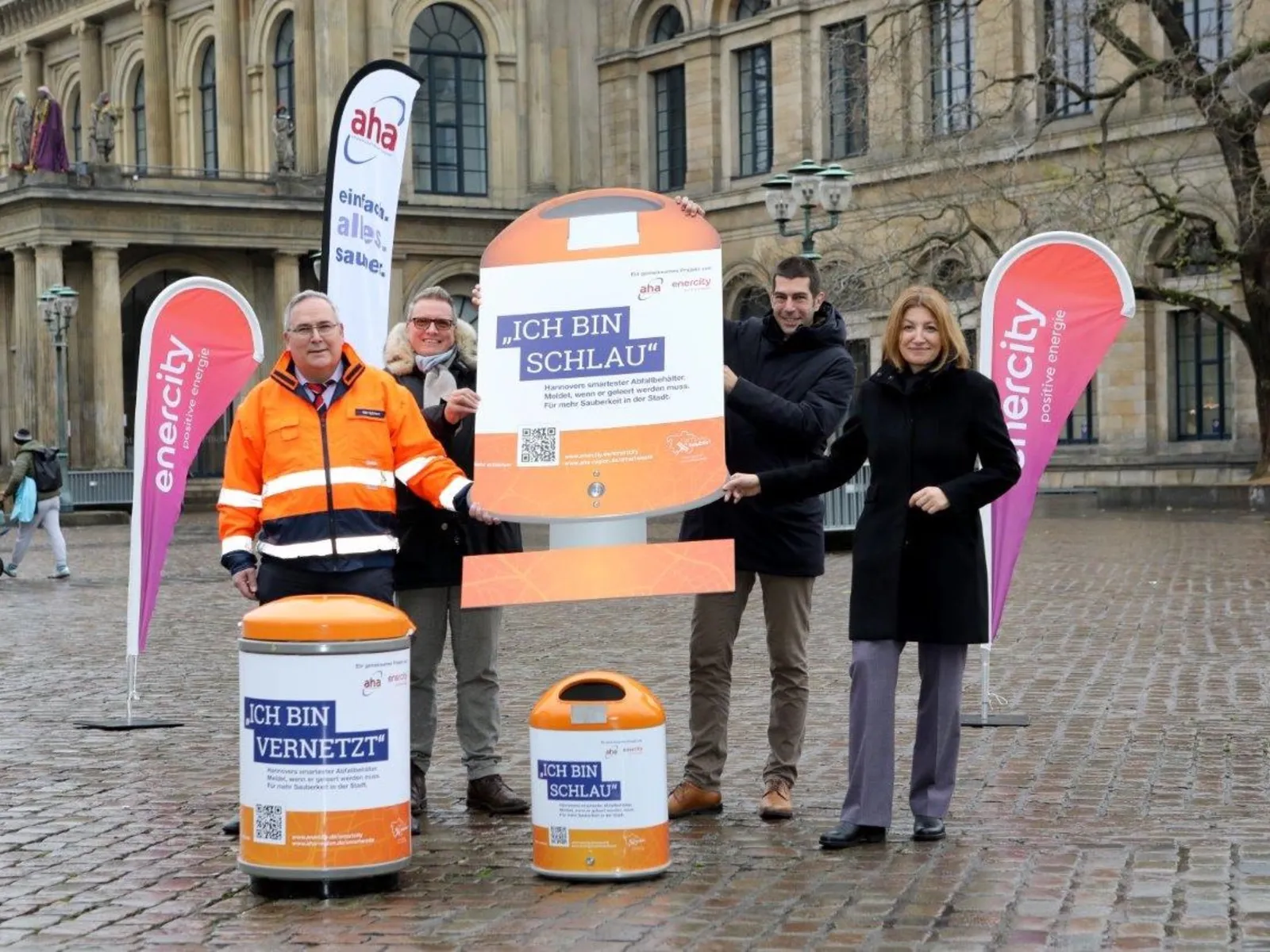
To this end, aha and enercity have equipped 20 waste containers with smart sensors that detect fill levels and transmit the data. enercity connects the containers to the city’s sanitation department via a wireless network. Through this real-time data transmission, the city’s sanitation department receives an up-to-date overview of the bins’ fill levels from aha, allowing it to empty them as needed and optimize collection routes to reduce time, costs, and emissions.
"With smart waste garbage cans, we have the opportunity to prevent overflowing waste bins in a timely and targeted manner," says Dr. Axel von der Ohe, First City Councillor and Head of Finance and Public Order. "Digital solutions help to further increase Hanover's attractiveness as a location and make the city center even cleaner and more liveable."
The ultrasonic sensors integrated into the bins detect when the bin is full. They are robust, water and shock resistant and integrated into a LoRaWAN wireless network. LoRaWAN (Long Range Wide Area Network) is a network for long-range, wireless radio technology that is particularly characterized by energy efficiency during transmission.
"Connected cities and regions provide lasting benefits for the people who live there. With smart solutions, we are improving the quality of life in Hanover," says enercity CEO Dr. Susanna Zapreva. "I am pleased that, with this forward-looking project, we are digitizing the city’s infrastructure and thereby making a further contribution to energy efficiency, CO2 reduction, and climate protection in the city."
Less CO2, more cleanliness, higher quality of life in the city
The pilot project is scheduled to run for six months. Ten stationary and ten suspended bins in the city center were equipped with the modern technology to test the digital fill level sensors. A particular focus is on the possible use of the fill level data for the planning and implementation of optimal route logistics in bin emptying.
"In consultation with our project partners, we deliberately chose downtown Hanover," emphasizes aha Managing Director Thomas Schwarz. "Experience has shown that there is a higher volume of waste here. In addition, the downtown facility, which is staffed around the clock, can respond quickly to a higher volume of waste, such as during events."
"We are committed to ensuring that Hanover's downtown area presents itself in the best possible light. Safety, cleanliness, and the resulting comfort of visitors in downtown Hanover are among our top priorities," says Martin A. Prenzler, Executive Director of City-Gemeinschaft Hannover e. V. "With these smart trash cans, we are taking another digital step toward making our city even more attractive."
(Published on December 13, 2021)
 Deutsch
 English
 中文
中文
 Danish
 Eesti
Eesti
 Español
 Suomi
Suomi
 Français
 Italiano
 日本語
日本語
 한국
한국
 Nederlands
 Norge
Norge
 Polski
 Portugues
 Русский
 Svenska
 Türkçe
 العربية
 Română
 български