 Deutsch
 English
 中文
中文
 Danish
 Eesti
Eesti
 Español
 Suomi
Suomi
 Français
 Italiano
 日本語
日本語
 한국
한국
 Nederlands
 Norge
Norge
 Polski
 Portugues
 Русский
 Svenska
 Türkçe
 العربية
 Română
 български
Extended wave flow channel
The World's Largest Wave Machine in Hanover
Robert Habeck, Minister for Economic Affairs and Climate Action, and State Premier Stephan Weil officially opened the expanded wave-current channel together with representatives from Leibniz University and the Technical University of Braunschweig.
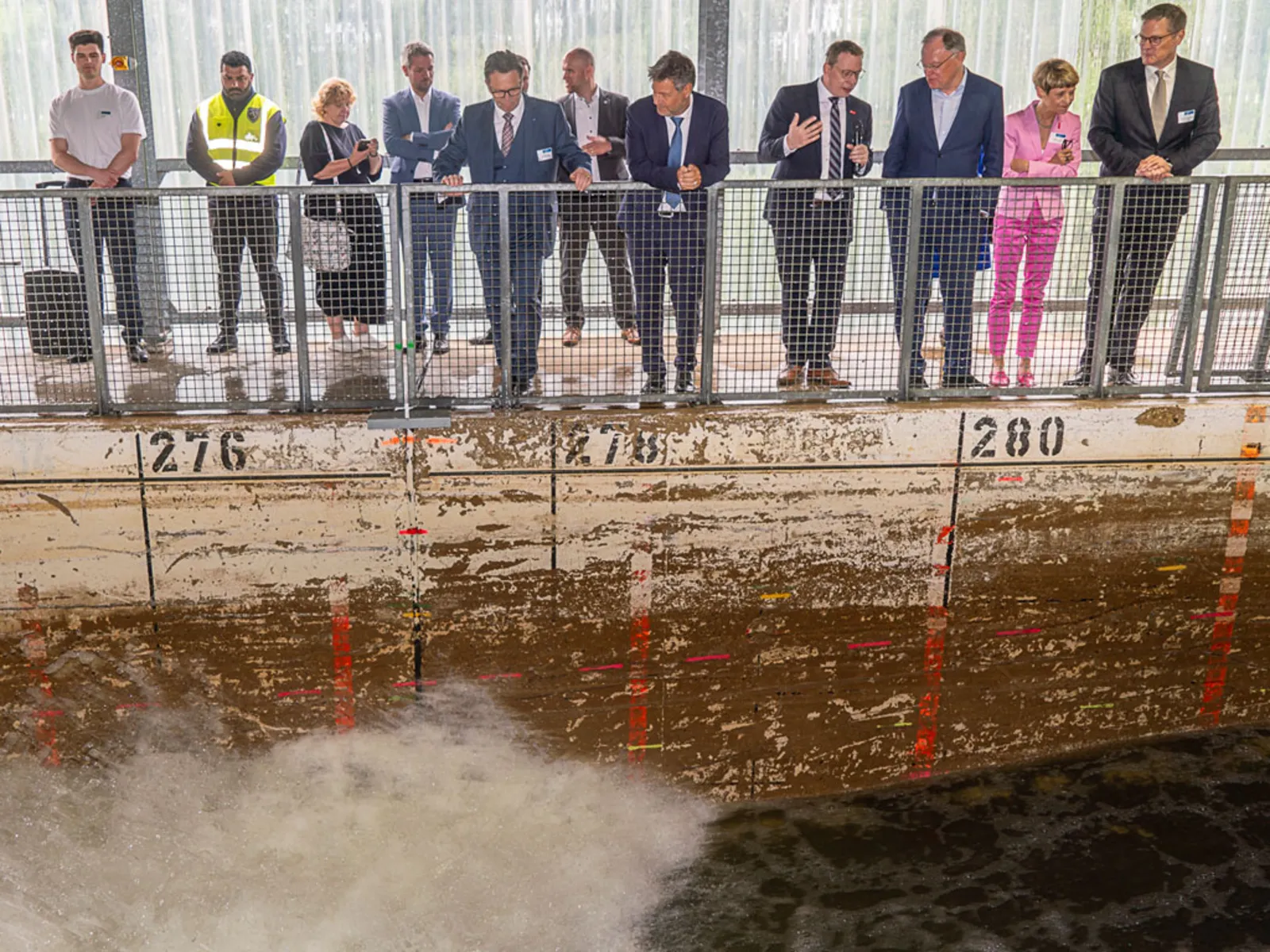
The wave in the 300-meter-long wave flume reaches a height of three meters. Front row, from left: LUH President Prof. Dr. Volker Epping, Federal Environment Minister Robert Habeck, Prof. Dr.-Ing. Nils Goseberg, Lower Saxony’s Minister-President Stephan Weil, TU BS President Prof. Dr. Angela Ittel, and Prof. Dr.-Ing. Torsten Schlurmann.
In recent years, Leibniz University Hannover (LUH) and the Technical University of Braunschweig (TU BS) have designed and extensively expanded the new Large Wave Flowing Channel (GWK+) in Hannover-Marienwerder. More than 35 million euros have been invested to significantly advance research on the energy transition at the GWK+. Among other things, the facility is used to study fixed and floating foundation structures for offshore wind turbines. Today, this large-scale research infrastructure—the only one of its kind in the world—was officially put into operation in the presence of Robert Habeck, Federal Minister for Economic Affairs and Climate Action, and Stephan Weil, Minister President of Lower Saxony, together with the university presidents and the lead researchers.
Generate waves and currents simultaneously
After a ceremonial push of a button to start the facility, the first impressive, three-meter-high wave formed in the 300-meter-long wave flume. Thanks to this expansion, the large-scale research infrastructure now features a high-performance flow facility, a deep-water section for studying the foundation structures of offshore wind turbines, and a high-performance wave generator capable of producing ocean waves up to three meters high. Thanks to the renovation, it is now possible to generate waves and currents simultaneously—a new milestone for Hanover: No other facility in the world offers this capability.
Robert Habeck, Minister for Economic Affairs and Climate Action
“Wind energy plays a central role in Germany’s electricity supply today and will continue to do so in the future. Due to the increasing demand for electricity resulting from the electrification of additional sectors—such as building heating with heat pumps or electric mobility—the use of wind energy must be expanded quickly and efficiently. The wave flow channel in Hanover will make an important contribution to this by enabling research into the optimization of offshore foundations. In this way, the expansion of offshore wind energy can become even more cost-effective and reliable. For this reason, and because of the wide range of other research topics that can be investigated using the wave flow channel, the approximately 35 million euros in research funding provided by the BMWK represents a sensible and forward-looking investment,” emphasized Robert Habeck, Minister for Economic Affairs and Climate Action, in his welcoming remarks.
Prime Minister Stephan Weil
Lower Saxony’s Minister-President Stephan Weil emphasized: “I am delighted that we now have this globally unique wave-current channel in Lower Saxony. It opens up far-reaching new opportunities for research and industry in the development of offshore wind turbines. And coastal protection—which is particularly important for Lower Saxony—can also be further researched and improved through the simultaneous generation of waves and currents. All in all, it is a truly impressive facility, and I would like to extend my heartfelt congratulations to everyone involved.”
Coastal Research Center (FZK)
Since the GWK began operations in 1983, numerous groundbreaking research projects have been conducted at the facility. However, research approaches and requirements have changed significantly in recent years. Until now, the facility has been capable of generating waves only. With the goal of expanding marine renewable energy (offshore wind energy, tidal/wave energy, and others), there is a growing focus on installation and operational concepts throughout the lifecycle of these structures, as well as on the influence of tidal currents. In 2017, the Federal Ministry for Economic Affairs and Climate Action (BMWK, formerly BMWi) therefore approved the research project “marTech – Testing and Development of Maritime Technologies for a Reliable Energy Supply” at the request of the participating universities, LUH and TU BS, in order to meet the requirements of research and industry regarding the expansion and operation of renewable energy sources. Since then, more than 35 million euros have been invested in the expansion of the Large Wave and Current Channel (GWK+) in Hanover. The Lower Saxony Ministry of Science and Culture (MWK) provided approximately 1.4 million euros in support for planning and land acquisition. The GWK+ is operated under the auspices of the Joint Coastal Research Center (FZK) of LUH and TU BS.
President of LUH, Prof. Dr. Volker Epping
Prof. Dr. Angela Ittel, President of the Technical University of Braunschweig, and Prof. Dr. Volker Epping, President of Leibniz University Hannover, are delighted that the GWK+ is now ready to begin research operations. “This research infrastructure will make a significant contribution to the testing and development of renewable energy technologies on and off the coast. This also directly supports the research focus on energy, which Leibniz University has firmly established in an interdisciplinary manner across many fields. Through our scientific capabilities at Leibniz University, we will help further accelerate the transformation of our energy systems at the federal and state levels,” emphasized Prof. Dr. Volker Epping.
President of the University of Basel, Prof. Dr. Angela Ittel
“Through our outstanding research at the Large Wave Flume, we are contributing to Europe’s energy transition and energy security. This unique research infrastructure allows us to study offshore wind turbines and tidal energy systems under controlled conditions. In doing so, we are strengthening Lower Saxony and Germany as centers of science and business. Together with our industry partners, we develop solutions that are technically mature and internationally competitive at the highest level,” said President Prof. Dr. Angela Ittel.
A wide range of applications in research
The lead researchers, Prof. Dr.-Ing. Torsten Schlurmann of Leibniz University Hannover and Prof. Dr.-Ing. Nils Goseberg of the Technical University of Braunschweig—both members of the Executive Board of the Coastal Research Center—explained the scientific and technical background of the expanded wave-current flume to the guests. “Here, we can study the combined effects of waves and currents on a large scale and thus in a manner that closely resembles real-world conditions,” said Prof. Schlurmann. Steeper and higher waves, as predicted by climate change, can also be replicated in experiments in the future, allowing for the simulation of stresses on structures. With the new circulating flow system, tidal currents can be studied for the first time under conditions similar to those in the ocean. “The new deep section makes it possible to simulate the portion of offshore wind turbines located in the seabed and to study the movements of the seabed and the turbine that occur there,” explained Prof. Goseberg.
Videos
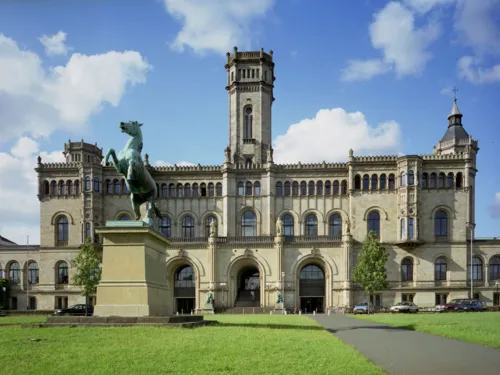
Leibniz University on wissen.hannover.de
Videos from Leibniz University Hannover in the media library of the Initiative Wissenschaft Hannover.
read(Published: June 30, 2023)
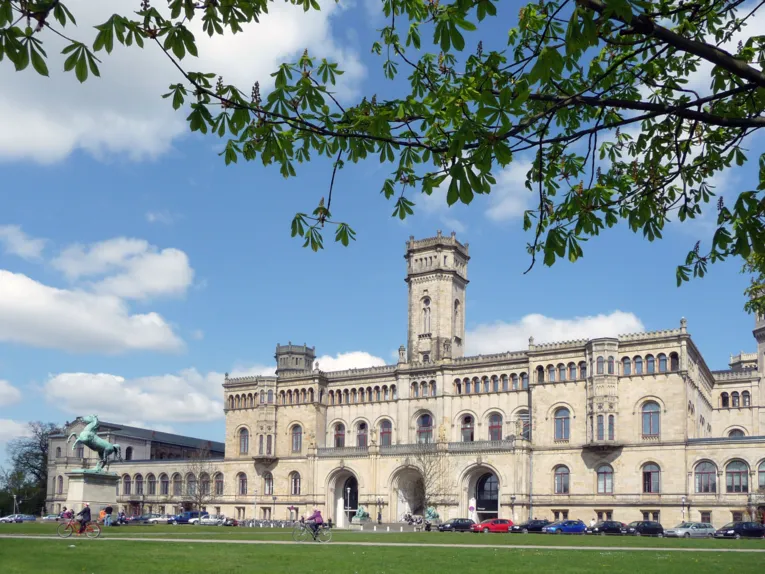
The campus of Leibniz Universität Hannover is located in the heart of the city center
30167 Hannover