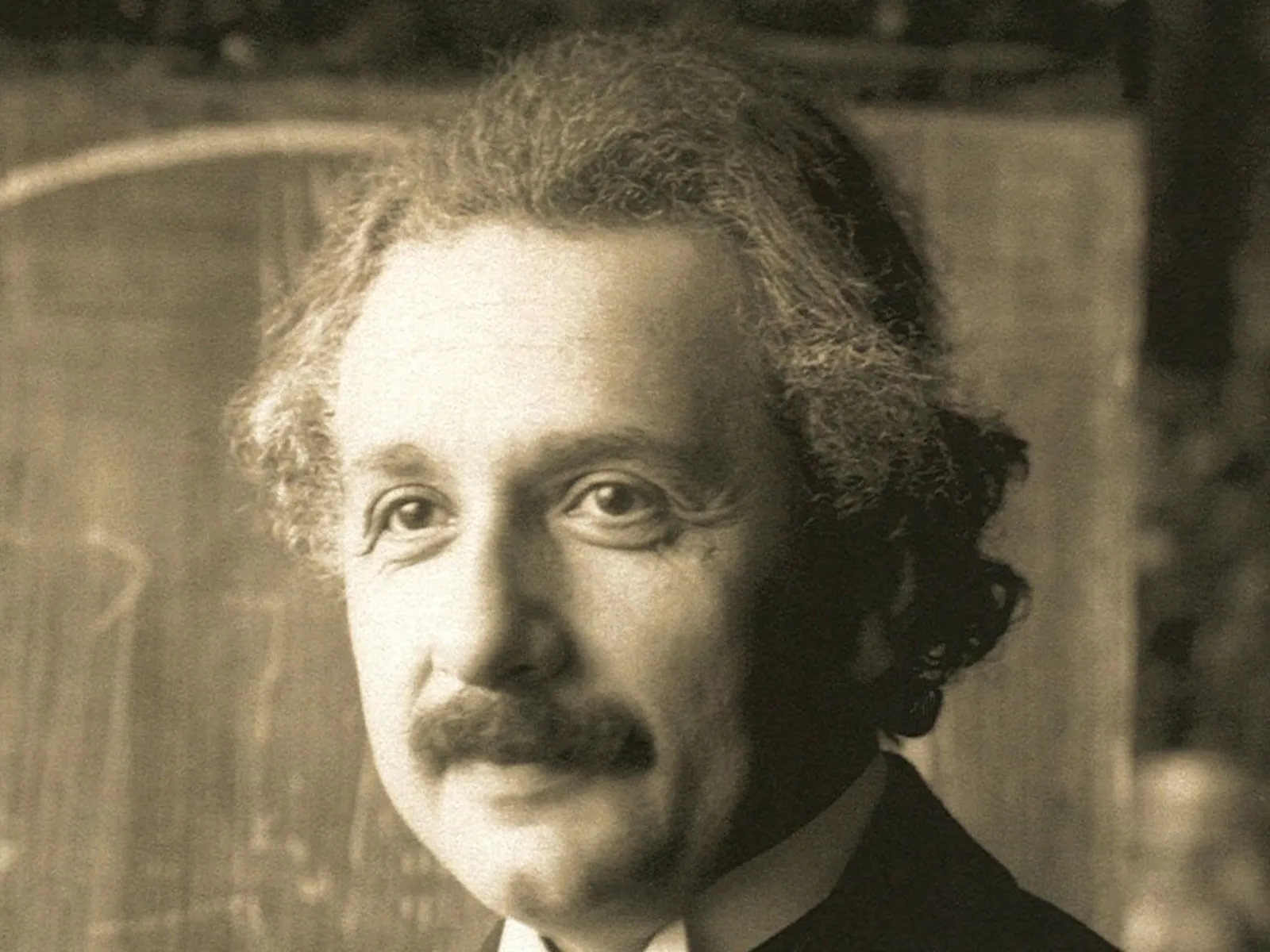
However, he thought the effect was so small that it would certainly never be possible to prove it. A mistake. A journey through a hundred years of research up to the greatest coup in physics of this millennium.
1916
Existence of gravitational waves
Albert Einstein publishes an essay entitled "Approximate integration of the field equations of gravitation". In it, he predicts the existence of gravitational waves for the first time. He derives them from the equations of his general theory of relativity, which he published in 1915.
1918
New formulas
Albert Einstein established a formula for the emission of gravitational waves, which is still considered valid in science today.
1936
Do gravitational waves exist or not?
Einstein begins to doubt the validity of his theory. He writes a paper with his colleague Nathan Rosen in which they claim to disprove the existence of gravitational waves. A reviewer finds an error in the argumentation; the paper is finally published with completely different results. Doubts remain as to whether gravitational waves exist or not.
Einstein begins to doubt the validity of his theory. He writes a paper with his colleague Nathan Rosen in which they claim to disprove the existence of gravitational waves. A reviewer finds an error in the argumentation; the paper is finally published with completely different results. Doubts remain as to whether gravitational waves exist or not.
1957
"Sticky Bead" thought experiment
An international conference on Einstein's theory of relativity is taking place in Chapel Hill, North Carolina. The focus is on Richard Feynman’s famous “Sticky Bead” thought experiment. In it, the physicist describes the effect of a gravitational wave on a small bead that moves up and down on a stick, generating heat through friction. The researchers conclude that gravitational waves must exist.
1960
The physicist Joseph Weber makes the first attempts to prove the tiny effects of gravitational waves.
1969
Successful proof?
Weber announces that he has succeeded in detecting gravitational waves. The news caused a sensation and encouraged scientists from all over the world to carry out follow-up experiments. However, none of these attempts were able to confirm Weber's discovery.
1974
Indirect proof
The two US astronomers Joseph Taylor and Russel Hulse succeed in indirectly detecting gravitational waves: They notice that the orbital period of two stars decreases extremely slowly but steadily. The system is obviously losing energy. The researchers' only explanation for this phenomenon is the emission of gravitational waves.
1992
Researchers in the USA put the LIGO observatory (Laser Interferometer Gravitational Wave Observatory) into operation. The new technology is four times more sensitive than previous systems. Nevertheless, the first attempts to find gravitational waves fail.
1993
US astronomers Taylor and Hulse are awarded the Nobel Prize in Physics for their indirect detection of gravitational waves.
2015
LIGO detectors discover gravitational waves
On September 14, 2015, researchers catch the decisive signal from space, 1.3 billion years old, with their measuring instruments at the LIGO observatory. Two black holes have merged together. In the final phase, shorter than a second, the gigantic black hole emitted such strong gravitational waves that the LIGO detectors were able to detect them on Earth. The scientists are beginning to analyze the data.
2016
A scientific sensation
The scientists complete the data analysis. Now they are certain: 99.99999 percent of the signal they received with the LIGO detectors in 2015 came from gravitational waves. A scientific sensation.
2019
Signals from 520 million light years away
The international network of gravitational-wave detectors has observed its second signal from merging neutron stars. The LIGO-Livingston and Virgo detectors identified the signal, designated GW190425, as a “highly significant event” on April 25, 2019. The signal originated from a distance of about 520 million light-years—four times farther away than the first gravitational wave from a neutron star merger in August 2017. Researchers at the Albert Einstein Institute in Hanover contributed methods for detecting and analyzing the signal in this discovery. They created models of the gravitational waves expected from merging neutron stars.
2020
A signal like no other before
The expectations of gravitational wave researchers have been fulfilled: Detecting gravitational waves is now part of their daily work. But now they have published a signal the likes of which they have never seen before: GW190412 shows for the first time how two black holes with very different masses merge - a smaller black hole with about eight times the mass of our sun is engulfed by a large black hole with about 30 times the mass of the sun. This observation not only enables more precise measurements of the astrophysical properties of the system, but also allows the LIGO-Virgo scientists to confirm a previously untested prediction of Einstein's theory of general relativity.

 Deutsch
 English
 中文
中文
 Danish
 Eesti
Eesti
 Español
 Suomi
Suomi
 Français
 Italiano
 日本語
日本語
 한국
한국
 Nederlands
 Norge
Norge
 Polski
 Portugues
 Русский
 Svenska
 Türkçe
 العربية
 Română
 български