
 Deutsch
 English
 中文
中文
 Danish
 Eesti
Eesti
 Español
 Suomi
Suomi
 Français
 Italiano
 日本語
日本語
 한국
한국
 Nederlands
 Norge
Norge
 Polski
 Portugues
 Русский
 Svenska
 Türkçe
 العربية
 Română
 български
Minimalist Living Concepts in Hanover
New forms of living
Living in a small space? Hanover has had ideas for this for a long time. As early as the 1950s, model buildings with small apartments were constructed here. Today, even more students and professionals live in the city who need small, affordable apartments. As a result, around 300 micro-apartments are now being built, each ranging in size from 24 to 33 square meters. Leibniz University is also giving the topic a great deal of thought: there, researchers and students are focusing on the research area “Habitats of the Future,” which explores new forms of urban living.
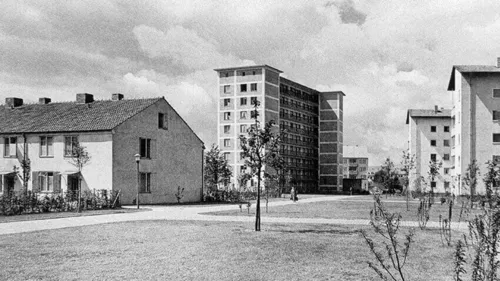
Hanover Yesterday
Hanover Yesterday
On the occasion of the 1951 international architecture exhibition “Constructa,” Hanover presented the so-called Constructa apartment complex on Hildesheimer Straße. These consisted primarily of two- to five-story buildings designed to house as many people as possible in a relatively small space during a housing shortage. In the 1950s, Hanover was still scarred by wartime destruction, and refugees from the former German eastern territories were arriving and in need of housing. Rapid reconstruction was therefore particularly important. Under the direction of urban planner Rudolf Hillebrecht, the Constructa housing complex was initially created as a demonstration model. A total of 500 apartments were built on the approximately 15,000-square-meter site.

Hanover Today
Hanover Today
Hanover, City of Singles: More than half of the city’s households are single-person households. While a single person needs less space than a family, small, affordable apartments have been few and far between. That’s why so-called micro-apartments are set to be built at three locations in Hanover: small apartments ranging from 24 to 33 square meters in size, each with a built-in kitchenette. The project is being led by the housing association “hanova,” which is investing just under 13 million euros. The enercity fund proKlima Hannover is providing 66,000 euros in funding, and KfW is also supporting the plan. The goal is to have 300 micro-apartments completed by 2021. The first 113 apartments were built at Kopernikusstraße 7B, near the university. In July 2018, residents moved into their apartments in the five-story new building. As a next step, hanova plans to build two additional residential complexes with about 200 apartments by early 2021, this time at Klagesmarkt 17 and Körnerplatz. Students, singles, and commuters are expected to benefit most from this.

Hanover Tomorrow
Hanover Tomorrow
What might human living spaces look like in the future? This is the question being explored by researchers and students at the Faculty of Architecture and Landscape Architecture at Leibniz University Hannover. Because the challenges of living together—especially in cities—are growing ever greater, the faculty has now focused its research efforts on the theme “Habitats of the Future.” Members from the fields of architecture, urban planning, landscape architecture, environmental planning, and technical education are collaborating on this initiative. One of the projects, called “Urban Voids,” is based at the Institute for Design and Urban Planning and explores the potential of urban voids—for example, as living spaces, but also as areas with variable uses. The city of Hanover serves as the case study for this project.