Around 360 teachers - including numerous internationally renowned personalities from the arts, education and science - are involved in the education of almost 1,400 students from all over the world. The balance between music, drama, pedagogy and science as well as the commitment to excellence in both top-level and general education form the core of its self-image. To this end, the HMTMH offers a diverse range of 33 degree courses, supplemented by numerous master classes. Interdisciplinary work is carried out in almost all areas through interdisciplinary artistic and academic projects.
Right to award doctorates and habilitations since 1978
The origins of HMTMH date back to the State Music School and the Hanover Drama School, both of which were founded as early as the 19th century. In 1950, they merged to form the Academy of Music and Theater, and in 1973, the State of Lower Saxony became the university’s governing body. In 1978, the University of Music and Theater was granted the status of an artistic-academic university with the right to award doctoral degrees and grant habilitation. In 2010, it added the word “Media” to its name. Among the 24 music conservatories, 13 drama schools, and approximately 30 media studies institutes nationwide, the “Hanover University of Music, Theater, and Media” is a leading institution.
Eleven institutes as places of networking
The Institutes for Chamber Music, New Music, Early Music and Jazz|Rock|Pop provide important artistic impulses. The Institute for the Early Promotion of Highly Gifted Musicians has been dedicated to the professional training of national and international talent since 2001. The Institutes for Journalism and Communication Research, for Music Education Research, for Music Physiology and Musicians' Medicine, for Musicology and the Research Center for Music and Gender also have a strong research focus. An ethnomusicological professorship links the HMTMH with the "Center for World Music" at the University of Hildesheim Foundation. The European Center for Jewish Music is an example of the various special collections at the HMTMH.
Lively exchange with the region
As the only college of music in Lower Saxony, the HMTMH also holds a special place in the state’s cultural landscape. With up to 500 public events per year, it is one of the largest cultural organizers in Lower Saxony. To sustainably strengthen the cultural region of Hanover and Lower Saxony as a “land of music,” the conservatory engages in ongoing dialogue with the community, cultivates networks, and initiates a wide variety of music education projects—including collaborations with Hanover’s theaters and opera houses, the NDR, regional event organizers, and academic and media institutions. As a member of the steering committee, the HMTMH supported Hannover’s successful bid for the title of UNESCO City of Music in 2014.
In the heart of the state capital since 1972
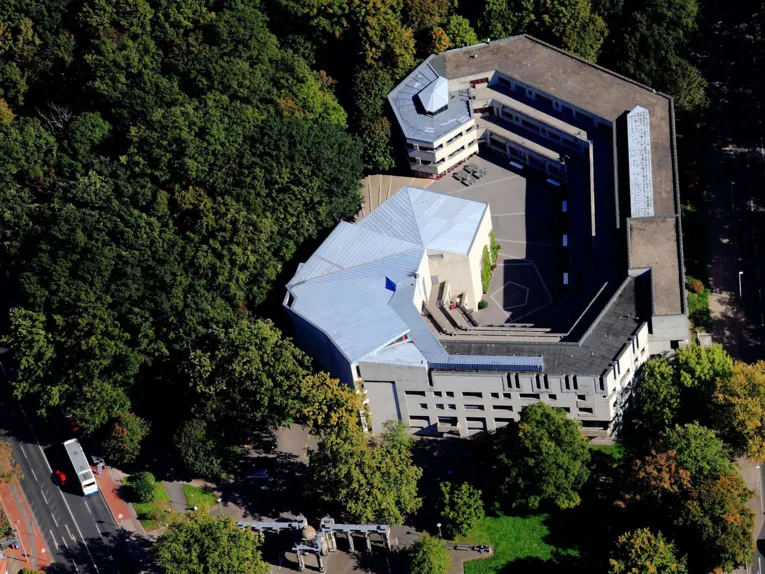
The main building of the HMTMH on Emmichplatz was constructed in 1972, based on plans by architect Rolf Ramcke, in the heart of the state capital of Hanover, directly adjacent to the Eilenriede city forest, specifically for use as an art college. Today, the college’s departments and students are spread across various locations throughout the city—from the Oststadt to the Expo grounds.
Films of the HMTMH
The Hanover University of Music, Drama, and Media provides additional useful information about everyday student and research life through multimedia content at wissen.hannover.de.
 Deutsch
 English
 中文
中文
 Danish
 Eesti
Eesti
 Español
 Suomi
Suomi
 Français
 Italiano
 日本語
日本語
 한국
한국
 Nederlands
 Norge
Norge
 Polski
 Portugues
 Русский
 Svenska
 Türkçe
 العربية
 Română
 български