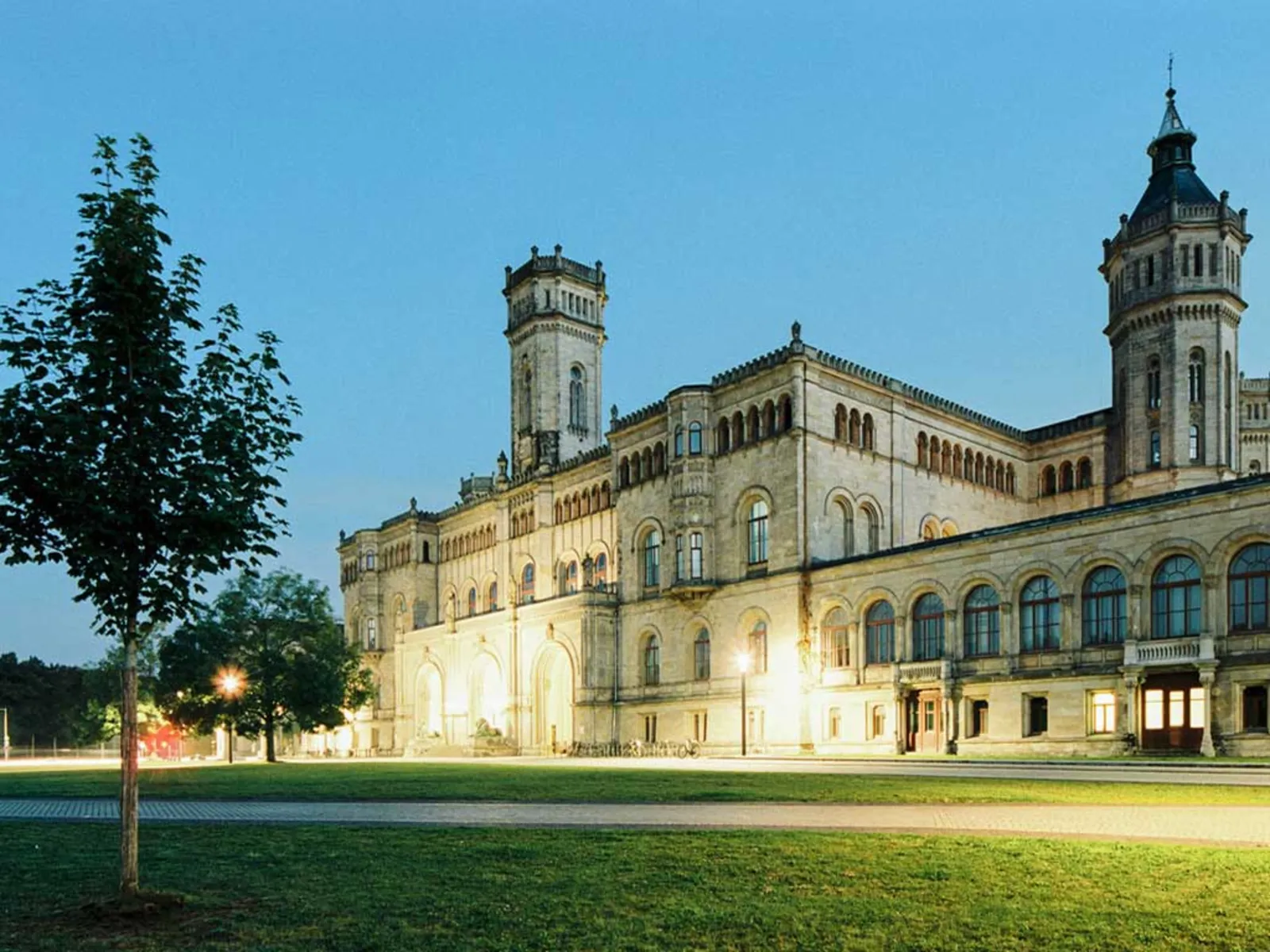
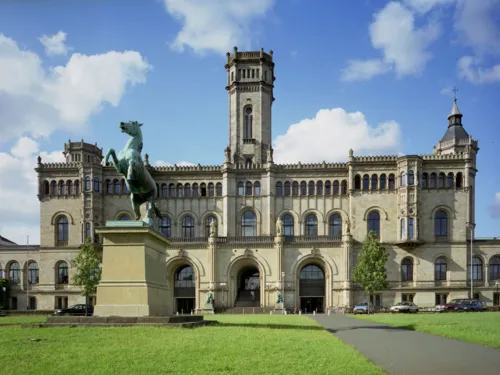
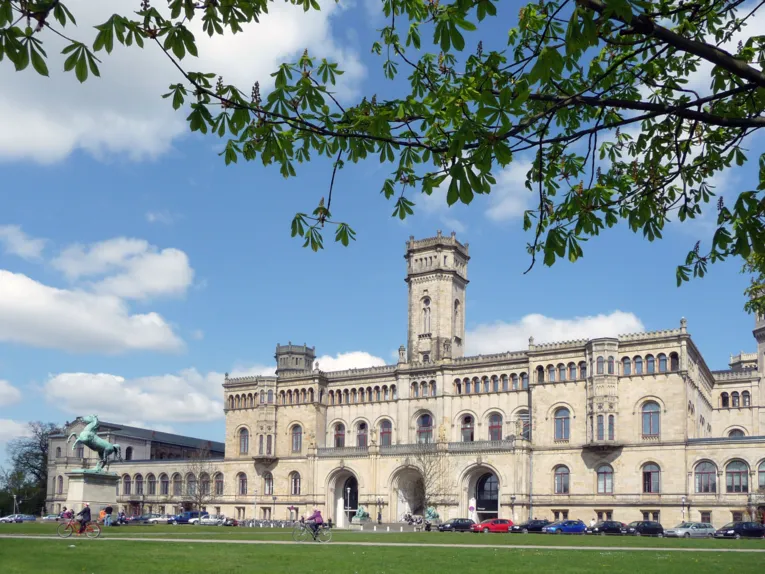
A campus surrounded by greenery right in the heart of the city—Gottfried Wilhelm Leibniz University Hannover (LUH) plays a key role in shaping the character of Lower Saxony’s capital. This is due not only to buildings such as the Welfenschloss, which serves as the university’s main campus, but above all to the people: Approximately 25,300 students are currently enrolled (winter semester 2025/2026). They have chosen one of Germany’s largest universities, which offers interdisciplinary teaching across a broad range of subjects and is renowned for research at the international cutting edge. Currently, LUH is receiving funding for the three Clusters of Excellence: QuantumFrontiers, PhoenixD, and Hearing4all. On this basis, LUH is applying for the “University of Excellence” funding program, which the federal government has established to permanently strengthen a university or a consortium of universities.
Study programs
With its nine faculties, approximately 150 institutes, and more than 80 degree programs, LUH covers nearly the entire academic spectrum. It also offers a range of sustainability-related degree programs with various courses across all faculties.
In the field of research, LUH focuses on areas of expertise that are competitive both nationally and internationally. The university holds a leading position in quantum optics and gravitational physics, in production engineering through the Center for Production Engineering (PZH), as well as in biomedical engineering and research, optical technologies, science studies, and energy research. In addition, the university places emphasis on plant sciences and nutrition, as well as on earth and environmental sciences and teacher education. It also maintains more than 168 partnerships with 139 universities in approximately 40 countries. LUH maintains numerous research partnerships and networks and, through its cross-faculty research centers, promotes interdisciplinarity in research. Exchange and cooperation with the political and business sectors are a natural part of this.
International orientation
More than 5,000 people work for the university, including more than 350 professors. Visiting academics and students from all over the world as well as numerous global collaborations also reflect the international orientation that the university pursues.
Founded as a technical college
Founded in 1831 as a higher vocational school, the institution quickly developed into a modern university. The university owes a special debt to Gottfried Wilhelm Leibniz: as the last great polymath, his life and work exemplify an extraordinary personality whose influence in science and culture extends far beyond his own era. Since 2006, the former University of Hannover has been known as Gottfried Wilhelm Leibniz University, and in the Leibniz Year 2016, it celebrated both the 370th birthday of its namesake and the tenth anniversary of its renaming.
Promoting young talent and careers
Leibniz University supports early-career academics through a variety of programs. For more information on this topic, please contact the Career Service, the Alumni Office, or the Graduate Academy.
Films of Leibniz University
Leibniz University Hannover provides additional useful information about everyday life as a student and researcher through multimedia resources at wissen.hannover.de.
 Deutsch
 English
 中文
中文
 Danish
 Eesti
Eesti
 Español
 Suomi
Suomi
 Français
 Italiano
 日本語
日本語
 한국
한국
 Nederlands
 Norge
Norge
 Polski
 Portugues
 Русский
 Svenska
 Türkçe
 العربية
 Română
 български