 Deutsch
 English
 中文
中文
 Danish
 Eesti
Eesti
 Español
 Suomi
Suomi
 Français
 Italiano
 日本語
日本語
 한국
한국
 Nederlands
 Norge
Norge
 Polski
 Portugues
 Русский
 Svenska
 Türkçe
 العربية
 Română
 български
Science
Hanover Science Initiative
Internationally exemplary cooperation between universities, science and society.
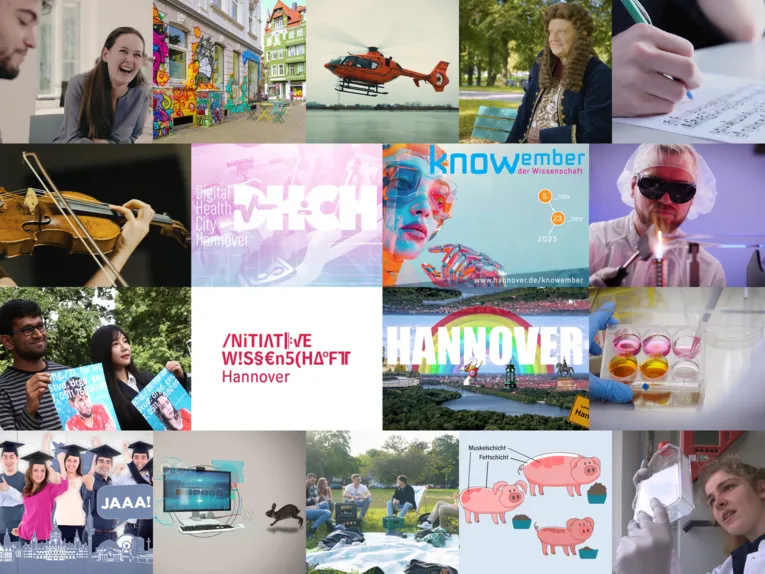
Diverse, excellent, and vibrant. Find out everything about studying and research at www.wissen.hannover.de.
Dialogue, cooperation, and knowledge transfer between academia, industry, and society are the hallmarks of the Hannover Science Initiative.
The network, founded in 2007, includes all eight of Hannover’s universities (Leibniz University Hannover | Hannover University of Applied Sciences and Arts | Hannover Medical School | Hannover University of Veterinary Medicine | University of Music, Drama and Media Hannover | University of Applied Sciences and Arts for Business and Economics Hannover | Leibniz University of Applied Sciences and Arts | Lower Saxony University of Municipal Administration), as well as Fraunhofer ITEM, the LIAG Institute for Applied Geophysics, the Hannover Student Services, the Volkswagen Foundation, the regional economic development agency hannoverimpuls GmbH, and the state capital of Hannover.
Strengthening the science location together
The Hannover Science Initiative aims to collectively strengthen and internationalize Hannover as a hub for higher education and science. The initiative seeks to improve conditions for students, faculty, and researchers and to attract external funding for the region. It also works to build connections between the research community and the business sector and to promote science communication within the city and society at large.
With 46,188 students (winter semester 2025/26)—including 7,102 international students (15.4 percent)—and approximately 21,000 employees at its universities, Hanover ranks among Germany’s leading centers of higher education. (Source: State Statistical Offices, StLA Lower Saxony, as of September 7, 2026)
Universities, research institutions, and the Hannover Student Services Organization are involved in urban development projects and strategic processes. Key priorities include making Hannover a climate-resilient city, fostering a welcoming culture for international students, and promoting extracurricular STEM programs.
Lighthouse project for young talent
Free, open, and accessible to all—at the new TUMO + STEM Center (working title), young people will be able to acquire digital skills for the future starting in spring 2027. The city, the business community, and universities are working together to bring the globally successful TUMO learning concept to Hanover and integrate it with the established STEM programs at Hanover’s universities. Hannover University of Applied Sciences and Arts (HsH) is expanding its offerings with its Zukunftshaus MINT to include workshops for all age groups and school types. Leibniz University Hannover (LUH) aims to let students benefit directly from cutting-edge research and is participating with the PROTOYS and foeXlab laboratories.
The GETEC Foundation is the anchor investor for the after-school STEM program located in the city center at An der Börse 7. Additional partners and sponsors are being sought to ensure the program’s long-term sustainability. The founding partners are the Lower Saxony Business Associations (UVN), the State Capital of Hanover, the GETEC Foundation, and HsH, which represents the state in TUMO + MINT Hannover gGmbH. The project is also supported by the University of Hanover (LUH), the Kreditanstalt für Wiederaufbau (KfW), the Hannover Medical School (MHH), and numerous partners from the business and education sectors. Several Lower Saxony ministries have signaled their support.
Collaboration within Hannover’s higher education and research community, as well as the activities of the Hannover Science Initiative, have received numerous national and international awards as examples of best practice. The network and the majority of the projects are coordinated by the Office of the Mayor of the State Capital of Hannover, specifically within the “Hannover Science City” division.
Leibniz in Hanover
The year 2026 marks the 350th anniversary of Gottfried Wilhelm Leibniz’s (b. 1646, d. 1716) arrival in Hanover, where he lived and worked for 40 years until his death. Lectures and discussions, geocaching, and Actionbound offer opportunities during this anniversary year to explore the intellectual world of what is arguably the last universal scholar. Program overview for “Leibniz Check-In”: www.hannover.de/leibniz.
Many institutions in Hanover preserve, research, or share information about the life and work of this polymath. A highlight for all geocachers is the “Leibniz’s (Geo)Secrets” tour. Another digital garden rally in the Herrenhausen Gardens using the Actionbound app invites you to explore and solve puzzles—the “Leibniz Tour: In Search of Leibniz’s Legacy” (suitable for teens aged 14 and up). For the latest information and events, visit: www.hannover.de/leibniz
Online: Daily news and media library at wissen.hannover.de
The science section of the city portal hannover.de, accessible via the short link www.sciencehannover.de, compiles the most important press releases from the higher education and research community on a daily basis.
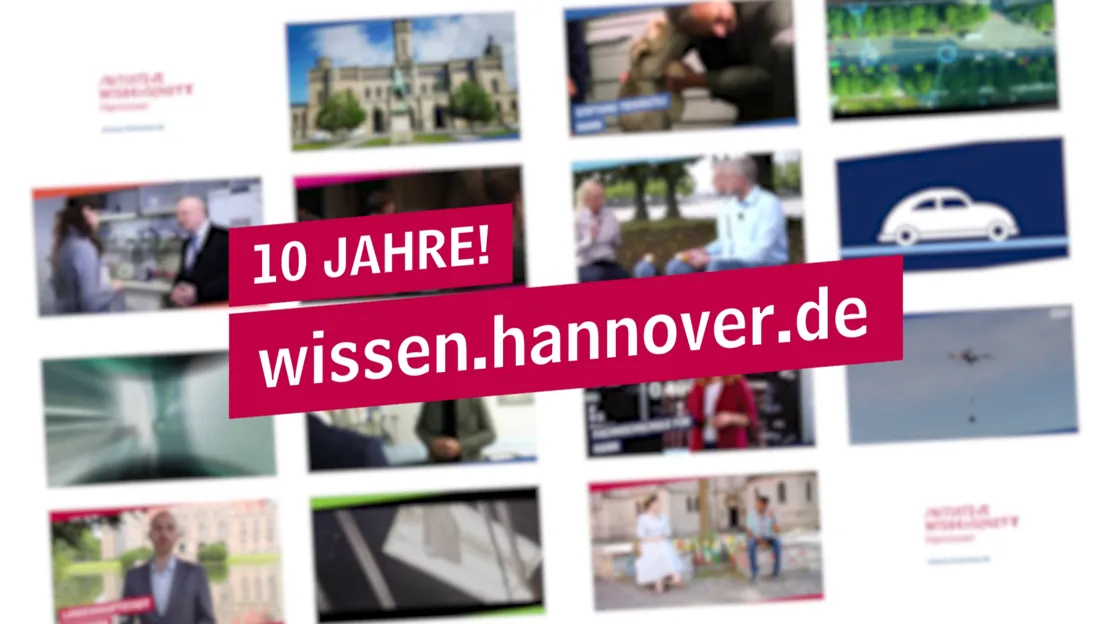
The wissen.hannover.de media library offers students and researchers insights into academic projects and everyday student life through a wide range of video clips. International students are a key target audience. The media library has been online since 2013 and has won several awards, including the Foxaward Gold for an efficient communication and marketing solution and for being an “impressive pioneering achievement.” The initiative uses Instagram and a newsletter to share information about videos and events at the university and research hub.
November of science - #knowember
The Wissenschaft Hannover initiative has developed and launched “November of Science,” a science communication event that has been inspiring tens of thousands of people far beyond Hannover every two years since 2008. For up to three weeks, high school and college students, as well as the general public, can explore Hannover’s research and higher education landscape. Many experts take advantage of the event to network. The next #knowember will take place in 2027.
Trailer #knowember 2025: www.wissen.hannover.de/knowember. Program page: www.hannover.de/knowember
Welcoming culture for international students
In 2026, various projects aimed at integrating international students will be implemented in collaboration with the International Offices and the Studierendenwerk Hannover. Recruiting skilled workers is a key focus of the internship placement program within the city administration. Service videos for international students on housing (www.wissen.hannover.de/wohnen), part-time jobs (www.wissen.hannover.de/jobben), and social counseling are produced in cooperation with the Studierendenwerk and used nationwide.
The Wissenschaft Hannover initiative is involved in projects and strategic processes related to urban development, such as "WIR 2.0 – We Are Hannover – Living Together in the City: Strategies for Migration and Participation." As part of a “Bertelsmann Stiftung pilot region,” the city, universities, and civil society developed a joint action plan. The successful initiative “Housing Campaign for International Students” (2016–2019) was shortlisted for the 2019 Policy Award. The state capital of Hanover works closely with the “Roundtable for International Students in Hanover.”
innover.city and AUFHOF
From 2023 to 2024, a vacant department store in downtown Hanover was transformed into a hub for science, society, and urban culture. Over the course of 13 months, Hanover’s universities, hannoverimpuls GmbH, and the city of Hanover worked together on the innover.city project to create a unique space for developing innovative solutions to current challenges. Innovercity was developed by Hanover University of Applied Sciences and Arts, through its Entrepreneurship Center NEXSTER, in cooperation with the Initiative Wissenschaft Hannover, and was funded by the Lower Saxony Ministry of Science and Culture. The project was an integral part of AUFHOF, the temporary use of the former Kaufhof building near the Marktkirche.
European cooperation
The European Union supports and promotes science, research, and exchange programs—including in Hanover. The Wissenschaft Hannover initiative has been actively involved in the 2024 European elections through a social media campaign that reached 60,000 accounts on Instagram. Videos in the media library also showcase examples of how European research projects are being carried out in Hanover, what happens in exchange programs, and what solidarity projects are taking place with Ukrainian researchers.
Private label
With the "Hausmarke" discount card, students at Hanover's universities receive, among other things, discounts at stores, restaurants, the Sprengel Museum, and the International Fireworks Competition.
Dual Career Network
The Dual Career Network was established with the support of the Hannover Science Initiative and assists dual-career couples in launching their professional careers in and around Hannover. The service is aimed at the partners of newly appointed professors and emerging leaders in academia and industry. Leibniz University Hannover serves as the lead coordinator for the service.
30159 Hannover