
 Deutsch
 English
 中文
中文
 Danish
 Eesti
Eesti
 Español
 Suomi
Suomi
 Français
 Italiano
 日本語
日本語
 한국
한국
 Nederlands
 Norge
Norge
 Polski
 Portugues
 Русский
 Svenska
 Türkçe
 العربية
 Română
 български
Calenberger Land
The buffalo are loose
Animal Encounters in the Calenberger Land: the water buffalo along the Ihme River in Vörie.
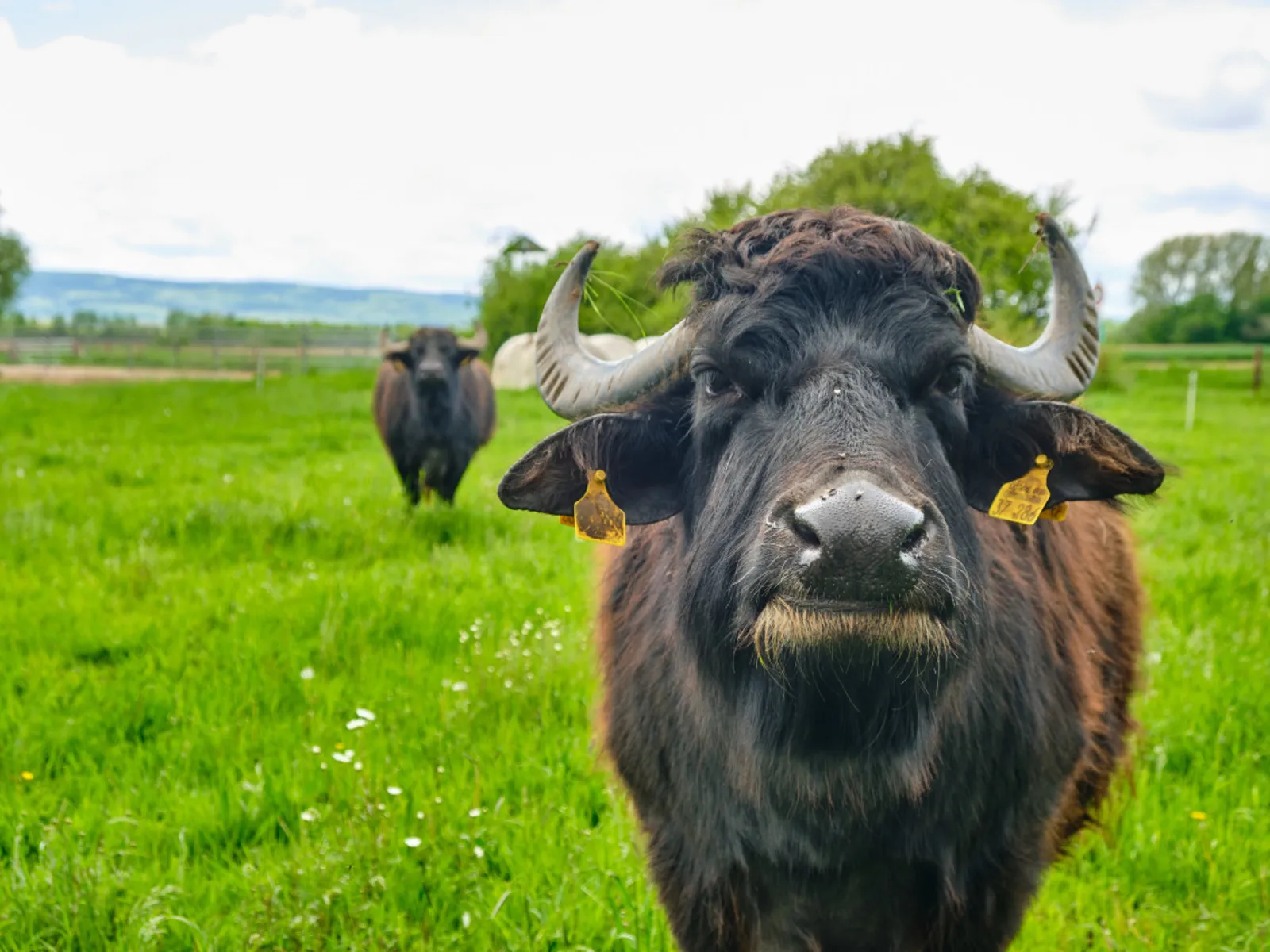
Water buffalo on the banks of the Ihme in Vörie
It’s quite rare to see a water buffalo in our part of the world. But along the Ihme River near Vörie, they’ve been given a permanent home—as stewards of the landscape, since these exotic cattle help with river restoration, flood control, and species conservation along the Ihme.
The Baumgarte farm in Ronnenberg-Vörie has been raising rare water buffalo since 2011 as part of a landscape conservation project on a site covering approximately 80,000 square meters. The area west of the railroad line is a stormwater retention area, known as a retention basin. As part of the construction of the Evestorf bypass (B 217), a biotope was created here as a compensatory measure. This wasn’t always the best solution: rampant vegetation clogged the floodplains, and flood protection was no longer guaranteed. And invasive plants such as creeping bentgrass soon came to dominate the area, causing biodiversity to decline steadily and leaving hardly any habitat for birds and other animals. Mechanical intervention throughout the year did not seem practical or cost-effective. The alternative was water buffalo. They have been used sporadically but successfully as landscape conservationists for some time now, for example in the Steinhuder Meer nature reserve. These undemanding and hardy cattle have an advantage over their native counterparts in that they eat almost anything and, as water-loving animals, are particularly effective at keeping riparian zones free of unwanted vegetation.
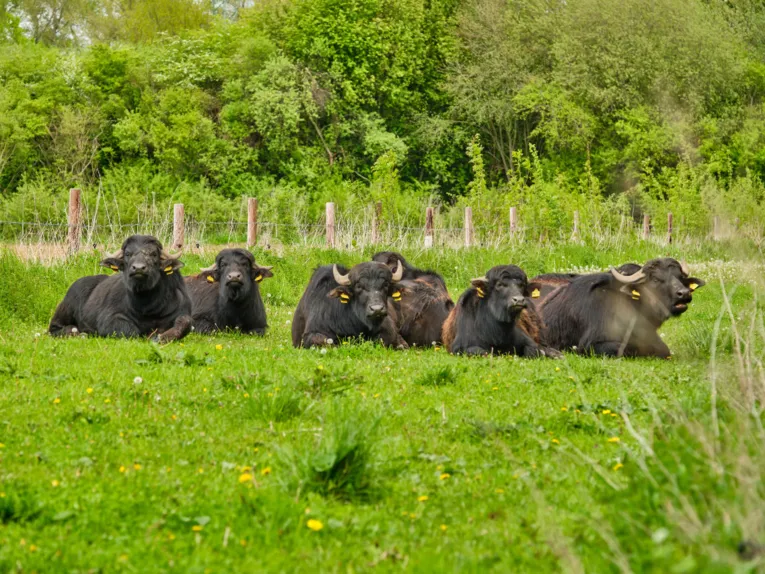
Animal landscape conservationists: a herd of water buffalo ensures biodiversity in the Ihme floodplains
Observation hut and information board
Water buffalo are generally docile, but only when they are accustomed to humans. When feral, they are easily agitated and can be dangerous. In the retention basin west of the railroad tracks, they are hardly visible to passersby, but they also serve other purposes. The floodplain landscape along the Ihme River extends far to the east, beyond the road to Weetzen (K228). About a hundred meters west of the road, the maintenance association has built an open winter shelter for the animals, with a small parking lot at a reasonable distance in front of it, featuring an information sign about the project. Across the road lie the two Stapelteiche ponds, formerly marshy areas that now serve as a refuge for waterfowl. Here, too, the water buffalo are used to prevent the shallow waters from silting up, a constant threat. A new observation hut has also been built there specifically for watching the buffalo.
The water buffalo also contribute to the biodiversity of the Ihme floodplain in other ways: Their footprints alone provide excellent hiding places for toads, and spiders can build their webs over them. And as the buffalo are kept naturally and are spared antibiotics, their droppings are particularly valuable. Most of the droppings lying around are inhabited - water and dung beetles have laid their eggs there, creating new life, which in turn serves as a food source for other life.
If you would like to find out more about the water buffalo, NABU offers guided tours. here
5.3 - Water buffalo - an effective biotope and landscape maintainer
5.3 - Water buffalo - an effective biotope and landscape maintainer
New opportunities for nature" series, leaflet 5.3
File type: pdf Size: 233.46 KB
Water buffalo Vörie
30952 Ronnenberg