 Deutsch
 English
 中文
中文
 Danish
 Eesti
Eesti
 Español
 Suomi
Suomi
 Français
 Italiano
 日本語
日本語
 한국
한국
 Nederlands
 Norge
Norge
 Polski
 Portugues
 Русский
 Svenska
 Türkçe
 العربية
 Română
 български
Active on the water
Würmsee
Lake Würm in Kleinburgwedel invites visitors to take a relaxing stroll along the nature trail, which features eight Land Art stations.
Lake Würm in Kleinburgwedel
“There’s a real sense of vitality here—the lake never gets boring.” That’s what visitors say as they stroll along the shore of this small lake, located in the northern part of the Hanover region. It’s the Würmsee near Kleinburgwedel, which invites you to take a relaxing walk through greenery and blue waters. Here, they can breathe in the fresh air, watch dragonflies in flight, and listen to the call of the natterjack toad. Eight stations along the nature trail offer plenty of variety.
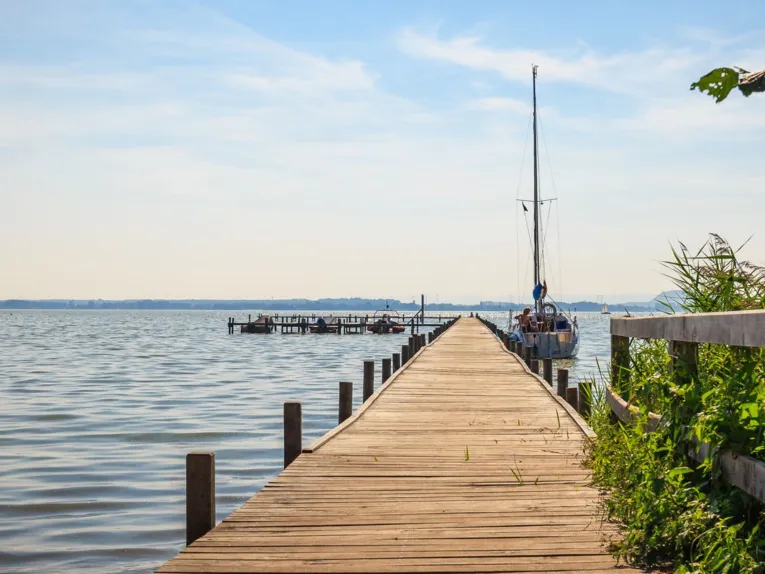
Wave-shaped loungers, a wooden pier, and swimming statues—a nod to the 1920s.
A Tradition of Tourism in Kleinburgwedel
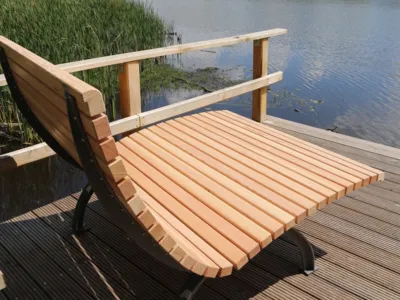
Relax on the wave lounger
The lake’s tourism tradition, with its “Golden 1920s,” is highlighted at the first stop. There, two wavy lounge chairs on a wooden pier invite visitors to take a break and enjoy the lake view. Life-size figures dressed in period fashion stand by the railing. A man with a camera joins the bathing beauty in her sun hat—naturally, he’s only aiming his lens at the lake. Teenagers ready for a swim gaze into the distance. Engraved in light blue on the front plank of the dock, right at the water’s edge, are the words: “Vacation greetings from Lake Würm.” The ideal selfie spot. That’s been taken into account, too.
A woman who lived through those days recalls her time at Lake Würm with a broad smile: “We’d often sit in pairs a little way back from the lake, behind the bushes, and ‘get engaged’—that’s what they called it back then.” These days, swimming—and certainly boating—would be incompatible with protecting the lake’s highly species-rich and diverse birdlife.
Guests pump the water themselves
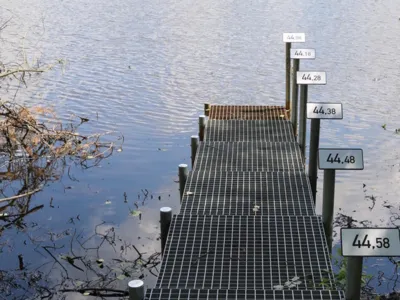
Water level indicator on the metal platform
Visitors get hands-on: At one station, they can pump water themselves using three different-colored hand pumps. The water flows down from the sky as rain from a cloud, runs naturally into the lake as shallow groundwater, or comes out of a faucet. “This way, everyone can get their hands dirty or get their feet wet—it creates a stronger connection to the lake than if there were just signs there,” says Frank Nordiek, describing part of the concept. He created the nature trail together with Wolfgang Buntrock from Atelier LandArt in Hanover.
The fluctuating water level plays an important role at another station. The two landscape artists designed a world first using terraced perforated grates along the shore—the walkable water level indicator. There, visitors can not only read the current water level on information panels but also walk barefoot into the water on the grate or stand on dry ground.
Extreme weather conditions, as seen under a magnifying glass
However, in addition to the drawbacks described, the fluctuating water level also has its benefits: What was a point of criticism six months ago during the drought—the lack of water—has now, with high water levels following heavy rain in March 2020, transformed into a spectacular natural phenomenon. “It’s as if we’re observing the increasingly pronounced extremes of our weather through a magnifying glass at Lake Würm,” emphasizes Wolfgang Buntrock, adding, “It’s absolutely wonderful at the lake right now! With the high water level, it’s a completely different experience.”
How it all began
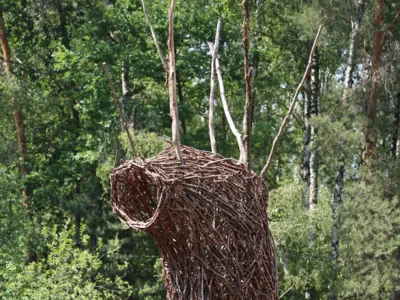
Art made from woven branches
The revitalization of the lake began in 2016. Trees and shrubs were removed, and silt was cleared away. The goal was to restore the lake’s accessibility. Another stated objective was to provide information about the lake, its history, and its wildlife right on the shore.
Visitors surveyed in a report expressed clear needs: They wanted to walk around the lake, observe nature, drink coffee, and spend one to two hours by the lake. They love the contrast between forest and water, the water lilies, the chorus of frogs, the simplicity, and the fresh air. While there used to be a boat rental service and swimming was even permitted, neither has been possible for a long time. The highly fluctuating water level results in a large mudflat one year, while the next year the water stands half a meter high.
Three "peat eaters" pique curiosity
Not far from the walkable viewing platform, three red steel animals serve as a reminder of the area’s boggy past. These are the “Peat Eaters.” When the groundwater level is high, their feet stand in the remnants of a wetland biotope that is off-limits to visitors. But these eye-catching sculptures, standing about three meters tall, are easily visible from the path thanks to their red color. The color, which was the subject of heated debate at the start of the planning process, was ultimately accepted. “We happened to find an acorn there that was almost the same shade of red,” recalls Frank Nordiek.
Aquatic fauna on display as steel models on the boat
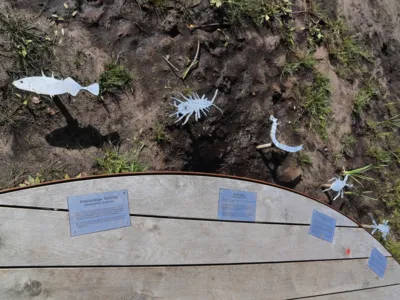
A Look at Aquatic Fauna
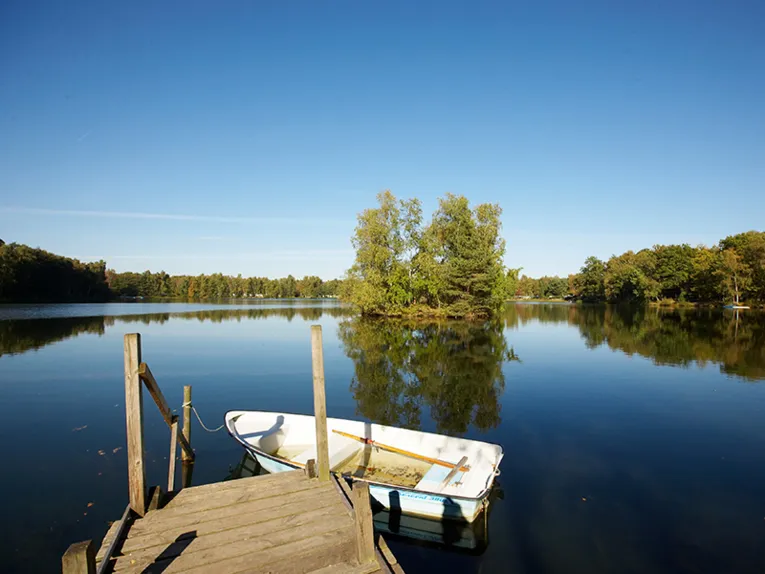
There have always been ample observations of the birdlife. The situation is different, however, when it comes to aquatic fauna. To avoid relying on generalizations here, a small-scale mapping exercise was conducted with an expert from the Lower Water Authority. Some of the species identified will be documented at another station. The landscape artists also came up with a fitting design for this: At the end of a pier built from staggered planks, a boat bobs in the water. Welded to the dock are steel models of mayflies, water scorpions, fire-bellied beetles, and mosquito larvae. This, too, offers a rich experiential value—especially since the dock provides a magnificent vantage point for gazing into the evening sun. With a bit of luck, a kingfisher might even glide across the scene. Orioles, which love moist softwood floodplains, also find shelter nearby. When the water level is low, the numerous gray herons put on an impressive spectacle as their food—in the form of countless fish—is served to them as if on a golden platter.
From a bench on the other side of the lake, however, you can watch the morning sun rise; even better: the forested bird island visible from there adorns Lake Würm. The view also takes in three homes built on tall stilts that the artists have constructed along the shore. Who would like to live in these seven-meter-high “nests”? “We leave that entirely to the imagination of the viewer,” explains Frank Nordiek. “One thing is certain: there is more around us than we can see or hear.”
Sitting on a bench, talking to the animals
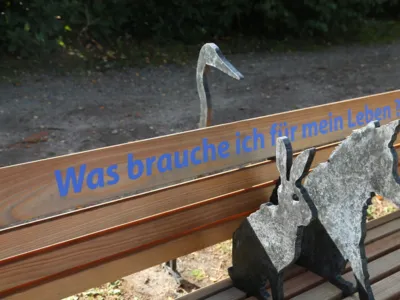
Sitting on a bench, talking to animals
Another exhibit is also impressive. There, a fox and a hare (as steel figures) sit next to you on a bench. Your gaze also falls on a heron, a toad, and a kingfisher. The theme is the question: What do I need to live? Humans: less than they think. Animals: more than they have. So everyone can ask themselves: What does my ecological footprint look like? What can I change in my daily life? How do my habits contribute to everything staying the same? Should it stay that way? What remains?