In the years immediately following World War II, communities in western Germany were overflowing with refugees and displaced persons.
The resulting mix of different denominations led to the establishment of a local Catholic parish even in Sehnde, which had been exclusively Protestant since the Reformation.
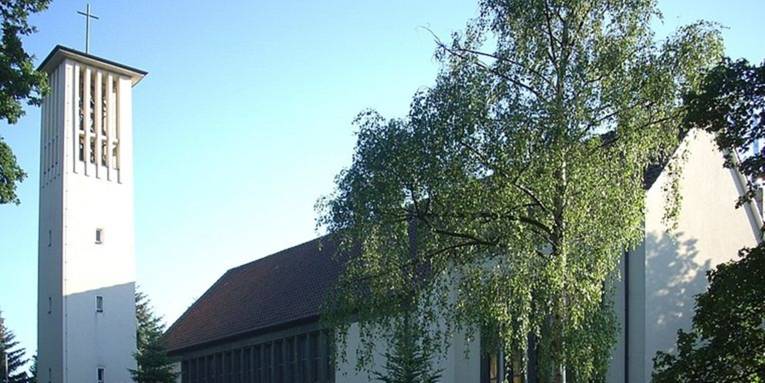
The church Pfarrkirche St. Maria is one of two Catholic churches in the town of Sehnde. After initial resistance from the local government at the time, which sought to prevent a Catholic church from being built in the town center, it was constructed in 1954–55 and finally consecrated on June 5, 1955.
In 2005, the 50th anniversary of St. Mary’s Sehnde was celebrated with two weeks of festivities packed with events.
The Building
The Building (Architect: Josef Fehlig, Hildesheim) is a simple, elongated hall with a raised and narrower rectangular chancel. The bell tower (21 m), which is square in plan, tapers slightly toward the top, and has housed three new bells since 2003, is crowned by a three-meter-long cross made of sheet copper. It is connected to the church by a passageway. The baptistery is located on the ground floor. The tower and nave are plastered in a muted white.
The bright interior contains, in addition to the altar of reddish marble, the bronze ambo adorned with plant and evangelist symbols, the Easter candlestick (Tree of Life with the serpent of Paradise), and the tabernacle clad in gold leaf and placed in front of a sun disc, the wooden figures of a large hanging crucifix, a Madonna with Child, St. Hedwig of Silesia, and, near the entrance, St. Barbara, the patron saint of miners. Together with a miner’s lamp placed next to it, this figure serves as a reminder of potash mining, which was a major source of income for Sehnde in the 20th century.

 Deutsch
 English
 中文
中文
 Danish
 Eesti
Eesti
 Español
 Suomi
Suomi
 Français
 Italiano
 日本語
日本語
 한국
한국
 Nederlands
 Norge
Norge
 Polski
 Portugues
 Русский
 Svenska
 Türkçe
 العربية
 Romanesc
 български