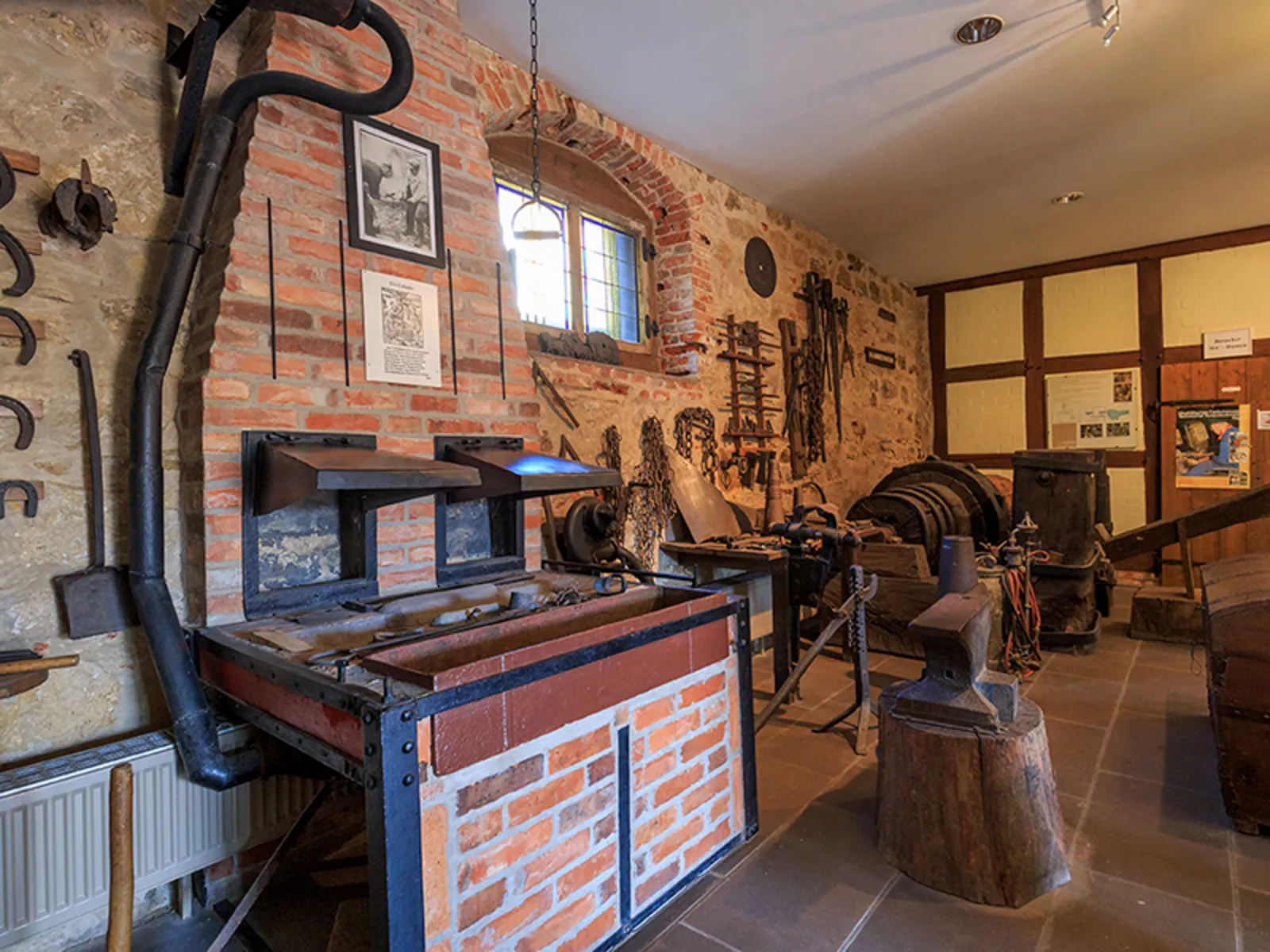
The museum is located in an old granary and a coach house on the grounds of the moated castle of the Counts of Hallermunt. It opened in 1969 as a museum dedicated to the former County of Hallermunt and the former district of Springe. Various thematic areas are presented across nearly 2,000 square meters of exhibition space. The ground floor of the main building houses parts of a hammer mill, a blacksmith’s shop, carpentry tools, and the special exhibition area.
The first floor features a pottery workshop, a shoemaker’s workshop, a saddlery, a carpenter’s workshop, metalworking, stonemasonry, mustard production, a kitchen with furnishings from the 17th to 19th centuries, laundry equipment, a 19th-century middle-class living room, and the interior of a living room from the 1950s, as well as the Militsch-Trachenberg Local History Room. The second floor houses the early history section, featuring geology, archaeological finds from the surrounding area, abandoned settlements, and the history of the County of Hallermunt.
Next is the history of Springe and the surrounding villages up to the present day, as well as thematic sections on churches, clubs, the railroad, the post office, commerce, and industry. The textile section was newly opened in the side wing in 1995. It traces the journey from flax to linen, as well as tailoring, hat-making, fashion, textile techniques, and fabrics. The agricultural section in the coach house, which also opened in 1995, deserves special attention. It provides insight into the development of agricultural technology between 1850 and 1950.
Since 2007, a special exhibit on the top floor of the Remise has provided information about the Deister as a natural, economic, and recreational area. Through numerous exhibits, it explores the role the Deister has played for the people of the region throughout various eras up to the present day.

 Deutsch
 English
 中文
中文
 Danish
 Eesti
Eesti
 Español
 Suomi
Suomi
 Français
 Italiano
 日本語
日本語
 한국
한국
 Nederlands
 Norge
Norge
 Polski
 Portugues
 Русский
 Svenska
 Türkçe
 العربية
 Română
 български