
 Deutsch
 English
 中文
中文
 Danish
 Eesti
Eesti
 Español
 Suomi
Suomi
 Français
 Italiano
 日本語
日本語
 한국
한국
 Nederlands
 Norge
Norge
 Polski
 Portugues
 Русский
 Svenska
 Türkçe
 العربية
 Română
 български
Sights
On the trail of famous poets, publicists and writers
Wilhelm Busch, Hannah Arendt, Hermann Löns, and many others were active in Hanover.
Hanover as a city of poets and writers? Absolutely—over the years, countless poets, writers, and authors have made their mark in Hanover. And even today, you can follow in their footsteps. Join us on a journey into the world of literature:
Kurt Schwitters
Download for editorial use: Image in printable resolution (300dpi)Copyright: HMTG
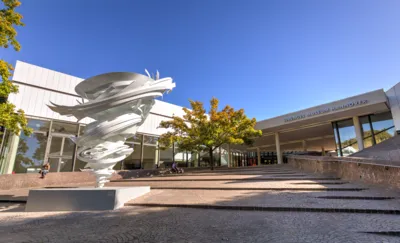
Kurt Schwitters was born on June 20, 1887, in Hanover and is Hanover’s greatest modern poet. He later attended the Realgymnasium Hannover, now known as the Tellkampfschule at Altenbekener Damm 83. His first Merz poem was titled “To Anna Blume.” Schwitters was one of the greatest artists of the Dadaist movement. A replica of the Merzbau and a large portion of his works are now housed at the Sprengel Museum Hannover. In Hannover’s Old Town, on Knochenhauerstraße, there is a floor relief by Siegfried Neuenhausen featuring a 1920 poem by Kurt Schwitters about the city and its inhabitants. Kurt Schwitters died on January 8, 1948, in Kendal, Cumbria, England. His remains were transferred to Hanover in 1970; his grave is located at the Engesohde City Cemetery.
Theodor Lessing
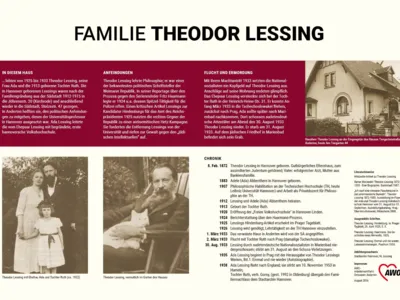
Commemorative plaque for the Theodor Lessing family in front of the entrance to the building at "Am Tiergarten 44"
Theodor Lessing was born on February 8, 1872, in Hanover. He later attended what is now the Kaiser-Wilhelm- und Ratsgymnasium (located today at Seelhorststraße 52) in Hanover. Starting in 1919, he and his wife, Ada Lessing, established the Hannover Adult Education Center in Linden, which is now called the “Ada and Theodor Lessing Adult Education Center Hannover” and is located in the Old Town on the Hohen Ufer. In 1925, he attracted widespread attention with his book about the trial of serial killer Fritz Haarmann. One of Theodor Lessing’s former residences is still located today in the Hannover-Anderten neighborhood (Am Tiergarten 44).
Wilhelm Busch
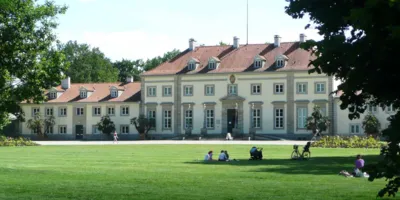
Georgenpalais
Wilhelm Busch is one of Germany’s most important poets and illustrators. Everyone is probably familiar with the pranks of Max & Moritz. He was born on April 15, 1832, in Wiedensahl. Beginning in 1847, he studied mechanical engineering in Hanover, but dropped out in 1851. Later, however, he returned to Hanover time and again to observe the monkeys at the zoo. These observations inspired him to write his short story “Fipps the Monkey.” The majority of Wilhelm Busch’s works can be viewed at the Wilhelm Busch – German Museum of Caricature and Drawing in the Georgenpalais in Hanover.
Hannah Arendt
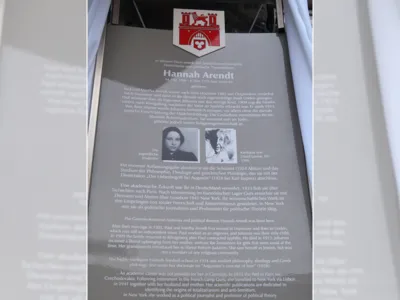
The commemorative plaque at Hannah Arendt's birthplace in Linden
The writer Hannah Arendt was born on October 14, 1906, in Linden (now a district of Hanover). Her birthplace is located at Lindener Marktplatz 2. One of her most famous works is titled *On Evil*. There are numerous places in Hanover that honor Hannah Arendt and/or are associated with her, such as the Hannah Arendt House and Hannah Arendt Square. You can find a list of these locations, along with detailed information, here
Adolph Baron Knigge
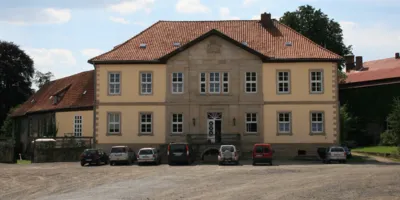
Adolph Freiherr Knigge was born on October 16, 1752, in Bredenbeck, now a district of Wennigsen (Deister) in the Hanover region. His birthplace was the manor house in Bredenbeck, which still stands today. He was a writer and an Enlightenment thinker. At the age of 14, the orphan was sent by his guardian to Hanover to be educated through private tutoring. He later went to Göttingen to study, but returned to Hanover in the mid-1780s and published what is arguably his most famous work: *On the Art of Social Conduct*. This work is known worldwide simply as “the Knigge.” The work was first published in 1788 by Schmidt’s Bookstore in Hanover. Later, the rights were transferred to Rittscher’s Bookstore in Hanover and subsequently, through a takeover, to Hahn’s Bookstore. The historic publishing building is still located today in Hanover’s Old Town at Leinstraße 31
Hermann Löns
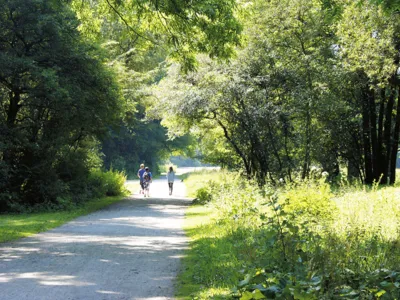
Relaxation in Hermann-Löns Park
The journalist and writer Hermann Löns was born on August 29, 1866, in Chelmno, Poland. He initially lived and worked in Hanover from 1892 to 1906. At that time, he worked as a journalist for the *Hannoverscher Anzeiger*, the predecessor of today’s *Hannoversche Allgemeine Zeitung*, published by the Madsack publishing house. At the same time, however, he was already pursuing a career as a writer. He became very popular for his satirical local columns written under the pseudonym Fritz von der Leine. In 1902 and 1904, he moved twice to other daily newspapers in Hanover. During this time, he became known as a successful journalist, author, poet, nature lover, and poet of the heath. Around 1900, he began writing poems, many of which were set to music. In 1906, he moved to Bückeburg, but returned to Hanover in 1909, where he worked as a freelance writer and penned various short stories and narratives. Hermann-Löns-Park in Hanover is named in his honor.
Charlotte Kestner
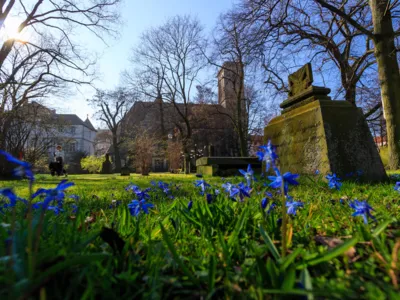
Garden cemetery
Charlotte Kestner (née Buff) was born on January 11, 1753, in Wetzlar. In 1773, she moved to Hanover to marry Johann Christian Kestner. She lived in Hanover until her death in 1828. She was the inspiration for the character Lotte in Johann Wolfgang von Goethe’s *The Sorrows of Young Werther* and in Thomas Mann’s *Lotte in Weimar*. Although Charlotte Kestner was neither a poet nor a writer, she remains an integral part of the world of literature. Charlotte Kestner’s grave is located at the Gartenfriedhof in Hanover.
Theodor Colshorn

Tell combat school
Ludolph Louis Theodor Colshorn was born on January 13, 1821, in Ribbesbüttel near Gifhorn. After attending a teacher training college in Hanover, he first went to Warmbüttel to work as a teacher. In 1848, he moved to Hanover and continued to work as a teacher, first at the Höhere Töchterschule starting in 1854 and then at the Realschule—later known as the I. Realgymnasium and now the Tellkampfschule—starting in 1857. In 1854, Theodor Colshorn, together with his older brother, the cantor Carl Colshorn, published the popular collection *Fairy Tales and Legends from Hanover*. The Brothers Grimm were among Theodor Colshorn’s friends
Rudolf Erich Raspe
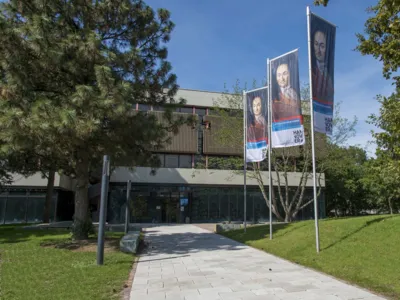
Gottfried Wilhelm Leibniz Library
Rudolf Erich Raspe was born on March 26, 1736, in Hanover. Beginning in 1761, Raspe worked as a clerk and later as a library secretary at the Royal Library of Hanover, whose collections are now housed in the Gottfried Wilhelm Leibniz Library. During his time at the library, Raspe also discovered previously unknown writings by Gottfried Wilhelm Leibniz. Later, Raspe moved to Kassel and then to Great Britain. There, in 1785, he became world-famous for his book about the Lying Baron Münchhausen.
Erich Maria Remarque
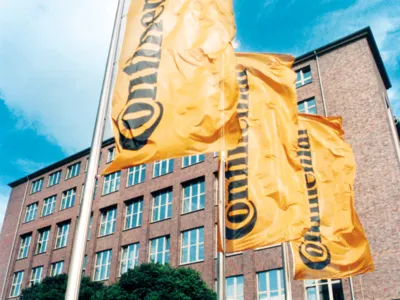
Continental AG
Erich Maria Remarque was born on June 22, 1898, in Osnabrück. In mid-1921, Remarque moved to Hanover, where he worked for Continental AG, writing advertising copy and comics. Beginning in 1923, he served as editor-in-chief of the company newspaper, *Echo Continental*. The former Continental administrative building can still be visited today and is located at Vahrenwalder Straße 7. During this time, Remarque also published about 100 short prose pieces in various daily and weekly newspapers. In 1925, Remarque moved to Berlin.
Ludwig Hölty
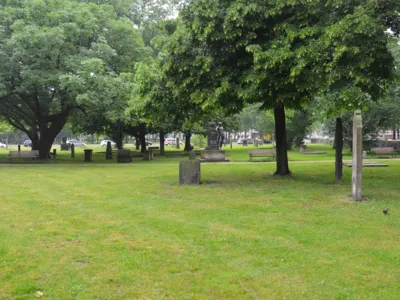
The southern part of the St. Nikolai cemetery
The poet Ludwig Hölty was born on December 21, 1748, in Mariensee. One of his best-known poems is “Üb’ immer Treu’ und Redlichkeit bis an dein kühles Grab” (The Old Farmer to His Son), which was even set to music by Wolfgang Amadeus Mozart. Hölty spent the last two years of his life in Hanover and died in 1776 following a serious illness. He was buried at St. Nikolai Cemetery in Hanover, though the exact location of his grave is unknown. Today, a monument created in 1901 by the sculptor Otto Lüer, located next to St. Nikolai Chapel, commemorates Hölty. The monument also includes a larger-than-life bronze statue of a young man. In honor of Hölty, the city of Hanover has awarded the Hölty Prize every two years since 2008. Hölty was a co-founder of the “Göttinger Hain” poets’ club.
Charles Philip Maurice
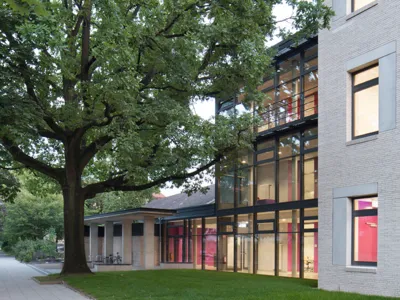
New wing of the Kaiser Wilhelm and Ratsgymnasium high schools
Karl Philipp Moritz was born on September 15, 1756, in Hamelin and was a writer of the Sturm und Drang movement. His novel *Anton Reiser* is set in Hanover. Prior to that, starting in 1771, Moritz attended what is now the Kaiser-Wilhelm- und Ratsgymnasium Hannover at Seelhorststraße 52. Along with Hölty, he was a co-founder of the poetry club “Göttinger Hain.”.
Heinrich Christian Boie
The poet Heinrich Christian Boie was born on July 19, 1744, in Meldorf. In 1776, Boie moved to Hanover, where he worked as a staff secretary at the Leineschloss. Later, Boie moved to Göttingen. Boie was a co-founder of the poetry club "Göttinger Hain.".
John Peter Eckermann
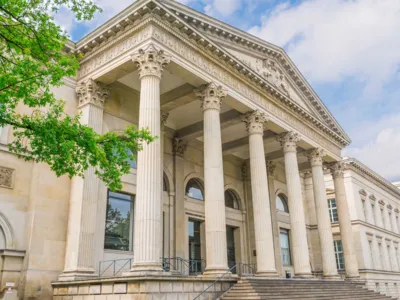
The portico of the Leineschloss with west wing
The poet and writer Johann Peter Eckermann was born on September 21, 1792, in Winsen (Luhe). After serving in the military in 1813–14, he moved to Hanover to become a painter. He wanted to study under the painter Ramberg. However, Eckermann was forced to abandon this plan after only a short time due to illness and financial difficulties, so he accepted a position at the War Chancellery in Hanover. At that time, the War Chancellery was located in the Leineschloss. At the same time, he attended high school in Hanover and devoted himself to literature. He was particularly interested in the works of Johann Wolfgang von Goethe. After a brief stay in Göttingen, Eckermann moved to Empelde (now part of the Hanover region). It was there that he conceived the idea of living with Goethe in Weimar. This led to the work *Conversations with Goethe in the Last Years of His Life*, published in 1836.
Gerrit Engelke
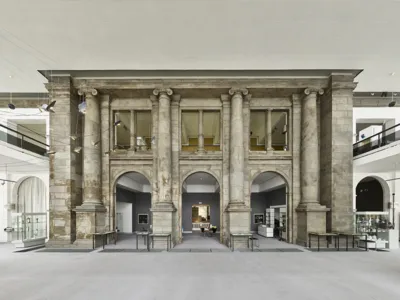
August Kestner Museum, interior view of the old facade,
"Shoulder to Shoulder" is just one of the works by the prominent working-class poet Gerrit Engelke. He was born on October 21, 1890, in Hanover and worked there for many years. After completing elementary school, he finished his apprenticeship as a painter by passing the journeyman’s examination. Beginning in 1909, he worked for various companies while attending evening classes at the Hanover School of Applied Arts (now part of Hanover University of Applied Sciences and Arts), where he also won two awards. Watercolors and drawings by Engelke are now housed in the August Kestner Museum and the Hanover City Library. After leaving Hanover, he turned to poetry and became famous as a “working-class poet.”.
Heinz Erhardt
Tell combat school
The poet, comedian, and actor Heinz Erhardt was born in Riga in 1909. From 1919 to 1924, Erhardt attended school in the Hanover region, first at a boarding school in Barsinghausen and later at the Tellkampfschule in Hanover, which was still called a “Realgymnasium” at the time. The school is located today at Altenbekener Damm 83. Afterward, Heinz Erhardt returned to Riga and later moved to Hamburg. He became one of Germany’s greatest poets and comedians, as well as an actor and composer. His film “Das kann doch unsren Willi nicht erschüttern” premiered in 1970 at what was then the Ufa Theater in Hanover.
Schlegel Brothers
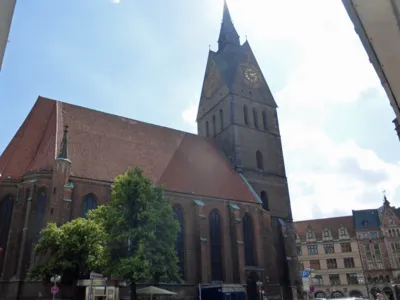
The Market Church in Hanover's Old Town
The Schlegel brothers—August Wilhelm Schlegel (1767–1845) and Friedrich Schlegel (1772–1829)—were born in Hanover and are considered co-founders of Early Romanticism. It all began for the brothers at the Marktkirche in Hanover, where their father served as pastor. August Wilhelm graduated from high school in Hanover and then went on to Göttingen. Friedrich’s upbringing caused the family a great deal of grief. As a result, he was first sent to live with his uncle Johann August in Pattensen (now part of the Hanover region) and then to his brother Moritz in Bothfeld (now a district of Hanover). Later, Friedrich moved to Leipzig and then studied in Göttingen
Frank Wedekind
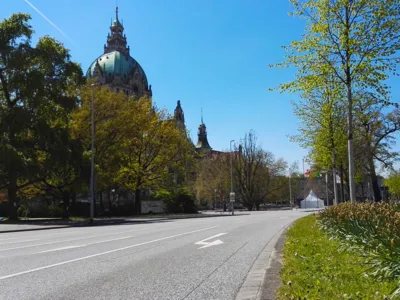
The Friedrichswall
The writer, playwright, and actor Frank Wedekind was born Benjamin Franklin Wedekind on July 24, 1864, in Hanover. Wedekind spent his childhood in Hanover until 1872, after which the family emigrated to Switzerland. Among his most famous works is the 1902 play *Pandora’s Box*. Unfortunately, Wedekind’s former home no longer stands. Today, the glass administrative building of NORD/LB stands on that site (Friedrichswall 10)
Ernst Jünger
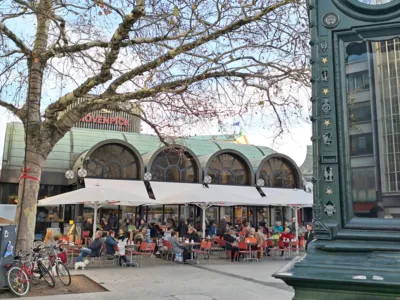
Café Kröpcke
The controversial writer Ernst Jünger was born on March 29, 1895, in Heidelberg. He spent his childhood in Hanover, in Schwarzenberg in the Ore Mountains, and, beginning in 1907, in Rehburg. Jünger began his schooling in 1901 at the Goethegymnasium in Hanover, which no longer exists. From 1905 to 1907, Jünger attended boarding schools in Hanover and Braunschweig. He then returned to Rehburg. In 1913, he joined the Foreign Legion in Verdun, later fled to Morocco, but was recaptured. Thanks to an intervention by the Foreign Office, arranged by his father, Jünger was released, and his father sent him to a boarding school in Hanover as punishment. On August 1, 1914, Jünger enlisted as a volunteer soldier in Hannover. After World War I, he became involved in writing through the publisher Paul Steegemann at Café Kröpcke (today: Mövenpick Café Kröpcke) in Hannover. His later novel *Die Zwille* (1973) is set in Hannover
Vicki Baum
The writer and musician Vicky Baum was born on January 24, 1888, in Vienna. One of the places she lived was Hannover. From 1917 to 1923, Vicky Baum worked as a harpist in Hannover. During her time in Hannover, she also published her first novel in 1919: *Frühe Schatten*. Vicky Baum initially lived with her family at 11 Dieterrichsstraße in downtown Hanover and later, from 1921 to 1923, at what was then 335 Podbielskistraße (now number 53) in the List district of Hanover.
Heinrich Heine
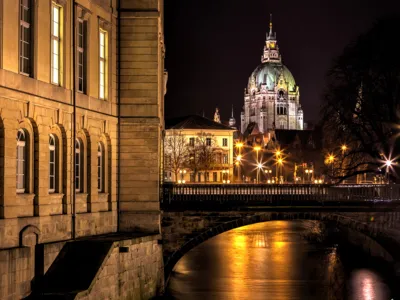
Linen castle
The poet and writer Heinrich Heine was born on December 13, 1797, in Düsseldorf. After his exile in Paris, Heine returned to Germany in late fall 1843, after 12 years away. He traveled from Paris via Brussels, Amsterdam, and Bremen to Hamburg, and on his return journey also passed through Hanover. He describes his observations and experiences in Hanover in his epic poem *Germany*. A Winter's Tale. In it, he describes, among other things, the city’s cleanliness and its many magnificent buildings.
August Wilhelm Iffland
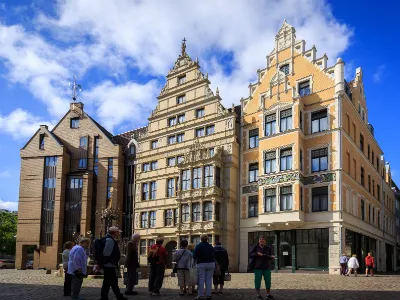
The actor and playwright August Wilhelm Iffland was born on April 19, 1759, at the Leibnizhaus in Hanover. He later attended the Lyceum—now the Kaiser-Wilhelm- und Ratsgymnasium in Hanover—where he was a classmate of Karl Philipp Moritz. In 1777, Iffland moved to Gotha. He went on to become one of Germany’s most famous actors and also wrote numerous plays. In 1782 in particular, he enjoyed tremendous success as “Franz Moor” in Schiller’s *The Robbers*. Schiller himself paid tribute to Iffland with the words: “Germany will find another master in this young man.”
Joachim Ringelnatz
The writer Joachim Ringelnatz was born on August 7, 1883, in Wurzen. Among the many places he lived during his life was Hanover. In 1913, he worked for Chamberlain Börries Baron von Münchhausen-Moringen at Landschaftsstraße 2 in Hanover. He was responsible for sorting the baron’s literature, pictures, and coins. In the process, Ringelnatz came across numerous advertising leaflets and water bottle labels, which the baron peeled off and took home with him.
Arno Schmidt
The writer Arno Schmidt was born on January 18, 1914, in Hamburg. Schmidt often visited Hanover. One of his most famous quotes is: “What’s so special about New York? A big city is a big city; I’ve been to Hanover.“
Theo Lingen
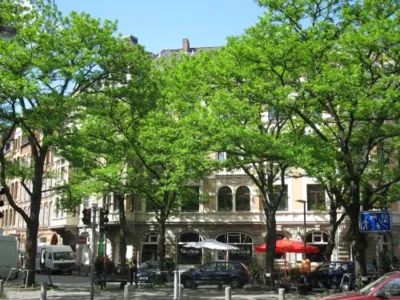
Wedekindplatz
The actor and author Theo Lingen was born on June 10, 1903, in a house on Drostestraße (between Wedekindplatz and Voßstraße) in Hannover-List. He later attended the Goethegymnasium. In the Goethegymnasium’s student theater group, he performed alongside Gretha von Jeinsen, who later became the first wife of the writer Ernst Jünger. Lingen’s acting talent was discovered during rehearsals for a student performance at the Schauburg Boulevard Theater in Hanover, which no longer exists. In 1922, he performed at the Residenztheater in Hanover. He later became one of Germany’s greatest actors and was also active as an author.
Karl Jakob Hirsch
The artist and writer was born on November 13, 1892, in Hanover. He grew up on Herschelstraße, then later on Stiftstraße, and, starting in 1905, on Königstraße. He spent most of his school years skipping class at Lyzeum II—a school that no longer exists—and eventually left without a diploma. In 1909, Hirsch briefly attended the Hanover School of Applied Arts, which also no longer exists. His parents then sent him to live with his grandmother in Munich, where he studied painting and graphic arts. After returning briefly to Hanover in 1911, he moved to Worpswede to join the artists’ colony there. His other stops included Paris, Berlin, and New York, among others. In 1931, his famous novel *Kaiserwetter* was published, in which he described the life and atmosphere of the late German Empire in the Prussian province of Hanover, primarily in the city of Hanover
Rudolf Augstein
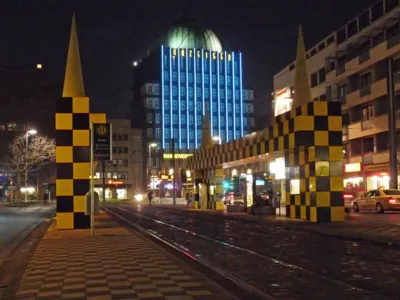
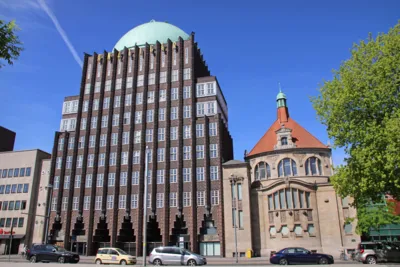
The Anzeiger high-rise.
The journalist, publisher, and columnist was born on November 5, 1923, in Hanover. After finishing school and earning his high school diploma, he completed an internship at the *Hannoverscher Anzeiger*, which later became the *Hannoversche Allgemeine Zeitung* (HAZ). After the end of World War II, Augstein initially served as an editor at the *Hannoversches Nachrichtenblatt*. In 1946, he became an editor for the weekly magazine “Diese Woche.” When the magazine was shut down by the British Foreign Office after only six issues due to its criticism of the occupying powers, it was transferred to German ownership. As part of this process, Augstein acquired the publishing license and became editor-in-chief and publisher. On January 4, 1947, he published the first issue of the news magazine under the new title DER SPIEGEL in the Anzeiger high-rise building. In 1952, DER SPIEGEL moved to Hamburg.
Download: Image in printable resolution (300 dpi)
Henri Nannen
The publisher and journalist was born on December 25, 1913, in Emden. After World War II, Nannen founded the daily newspaper *Hannoversche Neueste Nachrichten* in Hanover in 1946 and remained its publisher until 1947. From 1947 to 1949, he served as editor-in-chief of the *Hannoversche Abendpost*. In 1948, Nannen launched the magazine *Stern* from the youth magazine *Zick-zack*. The first publishing house was the *Anzeiger Hochhaus*. In 1951, he sold his shares in *Stern* to, among others, the printer Richard Gruner and Gerd Bucerius’s weekly newspaper *Die Zeit*. Henri Nannen was also active as a patron of the arts. He died on October 13, 1996, in Hanover.
Tourist highlights
Sights
Discover Hannover’s sights, rich in history and full of things to do.
read