
 Deutsch
 English
 中文
中文
 Danish
 Eesti
Eesti
 Español
 Suomi
Suomi
 Français
 Italiano
 日本語
日本語
 한국
한국
 Nederlands
 Norge
Norge
 Polski
 Portugues
 Русский
 Svenska
 Türkçe
 العربية
 Română
 български
Sights
On the trail of famous inventors and pioneers
Hanover is also a city of inventors and pioneers.
Many inventors and pioneers come from Hanover, and numerous inventions have also been made there. Embark on a “journey of innovation” through Hanover.
Cord Broyhan
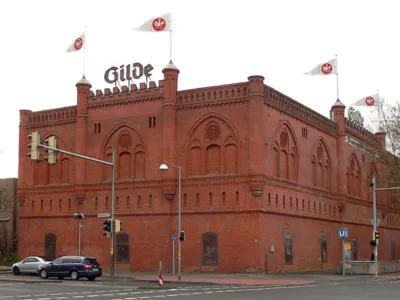
Gilde Brewery on Hildesheimer Street
Cord Broyhan was born in Gronau. After learning the art of brewing beer in Hamburg, he moved to Hanover in 1524. In Hanover, he modified the dark brown “Hamburg-style” beer and, on May 31, 1526, invented a new light brown beer: Broyhan beer. It became a major export hit for the city, and Cord Broyhan became a wealthy man. He purchased the Broyhan House at Kramerstraße 24, which still stands in the Old Town today. In 1546, the brewers formed a guild. This gave rise to today’s Gilde Brewery at Hildesheimer Str. 132. That same year, the “Broyhan Taler” was minted for the first time. The image of the Broyhan Taler still adorns every bottle produced by the Gilde Brewery to this day.
Emil and Joseph Berliner
Emil Berliner was born on May 20, 1851, and his brother Joseph on August 22, 1858, in Hanover. After completing his schooling in Wolfenbüttel and a business apprenticeship, Emil emigrated to the United States. Between 1881 and 1883, Emil Berliner visited Hanover. There, together with his brother Joseph Berliner, he founded the first European company to manufacture telephone parts, the J. Berliner Telephone Company. Back in the United States, Emil Berliner invented the phonograph and the gramophone in 1887. Later, Emil Berliner and his brother founded a record production company in Hanover, the Deutsche Grammophon-Gesellschaft. Joseph Berliner managed the factory and began mass-producing the first records in 1898. The factory building still stands at Podbielskistraße 164 and is used as the “Grammophon Office Park.”
Karl Jatho
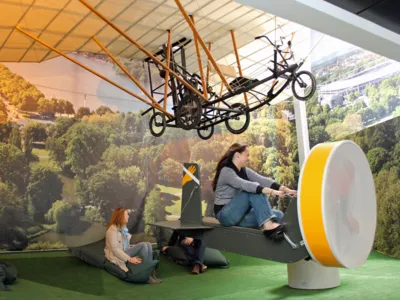
At the Hannover Airport Experience Center, visitors can follow in the footsteps of aviation pioneers.
Karl Jatho was born on February 3, 1873, in Hanover. In 1896, he began building gliders. It is said that on August 18, 1903—four months before the Wright brothers—he succeeded in making a powered flight with his Jatho-Drachen on the Vahrenwalder Heide in Hanover. However, this is disputed among experts. Nevertheless, the Jatho-Drachen was the first aircraft in history to feature a pilot’s seat, a lap belt to secure the pilot, and the ability to move under its own power. Starting in 1907, Jatho exhibited his flying machines at air shows, though he never flew them there. It was not until 1909 that he succeeded in making the first press-confirmed powered flight with the Jatho-Drachen No. 4. In 1910, he presented a replica of the Blériot aircraft. Later, he built additional aircraft, such as the “Steel Dove” in 1911 and the Jatho monoplane in 1913. That same year, Jatho opened the Hannover Aircraft Works and, shortly thereafter, a flight school. However, since the military showed no interest, both were closed again in 1914. Jatho died on December 8, 1933, in Hannover. Karl Jatho has received many posthumous honors. For example, the General Aviation Terminal at Hannover Airport was named after him, and a replica of the 1903 Jatho glider is on display in the airport’s permanent exhibition, “World of Aviation.” A Jatho memorial stone stands in front of the airport administration building. The Laatzen-Hanover Aviation Museum houses a model diorama depicting the Jatho glider’s takeoff. Another memorial stone is located in the Hanover-List district, on the northern side of the Mittelland Canal, between the Reiterstation and the Lister Bad, on the former Vahrenwalder Heide, which is now home to allotment gardens
Hugo Haase
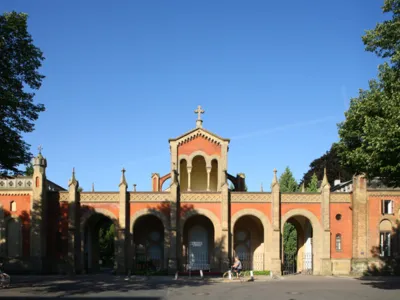
The Engesohde municipal cemetery.
The man who would later be known as the “Carousel King” was born on June 1, 1857, in Winsen/Luhe. With his amusement rides, he revolutionized the fairgrounds of his time. He founded two companies, one in the Harz Mountains and one in Leipzig. In 1909, Haase moved his factory from Leipzig to Hanover. After previously introducing his Carousel Palace (1902) and the "El Dorado" step carousel to the market, numerous other innovations were built in Hanover, such as a portable roller coaster. Hugo Haase also brought the bumper cars to Europe and introduced many innovations there, as he did with numerous other carousels. Many of his rides were then a regular feature at the annual Hannover Schützenfest. Hugo Haase died on September 13, 1933, in Hanover; his tomb is located at the Engesohde City Cemetery. Three times a year, Haase’s spirit still hovers over Hanover’s Schützenplatz when state-of-the-art and nostalgic rides spin at Lower Saxony’s largest spring festival, the world’s largest Schützenfest, and Northern Germany’s largest Oktoberfest.
Walter Bruch
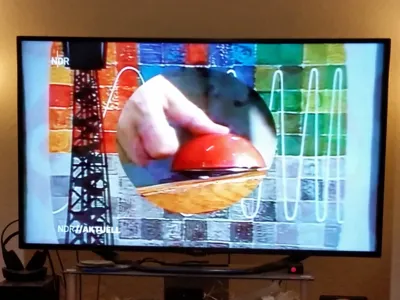
The color picture started due to an error before Willy Brandt pressed the button
Walter Bruch was born on March 2, 1908, in Neustadt an der Weinstraße. After having previously worked at Telefunken in Berlin, he returned to Telefunken in 1950—not to Berlin, however, but to Hanover. There, he headed the Basic Research Laboratory for Receiver Technology, where the PAL color television system—for which a patent application was filed on December 31, 1962—was developed. Walter Bruch first presented PAL color television to experts from the European Broadcasting Union (EBU) on January 3, 1963. The old Telefunken building is a designated historic landmark and is located at Göttinger Chaussee 76. Walter Bruch died on May 5, 1990, in Hanover; his grave is located at the Engesohde City Cemetery.
Ferdinand Sichel

The paste is mixed
Ferdinand Sichel was born on September 29, 1859, in Hanover. While working in his parents’ business, Ferdinand Sichel had already become familiar with the difficult process of making paste and glue. He wanted to simplify the whole process. Finally, he achieved a breakthrough: In 1888, Sichel invented the first ready-to-use wallpaper paste in Hanover. In 1889, he founded his company, “Arabinwerk, Chemische Fabrik Hannover,” at his parents’ business located at Große Packhofstraße 39 in Hanover. Demand was so high that production had to be expanded. In 1897, new production facilities were built in Limmer (now a district of Hanover), and the company was renamed “Ferdinand Sichel in Limmer.” Business boomed, and the “Sichel-Werke” continued to grow. Ferdinand Sichel died on August 4, 1930, in Hanover. His grave is located at the Jewish Cemetery in Hanover-Bothfeld. In 1962, the factory was ultimately acquired by Henkel AG & Co. KGaA. The factory is still in operation today and is located at Sichelstraße 1.
Hermann Bahlsen
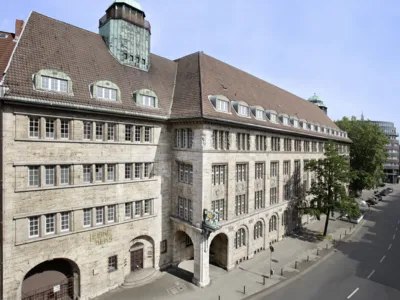
Bahlsen head office
Hermann Bahlsen was born on November 14, 1859, in Hanover. In 1889, he founded the “Hannoversche Cakesfabrik H. Bahlsen.” He wanted to market the “cakes,” which he had first encountered in England, throughout continental Europe. The factory’s most famous product was—and undoubtedly still is—the Leibniz butter cookie. In 1905, Bahlsen became the first manufacturer in Europe to switch to assembly-line production. In 1911 or 1912 (sources are not entirely certain), the word “Keks,” coined by Bahlsen, was finally included in the Duden dictionary and henceforth replaced the English word “cakes.” The former Bahlsen cookie factory now serves as the group’s administrative headquarters and is located at Podbielskistraße 11. Bahlsen died on November 6, 1919, in Hanover.
Gottfried Wilhelm Leibniz
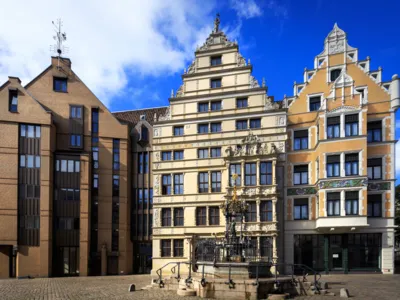
Leibniz House in the historic old town of Hanover.
Gottfried Wilhelm Leibniz was born on June 21, 1646, in Leipzig. In 1676, he moved to Hanover and was appointed court councilor two years later. Leibniz is regarded as the universal mind of his time. His inventions include a calculating machine and the binary system, which forms the basis of modern computers. He also developed infinitesimal calculus. This was the subject of a long-standing dispute, as Sir Isaac Newton is likewise regarded as the inventor of infinitesimal calculus. Research has shown that Leibniz and Newton developed infinitesimal calculus independently of one another and without each other’s knowledge. Leibniz left many traces of his life in Hanover. A detailed list with descriptions can be found here. Leibniz died on November 14, 1716, in Hanover. His grave is located in the Neustadt Court and City Church.
Karl Pollich and Fidelis Böhler
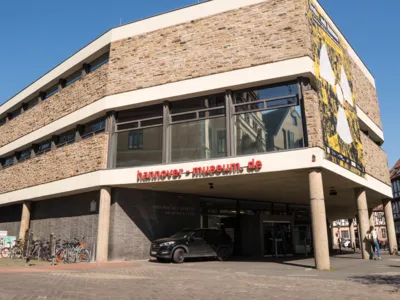
Historical Museum Hanover
Karl Pollich was born on April 7, 1892, in Baisingen, and Fidelis Böhler was born in 1887 in Friedingen (Langenenslingen). Both later became design engineers at Hanomag in Hanover and, in 1925, developed the Hanomag 2/10 PS compact car, which became known as the “Kommissbrot.” What made this small car unique was that it was manufactured entirely on an assembly line. While Opel had already been producing its “Laubfrosch” on an assembly line since 1924, the Hanomag 2/10 PS was the first small car in Germany to be manufactured on an assembly line. An example of the Hanomag 2/10 PS can still be viewed today at the Hannover Historical Museum
Georg Madelung
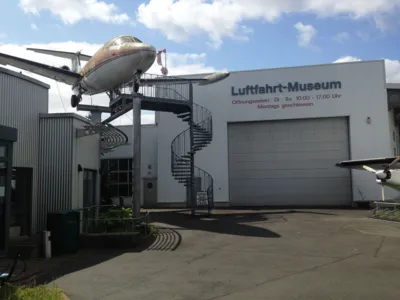
On 3,500 square meters of exhibition space, 38 aircraft, 800 aircraft models and 32 piston engines and jet engines will be on display.
Georg Madelung was born on July 31, 1889, in Rostock. In 1921, he earned his doctorate in mechanical engineering from the Technical University of Hanover. There, he designed a glider that would later become known as the HAWA Vampyr. The aircraft was designed by former World War I pilots Arthur Martens, Fritz Hentzen, and Walter Blume, all of whom were students at the Institute of Aeronautics at the Technical University of Hanover at the time. Under the direction of Hermann Dorner, the aircraft was built at the Hanover Carriage Factory (HAWA). The HAWA Vampyr is considered the forefather of modern gliders. A model of the aircraft is on display at the Laatzen-Hanover Aviation Museum
Franz Kruckenberg
Franz Kruckenberg was born on August 21, 1882, in Uetersen. He was a pioneer of high-speed rail travel. He designed the legendary “Rail Zeppelin,” which was built in 1930 at the Hannover-Leinhausen Railroad Repair Shop. What made this train unique was that it was propelled by a propeller at the rear. On June 21, 1931, the Rail Zeppelin set a world speed record of 230.2 km/h. This record was not broken until 1955. The buildings of the Hannover-Leinhausen Railway Repair Shop, which is no longer in operation, still stand today.
Konrad Dannenberg
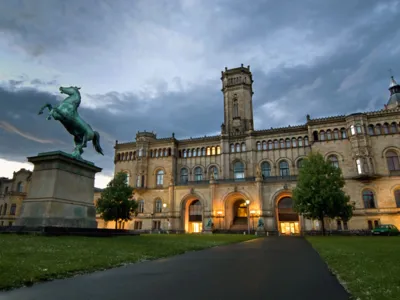
Welfenschloss (Leibniz University) - Photo: Christian Haase (Geocoordinates: 52.381782 9.71782)
The rocket pioneer was born on August 5, 1912, in Weißenfels (Province of Saxony). He earned his high school diploma at the Lutherschule in Hanover. He then studied mechanical engineering at the Technical University of Hanover (now Gottfried Wilhelm Leibniz University). Even then, he was already exploring propulsion technology, among other things. In 1931, Dannenberg became a member of the Society for Rocket Research—Hanover Group (GEFRA), which was founded by Albert Püllenberg. Dannenberg built diesel-powered rocket engines out of bicycle frames. In 1932, he joined the NSDAP, enlisted in the military, and in 1940 joined Walter Thiel’s engine team at the Army Research Center in Peenemünde, where he worked primarily on the propulsion system for the A4 rocket. As part of Operation Overcast, he relocated to the United States in 1945 along with Wernher von Braun and 117 other employees. In the U.S., he became deputy director of development for the Saturn rocket program at NASA. Thus, Dannenberg was involved in the construction of the “moon rocket,” the Saturn V, for the Apollo program.
Elly Beinhorn
The aviation pioneer was born on May 30, 1907, in Hanover. After finishing school, she contacted the Hanover Aeroclub to train as a pilot. However, the club turned her down because, at that time, only men were allowed to become pilots. So she went to Berlin, where she received her pilot training. She initially became a sought-after aerobatic pilot until she completed her first flight to Africa in 1931. In 1932, she flew solo around the world, with Hanover serving as one of her stopovers. This was followed by a second flight to Africa in 1933, a trip to America in 1934, and a record-breaking flight across two continents in 24 hours in 1935. From 1935 to 1939, she undertook further long-distance flights. Beinhorn completed her solo round-the-world flight in 1932 in a single-engine Klemm L 25 D. An aircraft of this type is also on display today at the Laatzen-Hanover Aviation Museum.
Lazar Shargorodsky
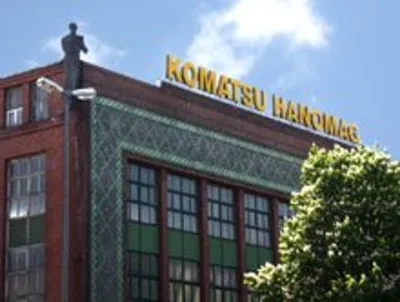
Lettering on the listed Hanomag site
The engineer was born in Odessa in 1882. In Hanover, he became chief engineer at Hanomag, where, among other things, he designed the Hanomag streamlined car in 1939, which set four world speed records for diesel passenger cars that same year. In 1939, Hanomag’s sports director and engineer Karl Haeberle reached 165 kilometers per hour in the vehicle during the Dessau Record Week. Unfortunately, the vehicle was lost amid the turmoil of the war. However, the streamlined car was reconstructed by the Working Group on Technology and Industrial History in the Hanover Region as well as by the Hanomag Interest Group. Since then, the vehicle has been exhibited at select events
Max Valier
The astronomer, writer, and pioneer of rocket technology was born on February 9, 1895, in Bolzano. To bring his rocket plans to fruition, he needed a financier and approached numerous companies and organizations. In 1927, Valier finally secured a financially strong patron in the automotive industrialist, sportsman, and race car driver Fritz von Opel. In 1928, the first tests with rocket-powered rail cars took place on the Isernhagen-Burgwedel railway line (now part of the Hanover region). On August 4, 1928, the tests were halted after the fourth rocket car exploded during a test run. In November, however, the test runs resumed, only this time in Berlin.
Georg Friedrich Grotefend
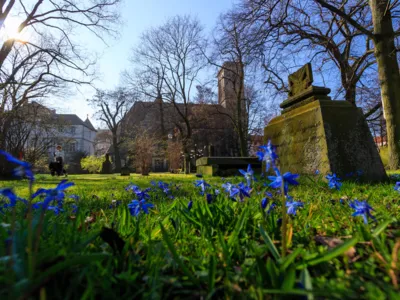
Garden cemetery
Georg Friedrich Grotefend was born on June 9, 1775, in Münden (now Hann. Münden). He studied philology and theology in Göttingen and worked there as an assistant teacher. In 1802, as a result of a bet, he deciphered the first words of a cuneiform inscription. In 1821, he moved to Hanover to become director of the Lyzeum (now the Kaiser-Wilhelm- und Rats Gymnasium) and was made an honorary citizen of the city. He died on December 15, 1853, in Hanover; his grave is located in the Gartenfriedhof. His magnum opus is *New Contributions to the Explanation of Persepolitan Cuneiform*, published in 1837.
Carl Hornemann
The chemist and entrepreneur was born on March 29, 1811, in Hanover. After studying chemistry at the polytechnic schools in Hanover and Munich, he began manufacturing artists’ paints in Groß Munzel in 1838. This marked the founding of Pelikan AG. In 1842, Hornemann moved to his hometown of Hanover and expanded his product line there. The product line included student paints, children’s paints, and artists’ watercolors. One of Pelikan’s innovations was liquid ink, which until then had only been available in stick form. Starting in 1895, the product range was significantly expanded. In addition to ink, the company now also manufactured office supplies. The iron gall ink “4001,” launched in 1898, became the world’s best-selling ink in the years that followed. In 1994, production in Hanover was discontinued and relocated to Peine. The old factory complex is now known as the “Pelikan Quarter” and houses, among other things, restaurants, a hotel, offices, and the Pelikan Ink Tower.
Ilse Knott-ter Meer
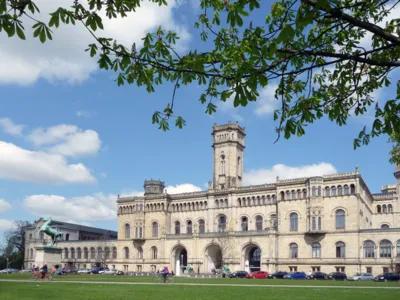
The campus of Leibniz Universität Hannover is located in the heart of the city center
The graduate engineer was born on October 14, 1899, in Hanover. After graduating from high school, she studied mechanical engineering from 1919 to 1922 at the Technical University of Hanover—now known as Gottfried Wilhelm Leibniz University—and from 1922 to 1924 at the Technical University of Munich. In 1924, Ilse ter Meer completed her mechanical engineering degree at the Technical University of Munich. She was thus one of the first two female mechanical engineers in Germany. In 1925, she also became the first female member of the Association of German Engineers (VDI).
Mary Wigman
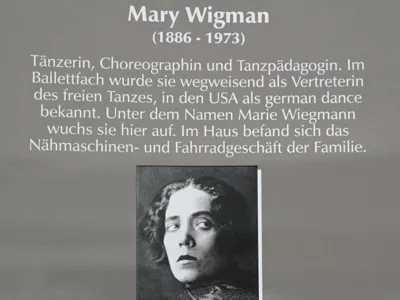
Excerpt from a memorial plaque to Mary Wigman
The dancer, choreographer, and dance educator was born on November 13, 1886, in Hanover. She spent her childhood and part of her youth in Hanover. After living in England, the Netherlands, and Lausanne, she studied rhythmic gymnastics in Hellerau from 1910 to 1911 but dropped out. She subsequently lived in Rome and Berlin. Finally, in 1913, she enrolled in Rudolf von Laban’s School of Art on Monte Verità in Switzerland. Mary Wigman performed her first public dances in Munich. Wigman had her major breakthrough in 1919 with her performances in Hamburg and Dresden. She brought “New German Dance” to international attention and became one of the most influential pioneers of rhythmic-expressive dance. Mary Wigman’s childhood home is located at Schmiedestraße 33 in Hanover.
Ferdinand von Lindemann
The mathematician was born on April 12, 1852, in Hanover. His family home was located at what was then 26 Langestraße, now 13–15 Leibnizufer. He spent the first two years of his life there before the family moved to Schwerin. Von Lindemann studied mathematics in Göttingen. Over the course of his life, he lived and worked in numerous other cities, including Munich, Würzburg, and Freiburg. In 1882, he discovered that it is impossible to square the circle using only a compass and a straightedge. In doing so, he solved one of the oldest problems in mathematics. A commemorative plaque honoring von Lindemann is located in front of the building at Leibnizufer 13–15.
Charles Feltman
Charles Feltman’s real name was Karl Feldmann, and he was born in Hanover in 1841. At the age of 15, the trained baker emigrated to the United States and settled in New York. There, in 1867, he invented the hot dog in its modern form by selling sausages in a bun with sauerkraut from a handcart on Coney Island. Karl Feldmann immediately began calling himself Charles Feltman and became a businessman. The hot dog business boomed, and in 1871 he opened “Feltman’s Restaurant and Beer Garden,” which eventually grew into what was then the world’s largest restaurant complex, featuring nine shops, a beer garden with two bars, and a hotel with a ballroom, bathhouse, and open-air movie theater. In Hanover, too, hot dog stands can be found today—particularly at the numerous folk, street, and neighborhood festivals—but also sporadically throughout the city.
Bulli and Beetle
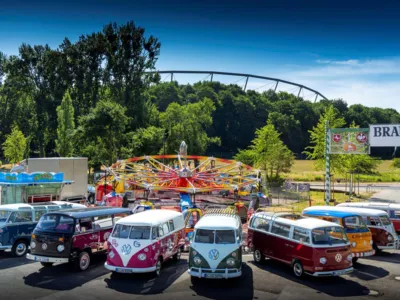
Volkswagen presents itself at the Schützenausmarsch with a Bulli parade.
Even though neither of them is a living, breathing being, no one can deny that both are true icons that have shaped entire generations. The VW Bus, or VW Transporter—known as the “Bulli”—rolled off the assembly line for the first time in Wolfsburg in 1950. In 1956, production of the bus was moved to the VW plant in Hannover-Stöcken, where it is still manufactured today. First came the T1, followed by the T2, T3, T4, and T5/T6 series. You’ll find plenty of Bullis here to rent and admire. Another iconic vehicle is the VW Beetle. It first rolled off the assembly line in Wolfsburg in 1938. From 1974 to 1975, 43,000 Beetles (Type 1) were also produced in Hanover. As early as 1973, a rare special version of the Beetle—the Nordstadt Beetle—was created at the VW dealership in Hannover-Nordstadt. It was a car shaped like a “VW 1303” Beetle but built on the chassis of the Porsche 914/6. A 2.7-liter engine from the Porsche Carrera RS was chosen to power it. The car could accelerate to 100 km/h in just over seven seconds and reached a top speed of nearly 220 km/h. The Beetle has enjoyed cult status ever since the U.S. film and television series featuring the Beetle “Herbie” or the German-Swiss film series featuring the Beetle “Dudu.” Every year on May 1, the Maikäfertreffen takes place at the Messeparkplätze Ost in Hanover; it is the largest VW Beetle gathering in Europe, featuring around 3,000 Beetles and other VW models
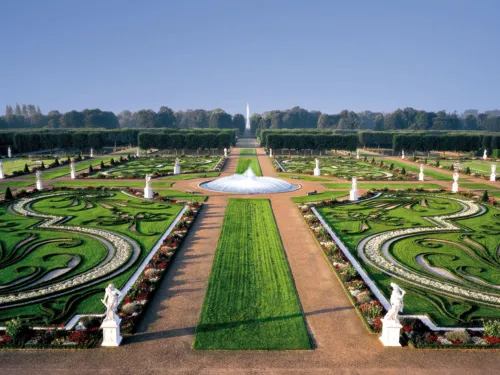
Tourist highlights
Sights
Discover Hannover’s sights, rich in history and full of things to do.
read