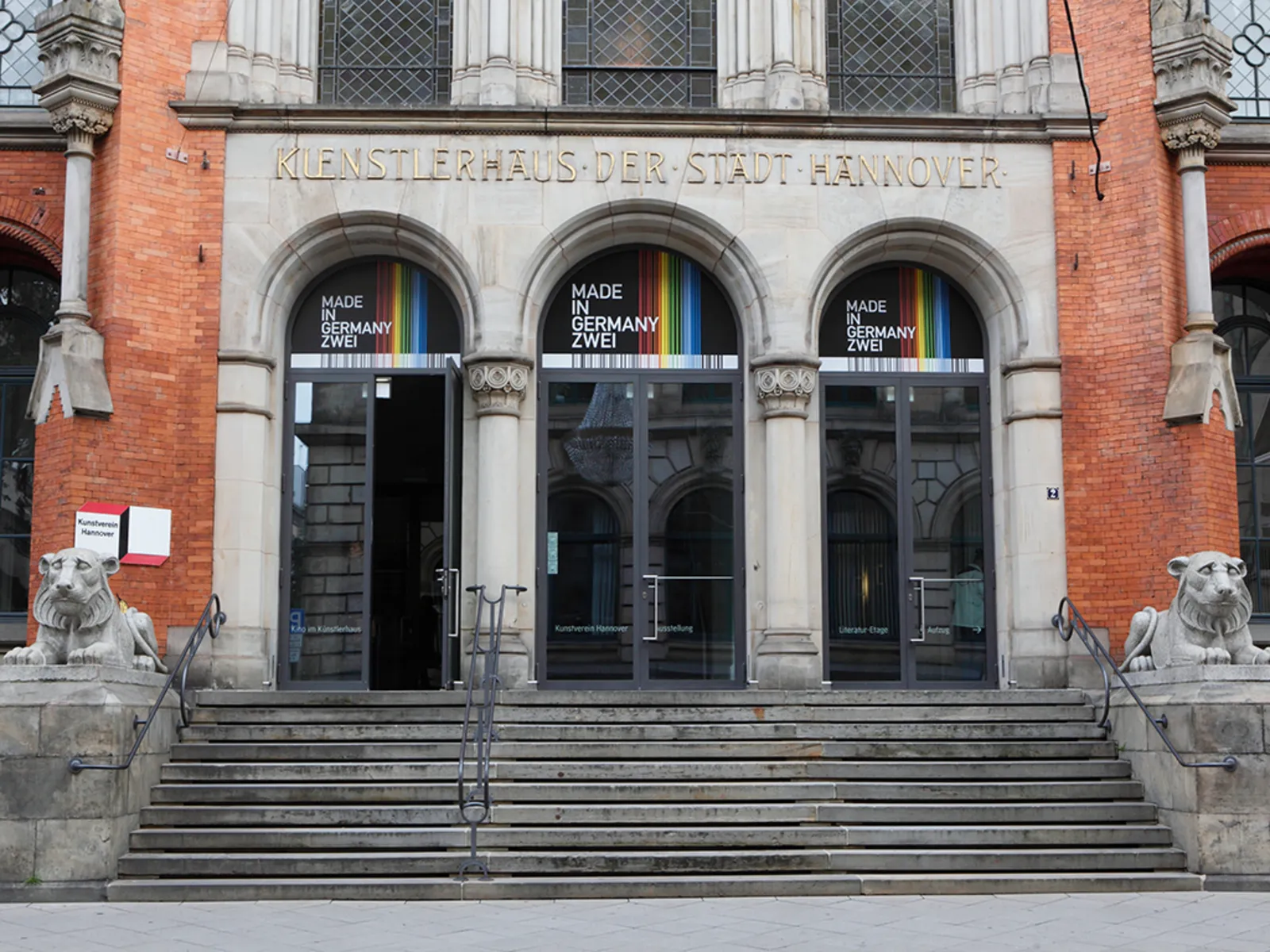
The Künstlerhaus is a dynamic modern cultural venue. Visual arts, film and literature have found their place here.
The Kommunale Kino is located in the Künstlerhaus Hannover
King George V of Hanover laid the cornerstone for today’s Künstlerhaus in 1853. He inaugurated it on February 23, 1856, together with the building’s architect, Conrad Wilhelm Hase (1818–1902)—a figure of great significance in Hanover’s architectural history—and the distinguished art lovers of the former royal capital. Among other features, the exterior façade includes a statue of Gottfried Wilhelm Leibniz.
Initially built as a "Museum of Art and Science", the building is an important example of the "polychrome raw brick building in the round arch style" that prevailed at the time. On this day, the keys were also handed over to all the associations that moved into the building. After more than 150 years, the Kunstverein and Künstlerverein have remained, while new institutions have been added.
Over the years, the building has survived and experienced the destruction of the war and numerous extensions, conversions and additions. With the last conversion, completed in 2001, the architects Pax/Hadamczik/Arndt/Brüning succeeded in largely reconstructing the original architectural concept and at the same time ensuring the conditions for a modern, primarily cultural use.
Today, the imposing, permeable façade made of red brook and grey sandstone continues to characterize the cityscape. The clearly organized spatial structure allows for a variety of uses: Visual arts, film and literature have found a place here with important institutions and their programs, as has the Lower Saxony Foundation as a prominent institution promoting culture.
In close cooperation with the adjacent Schauspielhaus, interdisciplinary projects and festivals are held in the Theaterhof, which is used for cultural and gastronomic events in the summer and completes the image of this lively urban cultural venue.

 Deutsch
 English
 中文
中文
 Danish
 Eesti
Eesti
 Español
 Suomi
Suomi
 Français
 Italiano
 日本語
日本語
 한국
한국
 Nederlands
 Norge
Norge
 Polski
 Portugues
 Русский
 Svenska
 Türkçe
 العربية
 Română
 български