 Deutsch
 English
 中文
中文
 Danish
 Eesti
Eesti
 Español
 Suomi
Suomi
 Français
 Italiano
 日本語
日本語
 한국
한국
 Nederlands
 Norge
Norge
 Polski
 Portugues
 Русский
 Svenska
 Türkçe
 العربية
 Română
 български
Marktkirche, Ballhof, and Half-Timbered Houses
Hanover's Old Town - History & Historic Sites
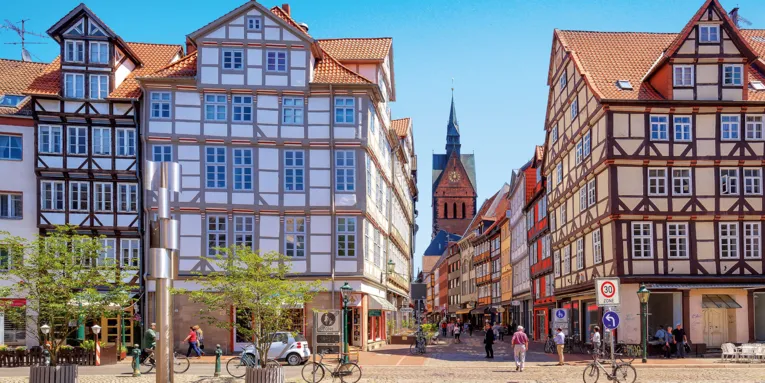
Half-timbered houses in the old town with the market church
Discover idyllic alleyways with inviting cafés and boutiques framed by historic half-timbered facades.
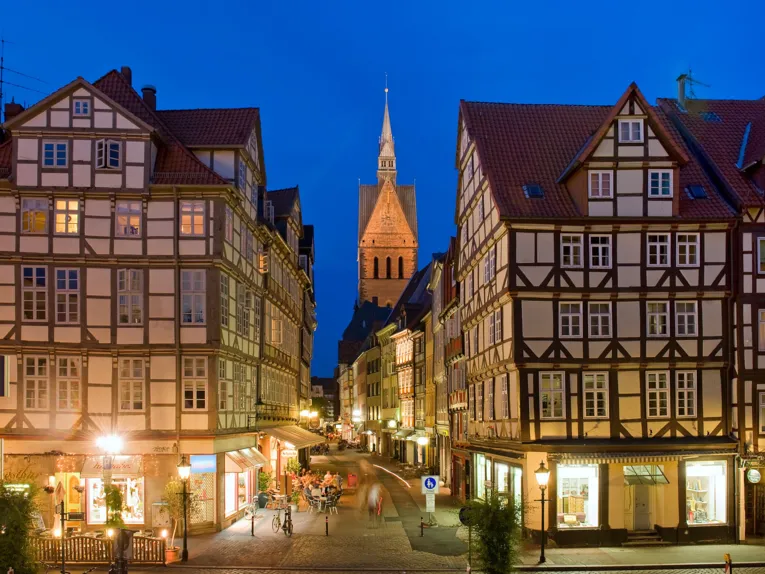
The historic half-timbered buildings in the Old Town are among the city’s most distinctive landmarks and adorn its heart. Here, visitors to Hanover can get a sense of the city’s history.
Around the Marktkirche and Old Town Hall
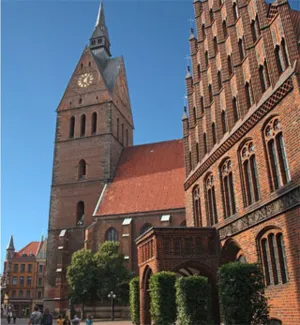
The Market Church and the Old Town Hall.
Hanover once had a large historic downtown area with half-timbered houses and narrow alleys, some of which dated back to the Middle Ages. However, the firestorms of World War II left no more than forty houses standing in the historic downtown. Twelve of these were located in the area around Knochenhauerstraße, Kramerstraße, and Burgstraße alone. In the late 1950s, it was decided to dismantle the remaining half-timbered houses scattered throughout the city and relocate them to this area. This created an old town district centered around the Marktkirche and the Old Town Hall, which, as a historic enclave, offers a good impression of what Hanover’s old town once looked like. Kramerstraße is also one of the city’s most popular shopping and strolling streets.
Wood Market
On Holzmarkt, very close to the Historical Museum, is a detailed replica of the Leibniz House, which was destroyed in the war. The original building was built in 1499 and renovated in 1652. Gottfried Wilhelm Leibniz, probably the city's most famous son, lived in it for many years.
The oldest town house and the oldest church
In the rear Burgstraße you will find the most beautiful and oldest Hanoverian town house from 1566 - with an elaborately decorated Renaissance façade and a rear building that is even two years older. The Kreuzkirche church is very close by. Built in 1333, it is Hanover's oldest church. The altar inside the Gothic church was designed by Lucas Cranach the Elder in 1537. The attached Duve Chapel was built by the Hanoverian merchant family Duve in 1655 after they donated money for the reconstruction of the spire. With its uniform buildings, the Goldener Winkel by the Kreuzkirche is considered one of the most idyllic residential areas in the city.
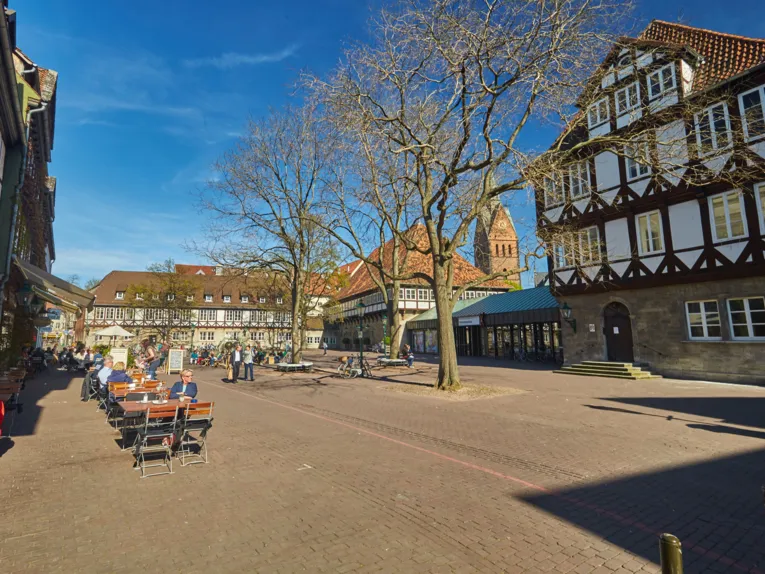
Ballhofplatz
Ballhofplatz
Crossing Kreuzstraße brings you to Ballhofplatz. Built between 1649 and 1664, the Ballhof was originally a sports hall where the court could play badminton in all kinds of weather. It later became a meeting hall and is now used as the venue for the Junges Schauspiel Hannover. The Ballhof is the most beautiful secular building in Hanover.
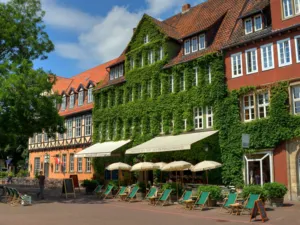
Ballhofplatz
The square of the same name with its fountain is considered one of the most tranquil places in the old town. Here you will find cafés, bars and restaurants with numerous outdoor seating areas from which you can enjoy the view of the beautiful square - or of the water feature with the three hollow spheres in the Ballhof fountain, which was created by Munich sculptor Helmut Otto Schön in 1975. Ballhofplatz also becomes a stage for jazz and tango several times a year.
Leineschloss: seat of the Lower Saxony state parliament
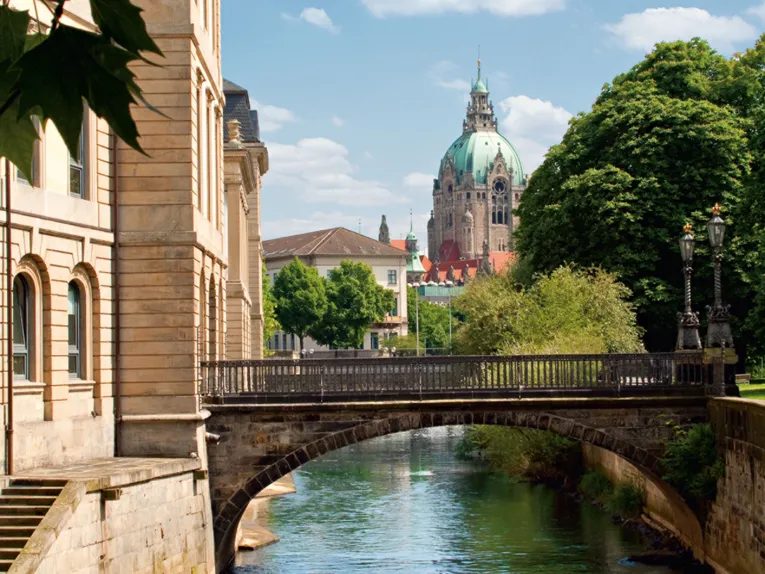
Discover beautiful Hanover!
Leineschloss, now the seat of the Lower Saxony State Parliament and formerly a royal residence, traces its origins to a Franciscan monastery founded in the 12th century, which was dissolved in 1533. After the Duke of Calenberg chose Hanover as his residence in 1636, the northwest wing of the palace was renovated in 1742. The remaining parts are based on designs by the architect Georg Friedrich Laves, who was very active in Hanover and completely rebuilt the palace between 1816 and 1844.
This also includes the representative neoclassical portico on Leinstraße with six Corinthian columns and a flat triangular gable bearing the coat of arms of the state of Lower Saxony. With its three storeys and mansard roof, the Leineside of the castle has a more baroque appearance. After being destroyed in the Second World War, the Leineschloss was rebuilt between 1956 and 1962 and the south wing was replaced by a modern plenary hall extension.