 Deutsch
 English
 中文
中文
 Danish
 Eesti
Eesti
 Español
 Suomi
Suomi
 Français
 Italiano
 日本語
日本語
 한국
한국
 Nederlands
 Norge
Norge
 Polski
 Portugues
 Русский
 Svenska
 Türkçe
 العربية
 Română
 български
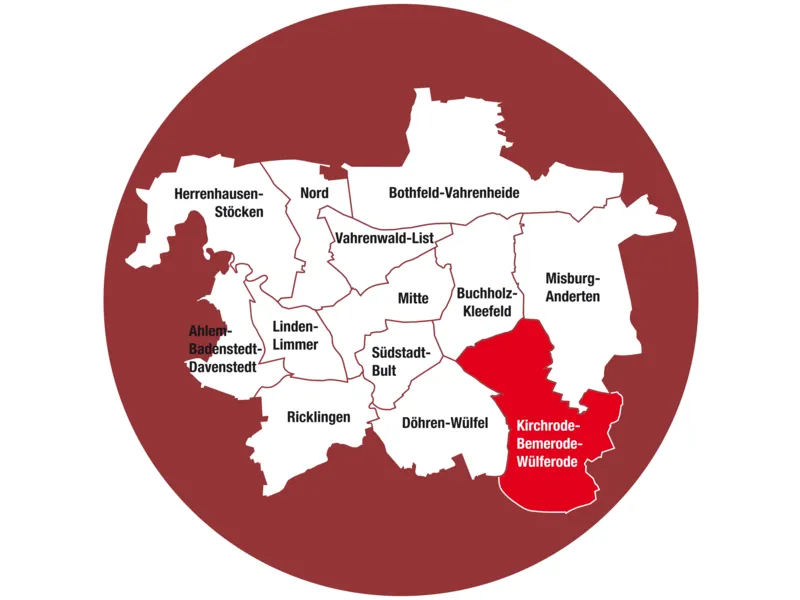
Kirchrode-Bemerode-Wülferode
Thanks to the greenery of the Eilenriede and the Tiergarten, Kirchrode, located in eastern Hanover, developed into a sought-after residential neighborhood—alongside Kleefeld, Waldhausen, and the Zooviertel.
It all began in 1897 with the construction of the Kühlshausen villa colony on Kaiser-Wilhelm-Straße. Little remains of the old village on Brabeckstraße and Kirchröder Markt; only the Henriettenstiftung complex on Schwemannstraße, which was developed from 1874 for the Alt-Bethesda nursing home and later as a clinic area, has early brick buildings. Bemerode remained village-like for longer. This was later followed by a few workers' houses and, in the 20th century, expansion to the north and finally, since 1997, the Kronsbergsiedlung.
Kühlshausen colony
775 Years - Discover Your Hannover
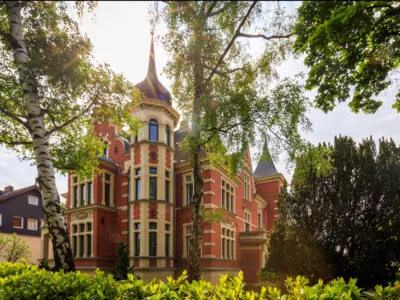
In 1897, the dog biscuit manufacturer and building contractor Johannes Kühl acquired the plot "Am Hüllenfelde", laid out Kaiser-Wilhelm-Straße as an avenue of lime trees and initially had six villas built. The colony was nicknamed "Kühlshausen". The villas at Kaiser-Wilhelm-Str. 1 and 2 exemplify the ideal of the detached, prestigious villa in the countryside in the German Empire. Kühl himself lived in the stately "Villa Fernblick", which was built in 1900. Further buildings followed and by 1913 the row was completely built up.
Address:Kaiser-Wilhelm-Straße, 30559 Hanover
Heinemanhof
775 Years - Discover Your Hannover
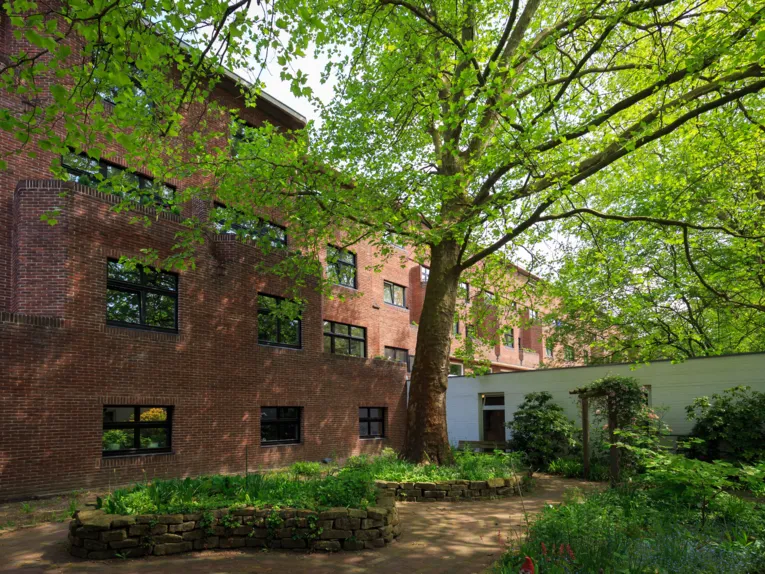
The gate buildings at Brabeckstr. 86 form the prelude to today's Heinemanhof 1-2 nursing home for the elderly in the south of Kirchrode. The former ladies' home of the Minna-James-Heinemanstiftung, which was built according to plans by Henry van de Velde in 1930-31, was intended for single ladies of the educated classes, preferably Hanoverians of Jewish faith.
Van de Velde was one of the most important architects of Art Nouveau. The architecture is in the tradition of the Amsterdam School: while the flat, austere north side is closed off like a block, the south side opens up with balconies, bay windows and terraces onto the park, which van de Velde planned together with the garden architect Wilhelm Hübotter and which interacts strongly with the building. Architecture and nature form a unity.
Address:Heinemanhof 1, 30559 Hanover