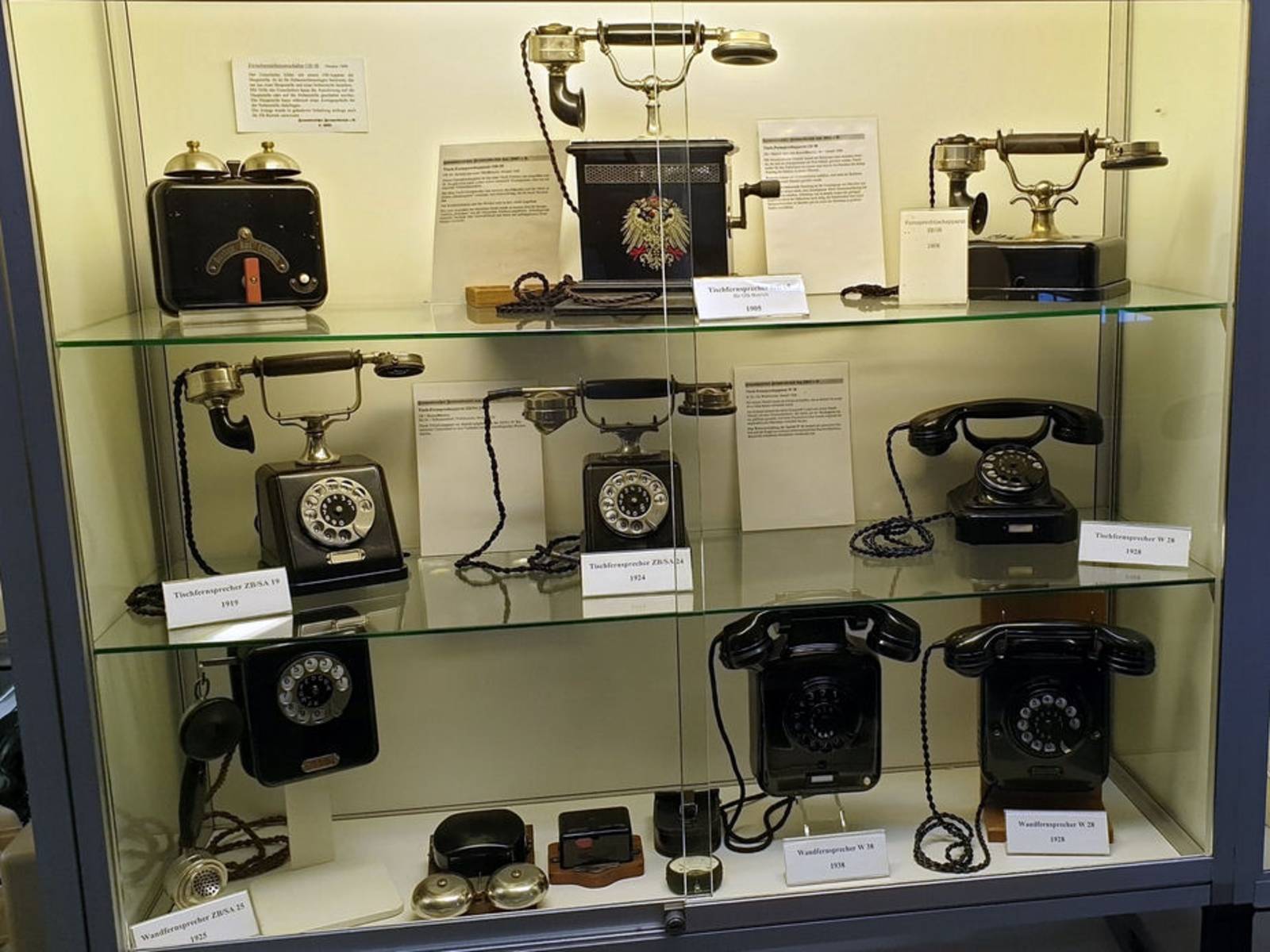
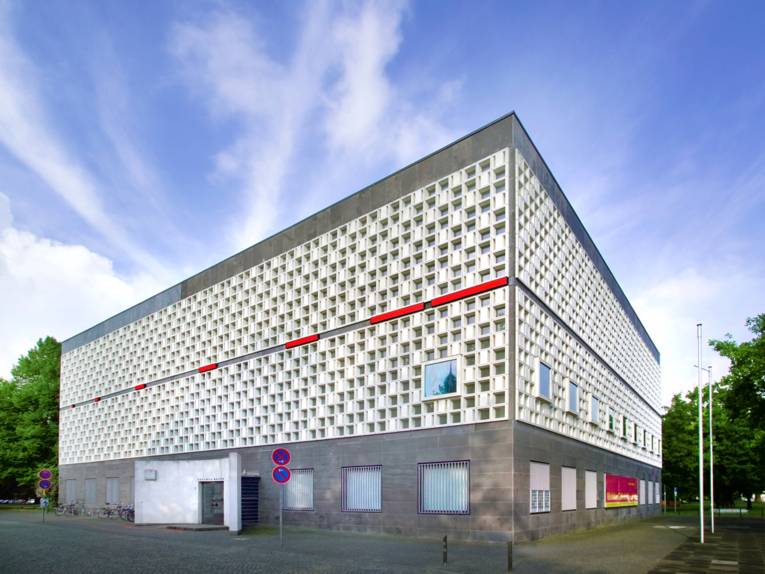
The museum is divided into sections covering the history of telegraphy, switching and line technology (i.e., the technology used to connect users to the end customer), as well as noise suppression and microwave radio technology. Of course, there are also telephones on display, which visitors are welcome to try out. Exhibits from the fields of microwave radio technology, as well as commercial and amateur radio, are also planned. To make the new museum a reality, the Hannoversche Telecommunications Club worked closely with the sponsoring association of the Tram Museum. After years of preparation, the exhibition is now open to visitors.
Highlights of the permanent exhibition
A highlight of the permanent exhibition is a replica of a “Gauss-Weber telegraph” from 1833—a model of which, according to the Telecommunications Club, only five exist in this country. The museum also features extremely rare replicas of the first commercially used telephones by Philipp Reis and Alexander Graham Bell, the originals of which were created around 1870. In terms of switching technology, a large local exchange—comprising components from several eras and interconnected in a functional manner—is particularly noteworthy. Its oldest components date back to the early 1820s and are still operational in the exhibition.
Germany's last manual switching console
While large switching centers, with their loud, clattering rotary dials, may seem rather confusing to the layperson, there is a simpler—and above all, quieter—alternative. According to the Tram Museum, Germany’s last manual switching console, which was not replaced by an automatic local exchange in Uetze until April 1966, is on display here in the museum. The last "telephone operator" had served the entire Uetze local network—which at the time had 374 subscribers—in this manner. The museum only touches briefly on modern digital technology and smartphones. However, the exhibition aims to illustrate the long journey to this point for everyone through the first, still rather bulky, mobile phones.
Huge collection and workshops on the museum grounds
Thousands more exhibits and countless spare parts are housed on several hundred meters of shelving in the vast storage area, which spans approximately 600 square meters. The museum also features a fairly extensive specialized library, a small theater, and several break rooms. The workshops are also housed here, as all the equipment on display is restored to working order so that visitors can see everything in operation.
Arrival by historic streetcar
The opening hours of the streetcar and telecommunications museums are coordinated. Both museums are open from the beginning of April to the end of October on all Sundays and public holidays between 11 a.m. and 5 p.m. and then take a winter break lasting several months. In addition to the entrance fee for the streetcar museum, there is an additional charge of €2.00 for adults and €1.00 for children. This can be paid either when entering the museum grounds or later, at the entrance to the telecommunications museum. You can travel to the museum grounds on one of the historic streetcars on the regularly operated circular route. The conductor will announce when you get off at the "Hohenfels-Süd" stop. The time for the return journey can be freely chosen.
Further information can be found on the Homepage of the Hanover Telecommunications Club
Source: Hanover Tram Museum / Hanover Telecommunications Club

 Deutsch
 English
 中文
中文
 Danish
 Eesti
Eesti
 Español
 Suomi
Suomi
 Français
 Italiano
 日本語
日本語
 한국
한국
 Nederlands
 Norge
Norge
 Polski
 Portugues
 Русский
 Svenska
 Türkçe
 العربية
 Romanesc
 български