 Deutsch
 English
 中文
中文
 Danish
 Eesti
Eesti
 Español
 Suomi
Suomi
 Français
 Italiano
 日本語
日本語
 한국
한국
 Nederlands
 Norge
Norge
 Polski
 Portugues
 Русский
 Svenska
 Türkçe
 العربية
 Romanesc
 български
Region Hannover and HMTG Publish a Brochure
More guests, more overnight stays: Tourism as an economic factor
The Hannover Region Economic Development Agency and Hannover Marketing & Tourismus GmbH (HMTG) have published the brochure “Tourism as an Economic Factor in the Hannover Region,” thereby highlighting the importance of the tourism industry to the Hannover Region.
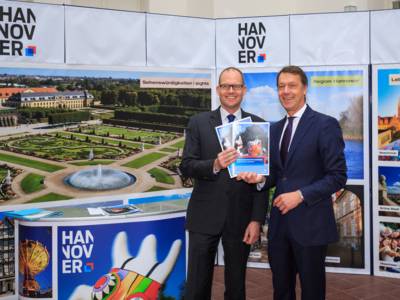
Ulf-Birger Franz (Director of Economic Affairs for the Hannover Region) and Hans Christian Nolte (Managing Director of HMTG, from left).
The city is aglow, the air is filled with the scent of mulled wine, and the region’s Christmas markets draw visitors from all over northern Germany. With net revenue of 2.3 billion euros last year, tourism is one of the most significant economic drivers in the Hanover region. The Hannover Region Economic Development Agency and Hannover Marketing & Tourismus GmbH (HMTG) published the brochure “Tourism as an Economic Factor in the Hannover Region” today (December 16, 2015), thereby highlighting the importance of the tourism industry for the Hannover region.
“The steady growth in trade shows and conventions, as well as in city tourism, clearly demonstrates that tourism is one of the most successful economic drivers in the Hanover region,” says Hans Christian Nolte, managing director of HMTG.
The figures
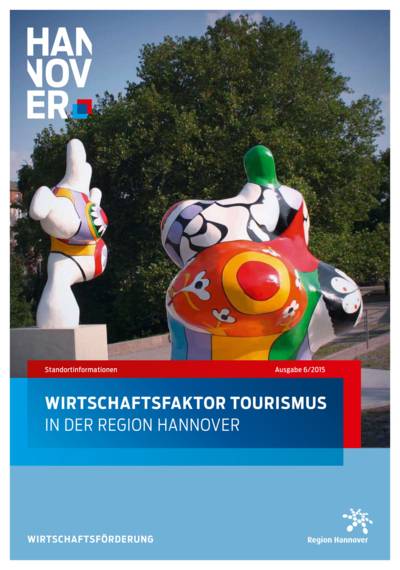
Download: Brochure (PDF)
The figures are impressive: On average, a guest in the Hanover region spends 41.10 euros per day and stays for 1.9 days. The hotel industry recorded 2.96 million commercial overnight stays, inns and bed-and-breakfasts 230,000, youth hostels, training and vacation centers, and rehabilitation clinics 360,000, and campgrounds 140,000. With 1.61 million overnight stays, the surrounding municipalities alone recorded more overnight stays than major cities such as Bremen, Essen, Dortmund, or Bonn. The state capital itself, with 2.08 million overnight stays in 2014, solidified its position as the city with the highest number of overnight stays in Lower Saxony.
“The diversity of cultural offerings—including music, theater, and the visual arts—as well as sporting events, recreational attractions, and shopping opportunities are driving the rise in tourism numbers,” says Ulf-Birger Franz, head of the Economic Affairs Department for the Hannover Region.
Over the past ten years, the number of overnight stays in the state capital has risen by 56 percent, and in the Hanover region by 54 percent. “With an annual increase in overnight stays of around four percent, Hanover is on par with cities like Leipzig and Nuremberg and even ahead of Cologne and Stuttgart,” says Franz. “The Hanover region offers a great deal of potential, especially for the growing number of young budget travelers.” Off the beaten path, both Hannover—an international university city—and its proximity to regional oases make it a worthwhile destination: wakeboarding on the Blauer See near Garbsen, for example, or a shopping trip through the small, owner-operated shops in Linden,” says Nolte.
The retail sector benefits the most from tourism: 43.6 percent (1.1 billion euros) of total sales in the Hannover region are generated by tourists in the retail sector, followed by the restaurant and hospitality industry (24.6 percent / 643.8 million euros) and leisure and entertainment (12.2 percent / 318.5 million euros).
Added value
Visitors' spending benefits more than just the retail and restaurant sectors: About 30 percent of net sales is converted into income for employees (value-added ratio). The value-added ratio is a reliable indicator for measuring the productivity of tourism services and for determining the wages and salaries of employees in tourism businesses as well as expenditures on intermediate inputs. Linking the value-added ratio to the net revenue of 1.75 billion euros in the state capital yields direct income from the tourism industry totaling 522 million euros. In purely mathematical terms, 37,791 people in Hanover can earn their living through tourism—this figure is derived from the tourism-related income equivalent, which is calculated based on the total tourism income and the average per capita primary income.
Foreign demand
“We see great potential, particularly among international guests, that we need to capitalize on,” says Franz, looking ahead to the coming years. “To achieve an increase in international arrivals and overnight stays, we need a joint effort by the business community and the tourism sector.” To intensify marketing efforts abroad, the HMTG is working closely with the “Magic Cities” marketing association of the German National Tourist Board. “The report once again demonstrates the economic power of tourism and, by extension, the importance and appeal of the Hanover region for tourism in the state of Lower Saxony,” says Nolte, offering a positive assessment.
The brochure
dwif-Consulting GmbH was commissioned by the Hannover Region to analyze the economic significance of the tourism industry. The study examined tourism demand, visitor spending at their destination, tourism revenue, benefiting sectors, as well as income and tax effects. The brochure “Tourism as an Economic Factor in the Hannover Region” can be requested by phone at (0511) 616 23 318 and is available for download here.
Download:
Contact:
Lennart Heise
, Region Hannover
Economic Development
Team Phone: +49 (0) 511 616 23238
lennart.heise@region-hannover.de