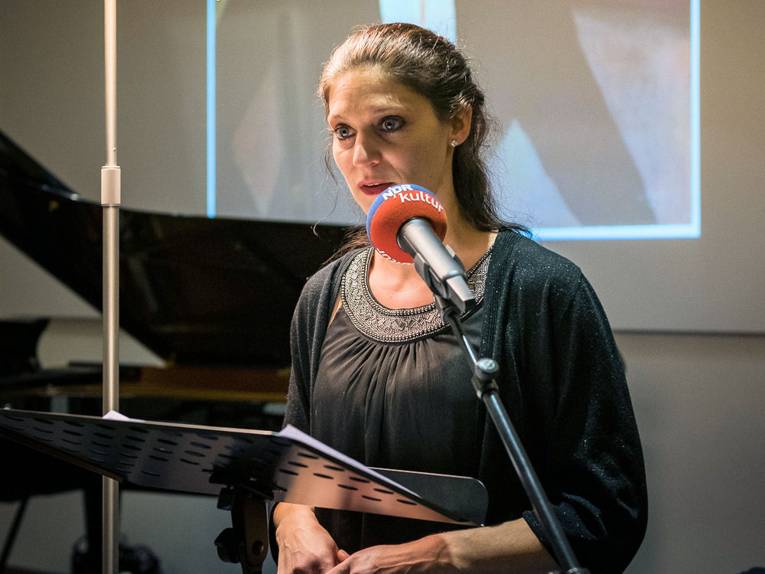
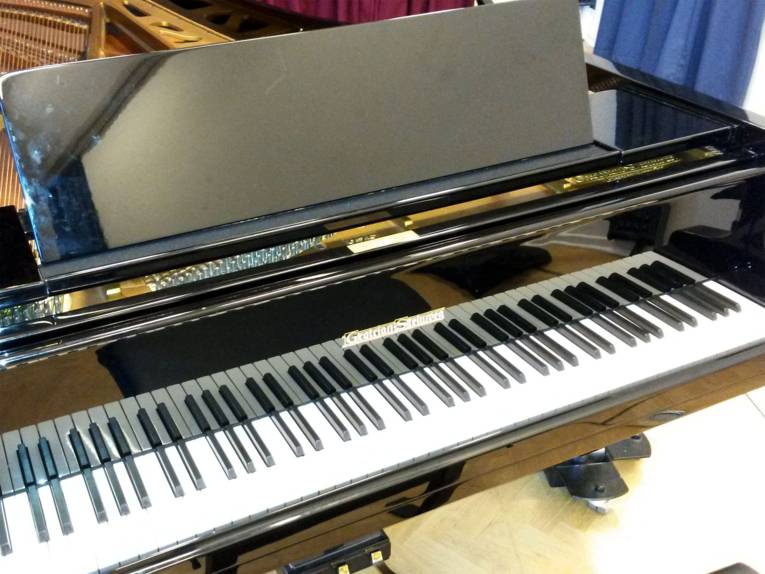
Each "Blue Hour" event centers on a work of art from the Sprengel Museum, whose theme is explored musically and literarily through the performed pieces and readings. Tickets grant free admission to the Sprengel Museum two hours before the concert begins. The "Blue Hour" series is a collaboration between the NDR Radio Philharmonic and NDR Kultur with the Sprengel Museum Hannover.
March 17 and 18: Dancing
A work by Jan Bach, a student of Copland who passed away in 2020, sets the tone: “Rounds and Dances” for brass quintet. Charm and wit—these terms best characterize Bach’s compositional style. This piece is no exception: it combines the sarabande and gallop with South American rhythms, brilliant solo passages with time-honored fugue techniques, and, right at the very end, Signore Rossini makes a guest appearance.
The other pieces are sure to set hearts racing—and not just those of brass fans: the highly virtuosic “Fire Dance” by Emmy Award winner Anthony DiLorenzo, as well as Brandon Ridenour’s cleverly shady “Killer Tango.” And last but not least, the “Dance Suite,” which Leonard Bernstein wrote shortly before his death: a wonderfully laconic piece, with ironic jabs not only at music history but also at politics and bad TV shows.
Interpreters
NDR Philharmonic Brass:
Stefan Schultz, trumpet
; Alexander Mayr, trumpet
; Ivo Dudler, French horn
; Emil Haderer, trombone
; Peter Stadlhofer, tuba
; Sonja Beißwenger, narrator
Program
Anthony DiLorenzo
Fire Dance
Jan Bach
Rounds and Dances
Leonard Bernstein
Dance Suite
Brandon Ridenour
Killer Tango
June 23 and 24: Paris
It’s a shame that time is so limited! Still, it’s enough for brief stopovers, just like on a proper stroll through the city: sometimes the flute converses with a string instrument, and sometimes the strings stick to their own. The fact that some of the pieces were not composed by Frenchmen at all, but by immigrants from Switzerland (Honegger), Russia (Lourié), and the Czech Republic (Martinů), is typical: as the world capital of music, Paris benefited from its creative guests just as much as they benefited from it.
Even musicians from the north and south of the country, such as Roussel and Milhaud, could not resist the pull emanating from the metropolis on the Seine. But of course, the program also features music by “true” Parisians: Impressionist works by Claude Debussy, for example, along with more recent pieces such as Guillaume Connesson’s lively Toccata and the dreamy “Océane” by Jérôme Naulais. And the fact that the evening concludes with a chanson by Edith Piaf, the “Sparrow of Paris”—c’est clair, mesdames et messieurs!
Interpreters
Christoph Renz, flute
; Catherine Myerscough, violin
; Carlos Campos Medina, viola
; Nikolai Schneider, cello
; Sonja Beißwenger, narrator
Program
Arthur Honegger
III. Allegro from: Sonatina for Violin and Cello, H. 80
Arthur Vincent Lourié
Adagio No. 2 and Presto No. 2 from: "La flûte à travers le violon"
Albert Roussel
I. Allegro grazioso from: Trio, Op. 40
Bohuslav Martinů
I. Andante from: String Trio No. 1, H. 136
Guillaume Connesson
Toccata and Nocturne
Jérôme Naulais
"Océane"
Darius Milhaud
II. Sérénade from: String Trio, Op. 274
Claude Debussy
Sections I–III from: Six Ancient Epigraphs
Édith Piaf/Louiguy
"Life in Rose-Colored Glasses"
Blue Hour in the Small Broadcasting Hall
 Deutsch
 English
 中文
中文
 Danish
 Eesti
Eesti
 Español
 Suomi
Suomi
 Français
 Italiano
 日本語
日本語
 한국
한국
 Nederlands
 Norge
Norge
 Polski
 Portugues
 Русский
 Svenska
 Türkçe
 العربية
 Romanesc
 български