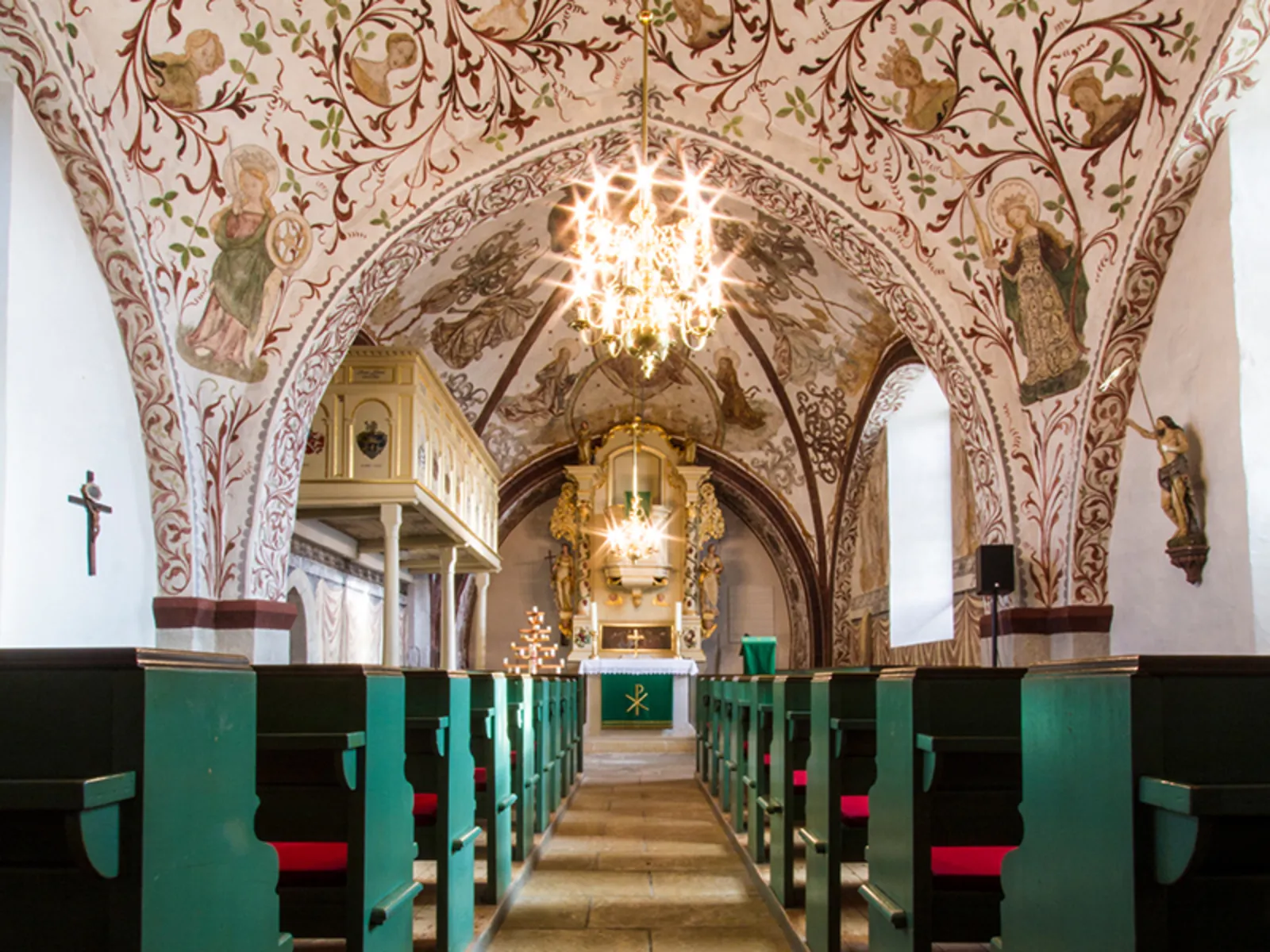
As one of the oldest settlements in the Calenberger Land region, the town once lay along the Hellweg, a trade route from the Rhine to the Elbe. A mighty moated castle protected Leveste.
St. Agatha Church, built in 1229, celebrates its 788th anniversary in 2017. It was constructed in the transitional style of the first half of the 13th century. The Gothic frescoes in the choir and the organ vault date from the 15th century, while the frescoes in the nave are dated to the period between 1370 and 1430. Anyone looking up at the church’s vaulted ceiling will see four holy martyrs with their retinue. In the choir, one gets a sense of the Christian worldview of that time and its clear dualism between heaven and hell, as well as Christ as the savior of the world. The Neoclassical organ facade was also a gift from Baron Wilhelm Knigge in 1808.
The illustrations were later painted over with white paint. Thanks to this overpainting, the works of art have been largely preserved in their original state. In 1924, the overpainted frescoes were discovered and uncovered. Today, the portraits are of great importance to scientists, film directors, actors and costume designers because they faithfully reproduce the fashion of the period around 1400.
See and be amazed is the motto here.

 Deutsch
 English
 中文
中文
 Danish
 Eesti
Eesti
 Español
 Suomi
Suomi
 Français
 Italiano
 日本語
日本語
 한국
한국
 Nederlands
 Norge
Norge
 Polski
 Portugues
 Русский
 Svenska
 Türkçe
 العربية
 Română
 български