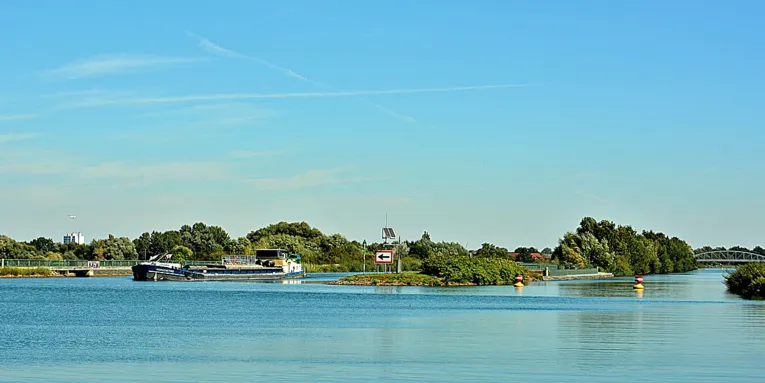
Over a wide trough bridge at the waterway crossing, which is well worth seeing, the large freighters can leisurely sail across the country on Hanover's "Canale Grande", while day-trippers paddle leisurely through the greenery on the Blue below.
The bridge for ships
On the trough bridge, painted lime green, the Mittelland Canal (at 325.3 kilometers, Germany’s longest man-made waterway) splits into two “lanes”—namely, the so-called “Alte Fahrt” and the “Neue Fahrt.” In fact, the riveted steel-girder bridge, resting on angular natural-stone piers, consists of two separate structures built in different eras. The trough bridge over the 24-meter-wide, 3-meter-deep, and now-defunct “Alte Fahrt” was put into service in 1917; with its Art Nouveau-style railing, it faces east, is a designated historic landmark, and is now used only as a detour route during inspection and maintenance work on the new canal sections. Its neighbor, the trough bridge spanning the “Neue Fahrt”—which, at 55 meters, is significantly wider and 4 meters deep—is the Leine flood control bridge; it was built in the 1980s and 1990s when the Mittelland Canal had to be expanded to accommodate increasingly wider cargo ships due to higher shipping traffic.
Cycling along the waterway
For day-trippers, the impressive pair of bridges—one above and one below the water—is particularly appealing, as a section of the 333-kilometer-long Leine Bike Path runs along the Mittelland Canal to Garbsen on the old trough bridge. It’s worth cycling down from the embankment (which, by the way, is also ideal for short walks with your dog) along the paved path to the banks of the Leine, right beneath the two trough bridges: only up close can you truly appreciate the imposing steel structures that must bear the full weight of the canal water and the ships. By the way: you can see the flood marks on the left side of the masonry. If you’d like, you can cycle back up to the canal via the “Neue Fahrt” section and continue eastward to the “Alter Hafen” boat landing in Garbsen.

 Deutsch
 English
 中文
中文
 Danish
 Eesti
Eesti
 Español
 Suomi
Suomi
 Français
 Italiano
 日本語
日本語
 한국
한국
 Nederlands
 Norge
Norge
 Polski
 Portugues
 Русский
 Svenska
 Türkçe
 العربية
 Română
 български