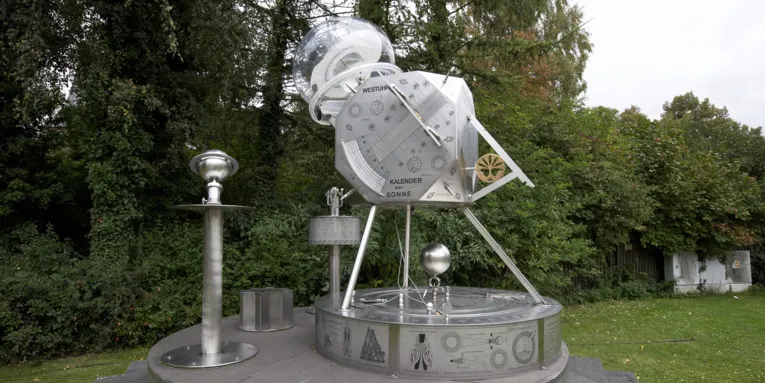
Time monument - sundial
A sundial has been on display in Wennigsen (Deister) for some time now. This time monument was created by master precision engineer Erich Pollähne to mark his 80th birthday and his 25 years of work with sundials. All metal parts of the structure are made of stainless steel; the designs are etched and black chrome-plated, and the basalt stones are built to last a very long time. The sundial consists of a base plate featuring a cross-shaped cover plate. It depicts the stone engraving from Bornholm showing the Germanic people’s sixteen-part calendar. The base plate is fitted with a stainless steel frame. This frame features 18 images depicting the history of timekeeping and astronomy up to the present day, including the moon landing and Neil Armstrong’s “small step.” The top plate of the sundial base features, at its center, a view of the Earth with the Southern Hemisphere fanning out. The Platonic cube (south face) displays the main clock. The horizontal clock is arranged on top of the cube (upper side). It displays the Babylonian and Italian hours. The equatorial clock, made of acrylic glass, is oriented parallel to the Earth’s axis, just like the south base of the cube. Here, it is possible to read both standard time and daylight saving time in CET.
Double helix - spiral of life
Long before our era, the single spiral was revered as a symbol of life. The new form, conceived as a double spiral by Hugo Kükelhaus—a craftsman-philosopher—is reminiscent of the DNA helix that carries our genetic material; however, it winds in opposite directions. It demonstrates the unity of opposites; it has no beginning and no end. It symbolizes life, physical decay, but also resurrection or rebirth. Here, in the center of town, it stands for all of us. Take your time to follow the path of the spiral’s connections. Despite the traffic, a sense of calm will come over you at this spot. The harmonious reversal of the coils reveals the eternal cycle. Ascent and descent occur in a single movement—the unity of opposites—even though every point on the spiral moves only in a single plane. The Wennigsen symbol at the tip of the spiral reveals another phenomenon. The crisscrossing of the symbol creates a pulsation through its expansion, representing breathing and a heartbeat. The elliptical shape alternates against the sky with the full circular disc. If you stand with your back to the sun and look at the disc, the cross symbol emits flashes of light corresponding to four times the number of turns in the spiral, which are themselves visible on the ground. No other man-made structure has combined as much meaning and significance as the engraved field disc.
 Deutsch
 English
 中文
中文
 Danish
 Eesti
Eesti
 Español
 Suomi
Suomi
 Français
 Italiano
 日本語
日本語
 한국
한국
 Nederlands
 Norge
Norge
 Polski
 Portugues
 Русский
 Svenska
 Türkçe
 العربية
 Română
 български