 Deutsch
 English
 中文
中文
 Danish
 Eesti
Eesti
 Español
 Suomi
Suomi
 Français
 Italiano
 日本語
日本語
 한국
한국
 Nederlands
 Norge
Norge
 Polski
 Portugues
 Русский
 Svenska
 Türkçe
 العربية
 Română
 български
Hanoverian specialties
Beer from Hanover
Hanover’s brewers can look back on a tradition dating back several centuries. As early as 1526, Cord Broyhan, who was born in Stöcken, invented a light, top-fermented beer that is known today throughout the world—along with a glass of Korn—as Hanover’s iconic drink, “Lüttje Lage.” Twenty years later, in 1546, he founded the Brewers’ Guild together with other master brewers; this guild later became the Gilde Brewery in the Südstadt district. Hanover’s second major brewery, the Herrenhausen Private Brewery, has been brewing its beer in the northwest of the city since 1868, very close to the world-famous Herrenhausen Gardens.
Other traditional breweries, such as the Lindener Aktien-Brauerei, founded in 1853; the Kaiser-Brauerei, which opened in Ricklingen in 1889; and the Lagerbier-Brauerei-Wülfel, established in 1906, eventually had to shut down their taps and are now a thing of the past. Hannover’s pub breweries, on the other hand, are very much alive and well—such as the Brauhaus Ernst-August on the edge of the Old Town or Meiers Lebenslust at Aegi. And then there’s the craft beer brewery Mashsee: young and bursting with creativity when it comes to artisanal specialty beers.
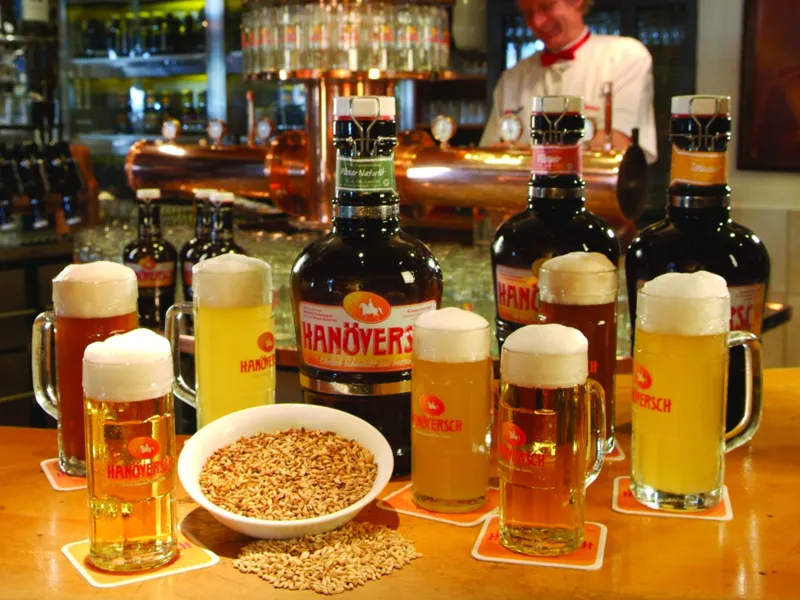
The Art of Brewing at the Ernst August Brewery—A Hannover Tradition
Liquid Gold Made in Hanover
The Gilde Brewery, located not far from Lake Maschsee in the southern part of the city, is the city’s largest and oldest brewery. The trademark of this brewery, founded in 1546, is the so-called “Broyhan-Taler”; this circular emblem featuring a white rooster on a red background was once the seal of quality for the beer produced by the Hanover Brewers’ Guild. Today, in the imposing brewhouse on the company grounds on Hildesheimer Straße, the following beers—which are extremely popular not only in Hanover—are brewed: Gilde Ratskeller Premium Pils (the traditional beer with a perfectly rounded hop note), Gilde Pilsener (a spicy Pilsner with a light hoppy note and pleasant freshness), and Lindener Spezial (a bottom-fermented, golden-yellow full-bodied beer with a pronounced hoppy note)—all of which are extremely popular not only in Hanover—are brewed today.
The Herrenhausen private brewery brews seven beers under the emblem of the white Lower Saxon steed on a red coat of arms: Herrenhäuser Premium Pilsener (this delicately tart Pilsner is also known in Hanover as “Herri” and is brewed according to the Pilsner style using water from the brewery’s own well), Herrenhäuser Alsterwasser, Herrenhäuser Icebeer (a particularly mild beer produced using a special brewing process in which the hops are frozen to minus 3° C to bind the bitter compounds to ice crystals, which are then filtered out), Herrenhäuser Weizenbier (the first wheat beer in Northern Germany) and Herrenhäuser Spezial (a mild and quite smooth Pilsner), as well as Lüttje Lagen (a top-fermented draft beer traditionally served with a shot of grain schnapps) and Hannoversches Festbier, which is available only fresh on tap and exclusively during the Oktoberfest in Hanover.
Beer has been brewed at the Ernst-August Brewery on the outskirts of the Old Town since 1986 and served fresh from the tap at the attached pub. Among the house brands—which have been produced exclusively from organic-quality German ingredients for over 20 years—are the naturally cloudy Hanöversch Pilsener, Hanöversch Organic Wheat Beer, Hanöversch Pale Ale (a refreshingly fruity beer with notes of lemon, mandarin, and grapefruit), Hanöversch Roter Saphir (a naturally cloudy, top-fermented red beer) and Hanöversch Lüttje Lage (a bottom-fermented draft beer traditionally enjoyed alongside a glass of schnapps), as well as the seasonal specialties Hanöversch Mai-Bock (a naturally cloudy strong beer with a delicate hop flavor), Hanöversch Fest-Bier (an amber-colored Märzen with a smooth malty character, served exclusively at the Hannover Schützenfest in the summer), and Hanöversch Winter (a Schwarzbier with a subtly smoky flavor, brewed only from October through February).
The brewhouse of the small craft brewery Meiers Lebenslust am Aegi, founded in the summer of 2012, is located right in the middle of the restaurant. Through a small window in the floor, guests can look directly down into the basement below, where the craft-brewed beers—Meiers Helles, Meiers Dunkel, and Meiers Craft Beer—as well as a rotating selection of seasonal beers are fermenting and aging.
Off to training camp with hops and malt
Hanover’s newest addition is the Mashsee Brewery, which was opened on April 26, 2014, by certified master brewer Kolja Gigla and beer sommelier Alexander Herold in the Südstadt neighborhood and is now located not far from the convention center. The name of the city’s first microbrewery is both a reference to the Maschsee (Hanover’s large city lake between downtown and the stadium) and a little play on words combining “mash” (a soft mash made from crushed malt and water that will later become beer) and “see”—which, when pronounced together in a very British way, also sounds like “Maschsee.”.
Let's stay with English for a moment: Kolja Gigla's specialty is "craft beer" - specialty beers full of character that are brewed by hand in small batches using traditional methods. In contrast to industrially produced mass-produced beers, craft beers brewed by hand and with high standards are deliberately and sometimes fundamentally different from one another, are often given unwieldy or quirky names and can taste very individual - sometimes quite flowery or very fruity, sometimes powerfully malty or like coffee, caramel or herbs. The first and still most popular Mashsee beer, for example, is the "Trainings Lager" (another original play on words!) - a bottom-fermented, amber-colored beer with 5.5%, a pronounced but unobtrusive bitter note and gentle fruity aromas of pear and grapefruit.