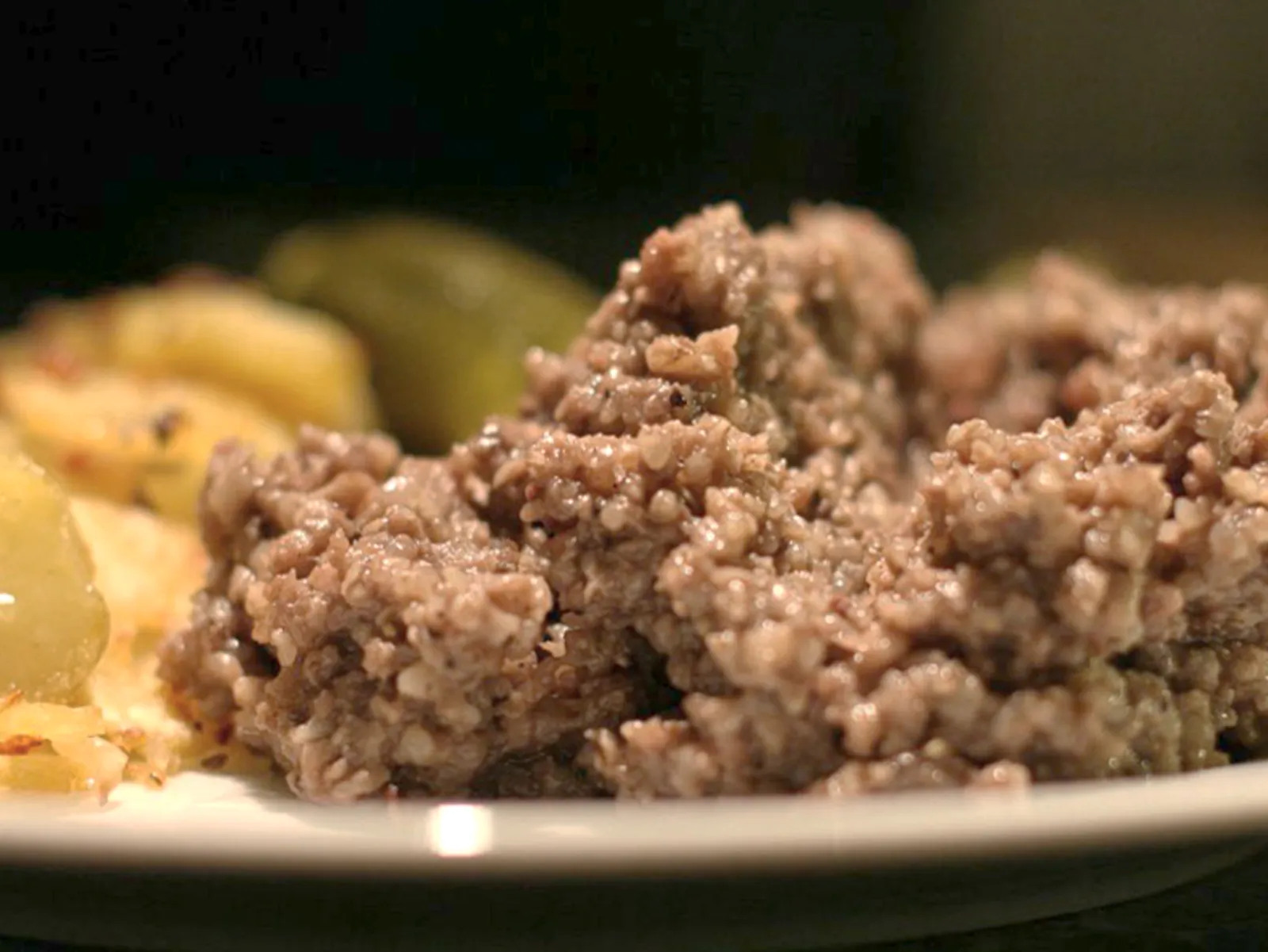
In Hanover, it's called "Pfannenschlag"; in Bremen, they say "Knipp"
In the capital of Lower Saxony, the spicy grützwurst is known as "Calenberger Pfannenschlag", and in the surrounding countryside you often hear the Low German term "Calenberger Pannenslag". In Bremen, on the other hand, it is called Knipp, and in Scotland it is known as haggis. In both countries, the cooked sausage specialty is made from oat groats, pre-cooked and chopped leftover meat, broth and all kinds of spices. The sausage meat is filled into natural casings and then scalded. This makes the sausage spreadable, yet it remains firm to cut.
To make the traditional Hanoverian Grützwurst, meat from beef and pork heads, as well as pork belly and pork rinds, is boiled and then ground in a meat grinder; it is then mixed with finely chopped onions, soaked oat groats or rolled oats (which serve as a binding and filling agent) and minced beef liver, and finally seasoned well with ginger, cilantro, mace, cloves, pepper, allspice, and salt. To prepare Calenberger Pfannenschlag, diced onions are first sautéed in a pan. Then a “Schlag”—roughly a ladleful of the sausage mixture—is added to the pan. The Pfannenschlag is then heated only slightly and not cooked all the way through. Calenberger Pfannenschlag is usually served with farmhouse bread or pan-fried potatoes, mashed potatoes or boiled potatoes, a fried egg, and pickled gherkins.
Bremer Knipp is traditionally made without beef, pan-fried until crispy, and either served simply with whole-grain bread or as a main course with pan-fried or boiled potatoes, accompanied by pickled cucumbers, sweet-and-sour pumpkin, sauerkraut, applesauce, or beets.
Recipe tip
Ingredients for Calenberger Pfannenschlag:
1 kilogram of pearl barley
, 2 liters of rich vegetable broth
, 750 grams of beef
head meat and fatty belly meat, 200 grams of pork
head meat and fatty belly meat, 500 grams of bacon rinds
, a pinch of clove pepper, salt, and pepper
Preparation of Calenberger Pfannenschlag:
Cook the pearl barley in the stock and leave to swell over a low heat. Then cook the beef liver in the same stock and put through a mincer with some leftover pork and bacon rinds. Do not pour away the stock! Season the sausage meat mixture with a pinch of clove pepper, salt and pepper and mix well with the pearl barley. Then pour the sausage meat mixture into a linen bag and leave to stand in the stock for a further two hours. Finally, just remove the linen bag and the sausage meat is ready. Now place a "dollop" (i.e. a well-filled ladle) of the grützwurst in the already heated pan and fry until the mushy sausage forms a crispy crust. Place the pan-fried sausage on a flat plate and serve with boiled or fried potatoes and pickled vegetables (gherkins or mustard gherkins, gherkins, silver onions, mixed pickles).

 Deutsch
 English
 中文
中文
 Danish
 Eesti
Eesti
 Español
 Suomi
Suomi
 Français
 Italiano
 日本語
日本語
 한국
한국
 Nederlands
 Norge
Norge
 Polski
 Portugues
 Русский
 Svenska
 Türkçe
 العربية
 Română
 български