
 Deutsch
 English
 中文
中文
 Danish
 Eesti
Eesti
 Español
 Suomi
Suomi
 Français
 Italiano
 日本語
日本語
 한국
한국
 Nederlands
 Norge
Norge
 Polski
 Portugues
 Русский
 Svenska
 Türkçe
 العربية
 Română
 български
Hanoverian specialties
Asparagus
In April, a sigh of relief sweeps through Hanover and the surrounding region: it’s finally asparagus season again! Winter is a thing of the past, nature is blooming, and spring is in the air. We’re drawn back outdoors to garden parties with friends and Sunday outings with the family. And there’s one thing that can’t be missing from the festive tables—asparagus, the most popular delicacy far and wide. What a treat for all food lovers who call Hannover or its surrounding region home or are visiting, because they say that southern Lower Saxony is where the best asparagus in the whole country grows.
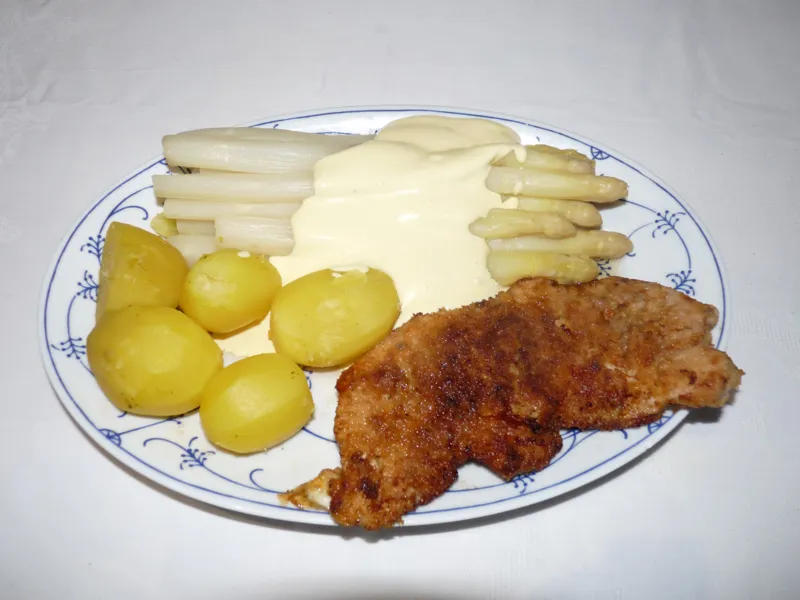
Asparagus with schnitzel
Asparagus - a precious natural resource and off-the-peg luxury
The two asparagus capitals, Burgdorf and Nienburg, north of Hanover, are connected by Federal Highway B 188, which is also known in this region as the “Lower Saxony Asparagus Route.” Along this country road, which winds its way over rolling hills through lush meadows, dense rows of grain, and idyllic farming villages, lie the treasures of the Hanover region: asparagus fields stretching as far as the eye can see. Shortly after sunrise, tireless harvesters are already out in the fields, harvesting whatever the sandy, flattened earthen ridges have to offer. This continues until St. John’s Day on June 24—that’s when the asparagus season ends, as this delicate lily plant needs to recover and regain its strength until next year.
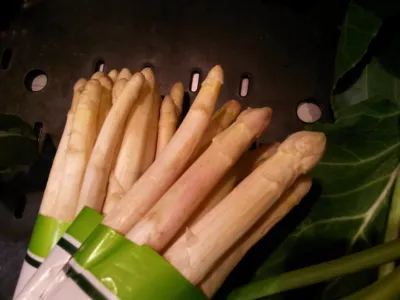
Depending on the weather, asparagus harvest season in the Hanover region is usually between April and June.
Asparagus is by no means a modern agricultural discovery; the aromatic spears were already known in ancient times. Hippocrates, on whom physicians swear an oath, attributed healing properties to Asparagus officinalis (its scientific name) as early as 460 BC and was convinced that the phallic vegetable refreshed the libido and aroused "lustful desire" in men. In fact, asparagus is rich in vitamins B and C, minerals and potassium salts. It owes its strong aroma to its high aspartic acid content - it gets the body's fluids going by draining the body and stimulating kidney activity. The slender spears are also good for the figure: one kilo (unsalted and without sauce) weighs in at just 170 kcal or 730 kl. In the Roman Empire, however, asparagus was prized as a tasty and expensive delicacy that only the wealthy could afford. Today and in this country, however, asparagus is on everyone's lips and affordable. The daily price for the delicate luxury off the shelf is largely determined by the weather: if there is a lot of warming sunshine in the fields, the yield is good and the supply is large. This lowers the price and raises the gourmet mood.
Burgdorf Showcases Its Asparagus
The noble asparagus has influenced German table culture like no other vegetable. The Burgdorf asparagus exhibition features over 1.000 exhibits from five centuries of fine porcelain, faience, silver and other materials - from sauce boats and serving dishes to silver cutlery, plates and tureens from all over the world: in addition to an exquisite asparagus service from the United States and the asparagus tureen "Schweinchen" from Japan, there are also magnificent asparagus tongs from Russia and a French porcelain asparagus table in the shape of the famous classic cookbook by Brillat-Savarin from 1826.
Friedrich-Karl Wiesener of Burgdorf collected all these treasures with great passion over many years and donated his unique private collection to his hometown in 1997. Since 2005, the Burgdorf Asparagus Collection—which also offers an entertaining cultural-historical retrospective and overview of this exclusive vegetable in art and literature, medicine, and pharmacy—has been on permanent display at the Lower Saxony Asparagus Museum in Nienburg, located at Leinstraße 4 (www.museum-nienburg.de).
Nienburg Celebrates Asparagus
In Nienburg, the “new castle” and former seat of the Counts of Hoya, food lovers from the city and the countryside gather every May for the “Nienburg Asparagus Festival.” They feast and celebrate late into the night at numerous tables, accompanied by music and dancing, and, following an old tradition, crown a new Asparagus Queen—the charming ambassador for a truly majestic vegetable.
Asparagus service
Purely a matter of taste: the color of the asparagus
White asparagus: thick, straight spears with closed tips that grow underground. They have a slightly bitter aroma and a delicate, mild flavor
. Green asparagus: grows above ground and has a hearty flavor. It can also be
cooked unpeeled. Purple asparagus: the first rays of sunshine add a touch of color to the elegant pale spears, giving them a spicy note
Tips & Tricks
The number one rule when buying asparagus is: the fresher, the better. Fresh asparagus has a closed head, the firm spears squeak slightly when rubbed together and the tips are juicy. An unmistakable indicator of freshness is the "nail test": if you press the cut ends of freshly cut asparagus with your fingernail, watery juice will drip out. If the cut ends remain dry, it is not advisable to buy them. Unpeeled asparagus can be kept in the fridge in a damp kitchen towel for about four days, frozen in the freezer for four to six months.
Use water sparingly when cooking the fine spears (bundle in portions and steam standing upright in a lightly salted water bath for 20 to 30 minutes)! Water rinses out the valuable aromatic substances and vitamins. If you cook asparagus for several days in a row, you should keep the stock and cook the next portion in it. After three batches, the broth provides the stock for a great asparagus soup.
Asparagus sale directly from the field
Fresh from the field, asparagus is sold at numerous roadside stands between Burgdorf and Nienburg, along the B 65 between Hanover and Nienburg, and along the B 3 between Hanover and Celle.
Recipe tip from Ekkehard Reimann of the “Clichy” restaurant in Hanover
Sautéed Asparagus with Tagliatelle (serves 4)
600 grams peeled asparagus (equivalent to about 1 kilogram unpeeled)
100 ml high-quality olive oil
20 grams butter
Salt, nutmeg, parsley, 1 pinch of sugar
100 grams grated Parmesan cheese
4 servings of tagliatelle
Preparation:
Slice
the asparagus diagonally into 4-mm-thick pieces. Heat
the olive oil and a little butter in a large skillet. Add the asparagus and sauté for about 3 minutes until tender (it should still be crisp!) Season
with salt, nutmeg, and sugar. Sprinkle with freshly grated Parmesan, toss quickly with the cooked pasta, and garnish
with parsley on the plate. Pair with a young German Riesling from the Mosel or a Baden Pinot Blanc
Enjoy your meal!