
 Deutsch
 English
 中文
中文
 Danish
 Eesti
Eesti
 Español
 Suomi
Suomi
 Français
 Italiano
 日本語
日本語
 한국
한국
 Nederlands
 Norge
Norge
 Polski
 Portugues
 Русский
 Svenska
 Türkçe
 العربية
 Română
 български
Hanoverian specialties
Truffles from Güse
Güse’s spherical pralines are famous far beyond the city limits and have been handmade since 1921 at Hanover’s only truffle factory. Over the course of three days and eight production steps, this small family-run business in the Südstadt district creates around 60 different varieties of these delicious cocoa masterpieces—made from chocolate coating, fondant, and cream fillings—based on the original recipes of the company’s founder, Emil Güse. These sweet treats are sold at the company’s own store on Kröpcke in the heart of the city and at the market hall on Karmarschstraße.
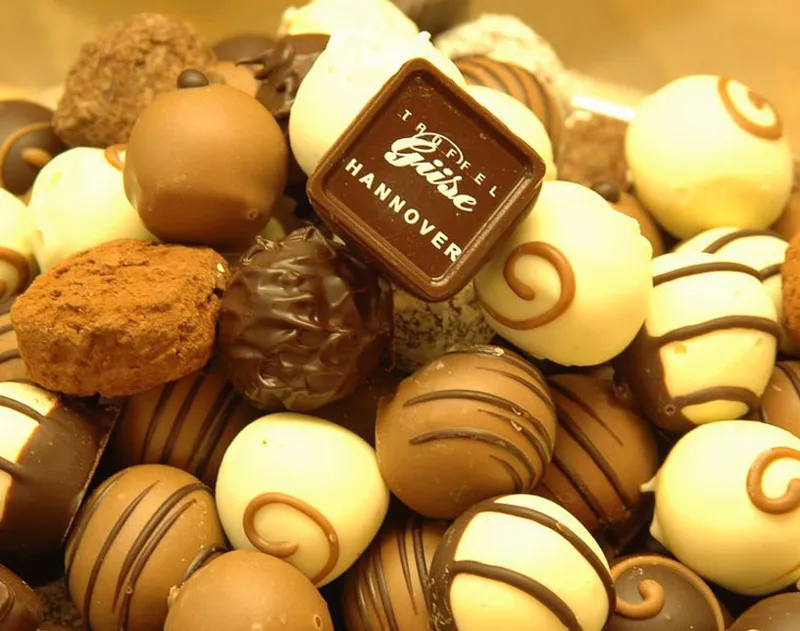
Truffles from Trüffel Güse
Hanover's sweet seducers
Of course, those with a sweet tooth and foodies know that a truffle praline does not contain a single one of these bulbous mushrooms, which grow well hidden in the forest floor and are often used to enhance olive oils, pasta dishes and salami sausages. The truffle praline got its name because it looks very similar to the rare wild mushroom and because, like it, it is an exclusive treat for all the senses.
Chocolate truffles are elegant pralines that resemble marbles in size and shape and are filled with a more or less solid chocolate cream, the so-called "ganache". Butter, cream and couverture are melted, stirred until creamy and refined with all kinds of fine flavorings such as vanilla or whisky, cappuccino, cognac or kirsch to make the delicately melting filling. All of this has always been done by hand at the Güse truffle factory in the following eight steps:
1st work step
The best couverture (a very high-quality chocolate), fondant (a specially cooked sugar), butter and a few mysterious ingredients are mixed together to create the truffle core
2nd work step
The mixture is spread onto trays and cooled
3rd work step
The hard mixture is rolled out and cut into small cubes
4th work step
The small cubes are rolled by hand into a round truffle core
5th work step
The truffle core is cooled
6th work step
Now the sliceable truffle core is coated with chocolate coating for the first time
7th work step
After another cooling cycle, the core is coated with chocolate coating a second time
8th work step
The truffle praline gets its characteristic surface by being decorated by hand with stripes or dots or rolled in powdered sugar or cocoa powder
Güse also makes chocolate bars by hand
Sabine Güse-Henschel and her brother Klaus, who have been running the family business together as the third generation since 1987, are not only well known throughout the city for their sometimes unusual truffle creations—the two also consistently come up with original ideas for their hand-crafted chocolate bars. A few years ago, for example, they asked six of the best chefs from Hanover and the surrounding region to create their very own gourmet chocolate. The result was a unique collection of six handcrafted 50-gram bars, including “Klauke’s Ginger” by Arne Klauke, executive chef at the Hotel Luisenhof; “Rasper’s Cherry” by Oliver Rasper, culinary director at NORD/LB; “Reimann’s Rum-Rosine” by Clichy owner Ekkehard Reimann, “Schu’s Leckerli” by celebrity chef Norbert Schu, “Sobotka’s Pfläumchen” by Celle-based Endtenfang Michelin-starred chef Hans Sobotka, and “Weick’s Goji Passion” by Arndt Weick, head chef at Gastwirtschaft Wichmann.
Just recently, Trüffel Güse released another small and exceptionally fine collection of traditional Hanoverian chocolate specialties with its Herrenhäuser Gärten Edition—featuring seven bars wrapped in delicate tissue paper, three of which are milk chocolate varieties with orange-sesame, pineapple, and vanilla-caramel; three bars of dark chocolate with coffee-cocoa chips, chili-lime, and spicy ginger; and one bar of white chocolate with a hint of poppy seeds and amaretto.