 Deutsch
 English
 中文
中文
 Danish
 Eesti
Eesti
 Español
 Suomi
Suomi
 Français
 Italiano
 日本語
日本語
 한국
한국
 Nederlands
 Norge
Norge
 Polski
 Portugues
 Русский
 Svenska
 Türkçe
 العربية
 Română
 български
Center
The city center has been dominated by market activity since the Middle Ages: Department stores, administrative offices, banks and insurance companies still characterize the cityscape today. The beginnings of the town go back further.
The Herrenhof on what is now Ballhofplatz and the market square in front of the old town hall have existed since the early 11th century. The almond-shaped city layout, with three longitudinal streets extending between the Aegidien Gate and the Stone Gate, was soon densely built up. The city’s economic importance grew, as did its sense of self-confidence, which was recognized in a charter issued in 1241 by Duke Otto I of Brunswick-Lüneburg. When Duke Georg made Hanover his residence in 1636, the citizens left him little room for a courtly life.
He therefore concentrated on the new town of Calenberg. It was fortified, a market and church were built, the sovereign's authorities and servants moved in and hotels were established. The town, which was independent from 1707 to 1824, developed into the entrance to the residence. It was not until the railroad connection (1843) and the end of the kingdom in 1866 that the economic center shifted to the Kröpcke. The breakthrough of the Karmarschstraße in 1879 - 98 strengthened the formation of the city, while the old town lost its importance. During reconstruction after the painful destruction of the Second World War, the city centre was extended by the "Cityring" and the uses were reorganized. The election of Hanover as the capital of Lower Saxony (1946) and the establishment of the industrial trade fair (1947) provided further impetus.
Begin tower
775 Years - Discover Your Hannover
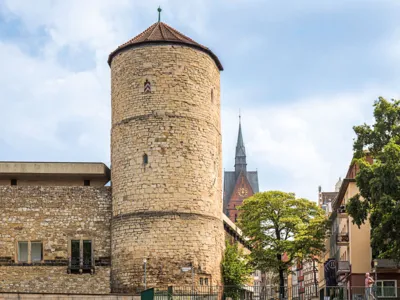
The semicircular Beginen Tower was the fifth and strongest tower of the medieval city wall. The citizens of Hanover built it in 1357 on the banks of the Leine River, across from the sovereign’s castle at Lauenrode. The structure is a striking demonstration of the city’s self-confidence: deeply embedded in the Hohe Ufer, soaring 23 meters high, and featuring walls three meters thick, it provided protection for the citizens while simultaneously serving as a threat to outsiders. The narrow Gothic windows at the top served both as vantage points and for defense. Even today, two iron rings and a hook above the windows catch the eye; these once held a wooden shutter in place to protect the defenders. For a time, the tower served as a prison, then as a peat storage facility, a residence, and finally as a restaurant. Today, it is a museum and educational center dedicated to the city’s history.
Address:Am Hohen Ufer, 30159 Hanover
New town hall
775 Years - Discover Your Hannover
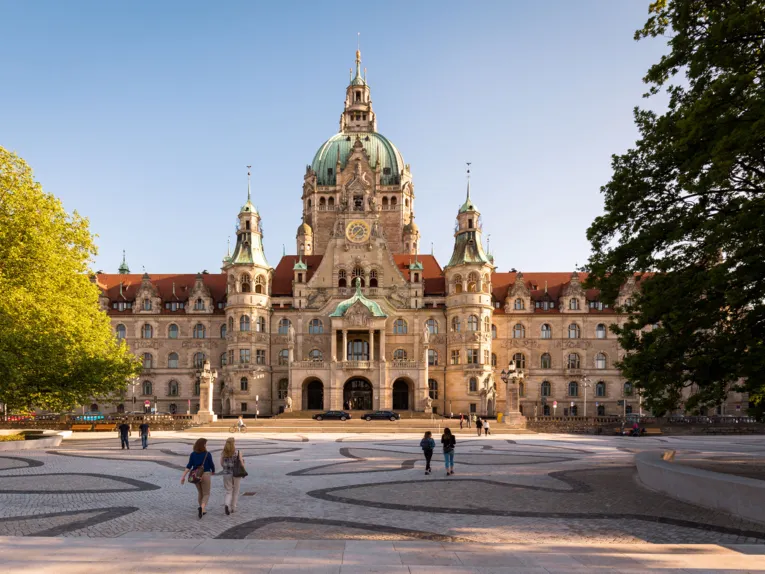
Following two design competitions in 1896 and 1897, architect Hermann Eggert planned a group of three buildings centered around a “courtyard of honor”: City Hall, the Building Authority (destroyed during the war), and the existing August Kestner Museum. Instead of the usual tower, the 129-meter-long and 124-meter-deep City Hall was given a dome—modeled after the Reichstag building in Berlin. The richly ornamented facades were designed in the Neo-Renaissance style, which is why the building was popularly known as “Heinrich’s Castle”—named after the city director at the time, Heinrich Tramm. The Square of Human Rights as a forecourt, the landscaped Maschpark, and the building’s imposing, monumental presence continue to fascinate visitors today, but with the democratic opening of the building and its institutions, they have lost their intimidating power.
Address: Platz der Menschenrechte 1, 30159 Hanover
Further information on the New Town Hall
Anzeiger high-rise
775 Years - Discover Your Hannover
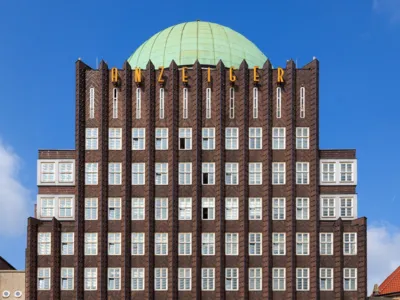
As a landmark in the urban landscape, the *Hannoverscher Anzeiger* high-rise stands as a testament to the special power of the press during the Weimar Republic. The nine-story reinforced-concrete frame building with its green planetarium dome was commissioned by August Madsack for the *Hannoverscher Anzeiger* from the Hamburg-based master of clinker brick architecture, Fritz Höger, and constructed between 1927 and 1928. The dynamic upward thrust of the pillars and pilaster strips, the stepped arrangement of the upper floors, as well as the elevated, stepped passageways and the approach to the cathedral-like lobby make the building a remarkable sight, a quality that is further enhanced by the artisanal detail of the clinker brickwork. In 1930, the high-rise was one of eight such buildings in Hanover; moreover, it marked the beginning of the use of clinker brick for residential buildings of the “Red Modernism” movement.
Address: Goseriede 9, 30159 Hanover
775 Years - Discover Your Hannover
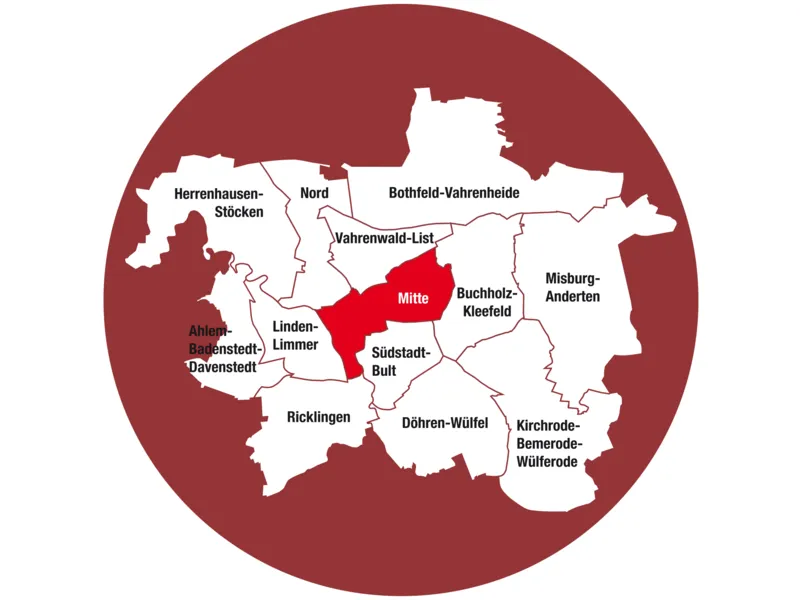
To the overview of the city districts
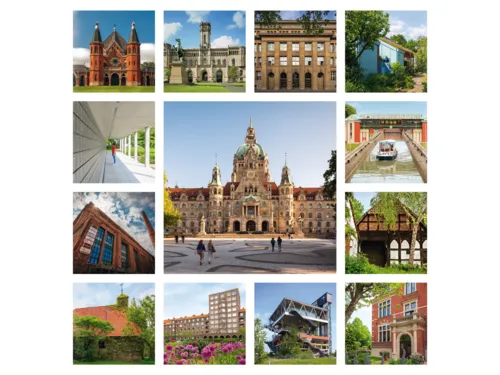
Click here for an overview of the 13 city districts with their particularly characteristic locations and neighborhoods.
readFurther information:

Experience with a panoramic view
Dome driveway in the arched elevator
Head to the town hall dome to take the spiral elevator and enjoy the panoramic view of Hanover
read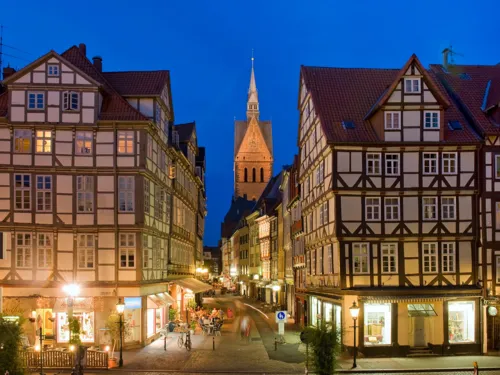
Place of interest
Old Town
Half-timbered houses, history and flair: Hanover's old town invites you to discover and linger.
read