 Deutsch
 English
 中文
中文
 Danish
 Eesti
Eesti
 Español
 Suomi
Suomi
 Français
 Italiano
 日本語
日本語
 한국
한국
 Nederlands
 Norge
Norge
 Polski
 Portugues
 Русский
 Svenska
 Türkçe
 العربية
 Română
 български
Making-of
Idea & technology
Behind the Scenes - Time Jump Hannover
Here you will find all the information about the idea behind the campaign and the technology behind the motifs created.
How It All Began - Hanover Timelapse
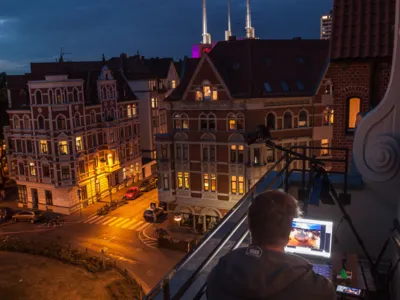
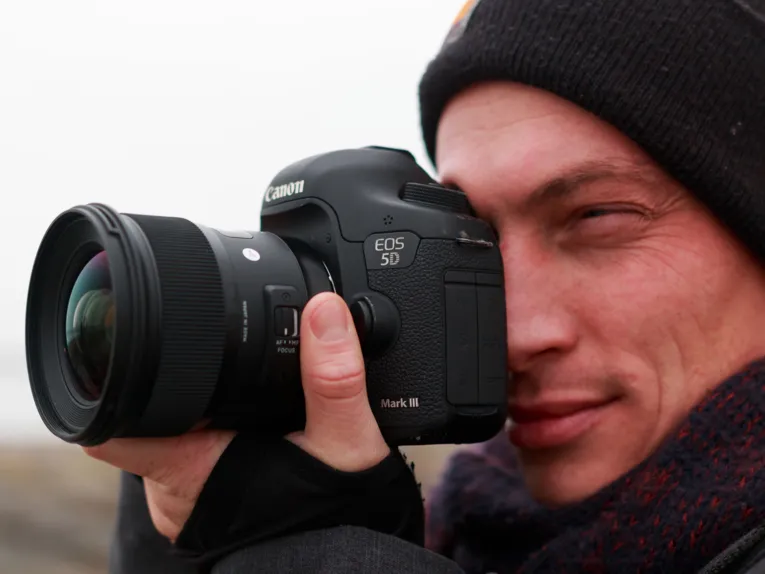
Stefan Knaak taking pictures at the Lichtenberg traffic circle.
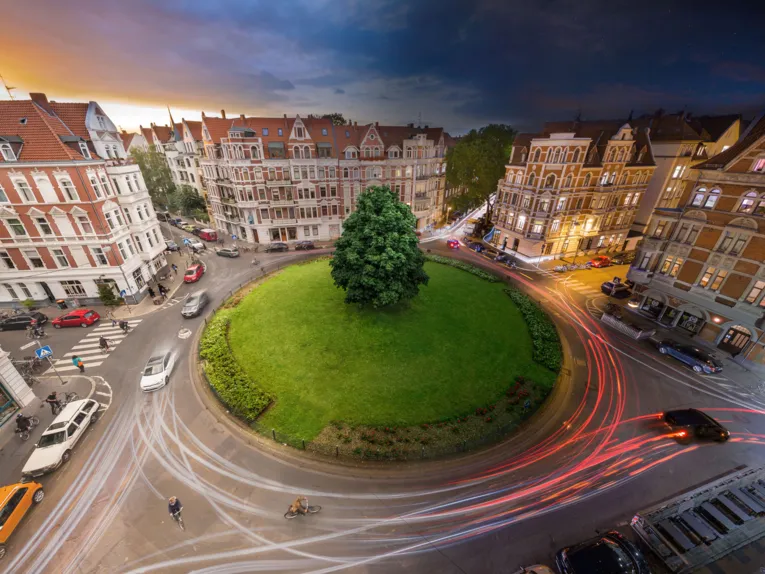
To showcase Hannover’s most beautiful places in all their facets. The challenge: to capture both day and night in a single image. Building on the success of the film “Hannover – Timelapse 2,” the moving images are now set to be featured on a poster! Stefan Knaak, a freelance photographer from Hannover, designed a similar motif back in 2015. Using a technique known as time-lapse, he captures the view from the Bredero skyscraper on Raschplatz across all of Hannover and creates a day-night image.
During an initial meeting between Stefan and representatives of Hannover Marketing und Tourismus GmbH, it quickly became clear that the project wasn’t about individual photos, but rather an image campaign. The subjects were developed collaboratively and include a diverse mix of locations from all city districts, alongside some iconic landmarks such as the new city hall and Lake Maschsee. Before the first shoot, all the planned locations had to be visited and photographed. This took three weeks. Initially, the focus was on 20 locations. After the test shots, it quickly became clear which locations were suitable for the type of photos being sought and which were not as well-suited. For Stefan Knaak, the summer of 2016 became a life lived between day and night.
The technology
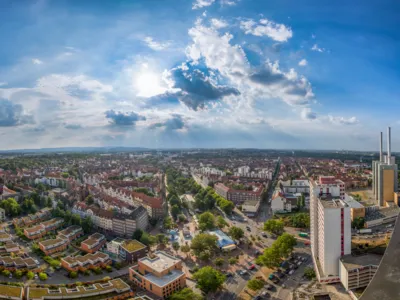
View from the Ihme Center toward the kitchen garden
To show day and night in a photo, photos must be taken during the day and at night. In between, the camera must not move so that there are no shifts between the photos. For each motif, Knaak stands from midday until the early hours of the morning at the respective locations where the pictures are taken. Between 800 and 3,500 photos were taken at each location.
A total of around 20,000 photos were taken during the campaign. Once the respective motif has been photographed, the images are viewed on the PC and then selected to determine whether the photo fits the motif. The selected photos are then edited in Lightroom and put together in Photoshop to create an overall composition. In total, this process takes between one and four days per image. Once the final image has been agreed with those involved in the project, it is forwarded to the graphic designer, in this case Jasmin Göbel from formreichdesign, who creates the print data for the posters, calendar and advertisements.
Possible difficulties arise in the form of so-called "converging lines", which occur when the subject is at an angle to the camera and the wide-angle object of the camera is distorted in perspective. For each image, the conditions of the subject must be checked in advance to ensure that converging lines are avoided by choosing the right lens. Unfortunately, this was not possible for all subjects due to the physical opposing planes.
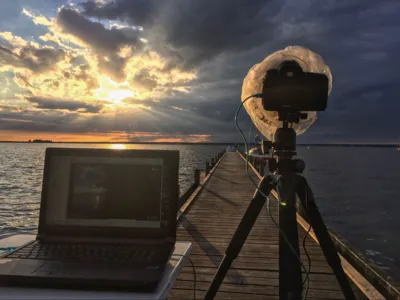
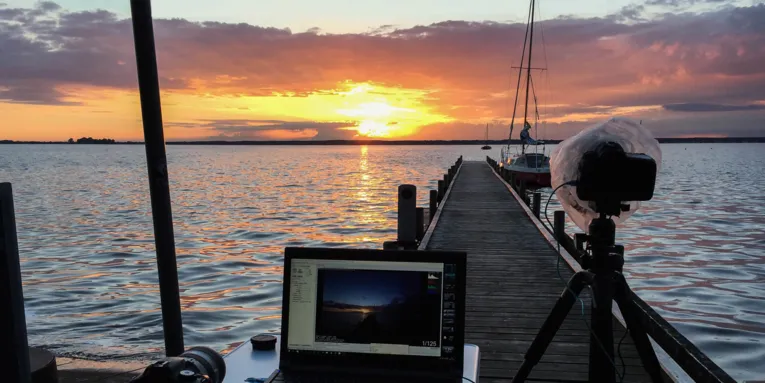
Photos taken at Steinhuder Meer
For example, Knaak needed a focal length of 11mm for Lichtenbergplatz, despite the full-frame camera, in order to be able to depict the sky and the entire traffic circle, although the falling lines are particularly noticeable here, which could be reduced by a tilt-shift lens. However, such a lens is not available with the required focal length. So the photographer makes use of the classic time-lapse technique, in which pictures are taken at a fixed interval. However, there is a small but decisive difference, as the exposure time of most campaign photos was significantly shorter than with normal time-lapse photography in order to be able to capture things in motion, such as people and cars, in sharp focus at all times. In a normal time-lapse, the exposure is longer, similar to a movie, in order to achieve smoother transitions.
Throughout the campaign, he will receive technical support from the company ProBis, which has provided Knaak with various lenses and clamping devices for railings and, if necessary, adapted them structurally to the circumstances of the respective motifs. This ensures that even the heaviest camera is held on the tripod or railing.
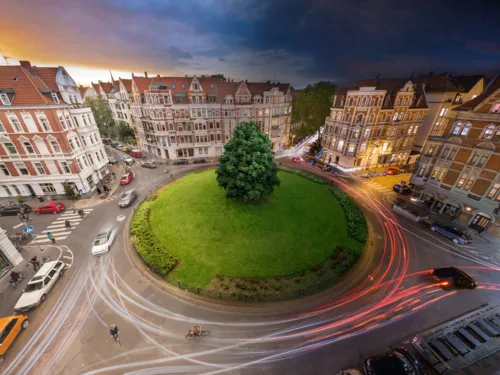
Making-of
Creation of the pictures
Here you can find out everything about the creation of the images as they change from day to night.
read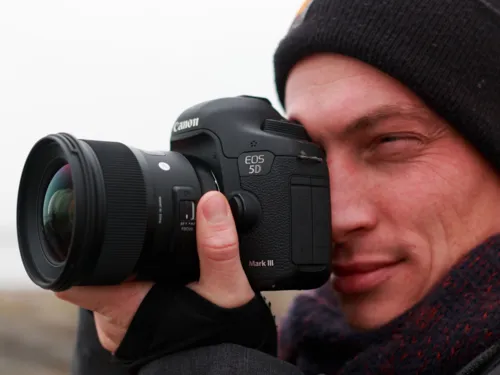
Stefan Knaak
Portrait of the photographer
Here you will find information about the photographer who took the motifs and the time-lapse videos.
read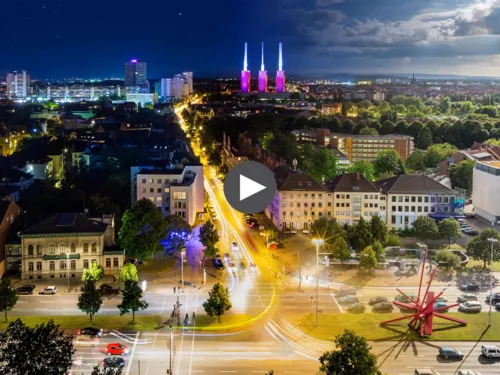
Videos to click through
Time Jump Hannover - Video Gallery
Here you can find all videos at a glance.
read