
 Deutsch
 English
 中文
中文
 Danish
 Eesti
Eesti
 Español
 Suomi
Suomi
 Français
 Italiano
 日本語
日本語
 한국
한국
 Nederlands
 Norge
Norge
 Polski
 Portugues
 Русский
 Svenska
 Türkçe
 العربية
 Română
 български
Place of interest
Landestrost Palace Portrait
Here you can find out interesting information about the history of the building, the Italian-style fortifications and the beautiful official garden.
Building history
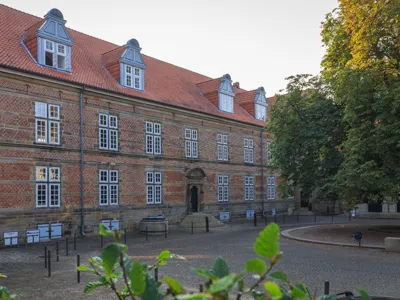
One of the largest and oldest palace complexes in the Hanover region is located in Neustadt am Rübenberge. Duke Erich II of Brunswick-Lüneburg built Schloss Landestrost between 1573 and 1584 as a representative residential building in the Weser Renaissance style. The three-winged complex was built on the remains of a medieval castle, which burned down in 1563. Duke Erich II took over the government of the Principality of Calenberg at the age of 18, but largely left the business to his first wife Sidonia, while he spent time abroad as a mercenary leader in the service of other rulers and was handsomely remunerated.
In the 16th and 17th centuries, the income generated by mercenary service was often invested in land and luxurious residential buildings. In this way, a number of prestigious castles were built on the Weser in the style later known as the Weser Renaissance. Duke Erich II had the palaces in Uslar (1559, burnt down in 1612), Hannoversch-Münden (1562) and Neustadt (1573) built in quick succession. All three castles show clear stylistic features of Italian and French Renaissance architecture, which Erich II probably became acquainted with on his travels to the Netherlands, France and Italy.
Landestrost Palace was planned as a closed four-winged complex, but only the east and north wings were built. The south wing, which was still from the previous building, was severely damaged and collapsed during the siege and capture of the castle by Tilly's troops in 1635. Erich II died in 1584 before Landestrost Palace was completed without legitimate heirs. After his death, the Principality of Calenberg-Göttingen was reunited with the Principality of Brunswick-Wolfenbüttel under Duke Julius.
Duke Julius had the construction work on the north wing completed. The castle remained the ducal residence of the Dukes of Lüneburg until 1636. It then became the seat of the bailiff for the Neustadt district until the district of Neustadt am Rübenberge was formed in 1885. In 1891, the district savings bank was housed in the castle, where it remained until a new building was erected on the site of the old south wing of the castle complex. In 1957/58, a further extension was built to house the district administration, which today houses the district court and the Neustadt municipal library.
Fortress and official garden
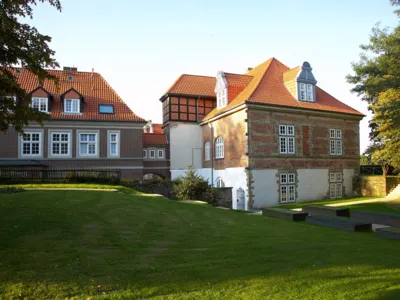
Landestrost Palace
The fortifications surrounding the castle and the town of Neustadt, built by Duke Erich II at the same time as the castle, bear traits of Italian and Dutch bastion fortifications. Following the Italian model, solid walls were built with acute-angled bastions and earth ramparts in front of them. Following the Dutch model, entire sections of the ramparts were built from earth, covered with turf and surrounded by a deep moat to increase the distance to the guns.
Even if there was no real enemy threat to the town of Neustadt and the ducal castle at the time, the planning of a fortification was in line with the duke's personal interests. The castle and the fortifications were to shape the character of Neustadt as a ducal residence. For this reason, Duke Erich II renamed the fortress, the castle and Neustadt "Landestrost" between 1574 and his death. The castle hill ("Rouwenberge"), which had already been heaped up in the Middle Ages, probably gave the town of Neustadt the nickname "am Rübenberge".
The southern bastion at the end of the Amtsgarten and an accessible casemate on the south side of the castle still remain from the fortifications. To the north of the castle, in Neustadt's old town, there are still remains of the former fortress wall that once surrounded the town. The so-called "Green Vault", a hornbeam walkway over 250 years old, is located to the south behind the castle in the official garden, which was redesigned according to historical plans.
Hanover Cultural Region Foundation and Team Culture
Landestrost Palace has been owned by the Hanover Cultural Region Foundation since 1997.
With an endowment capital of 20 million euros, the Hanover Cultural Region Foundation is one of the largest cultural foundations in northern Germany. It was founded in 1997 by the Kreissparkasse Hannover and the district of Hanover, whose legal successors today are the Sparkasse Hannover and the Region of Hanover. Since 1997, Schloss Landestrost has belonged to the Hanover Cultural Region Foundation, which includes the preservation and maintenance of the castle among its foundation tasks.
The Hanover Cultural Region Foundation runs a permanent exhibition in the castle that documents the history of the castle's construction and the life of its builder, Duke Erich II. The Hanover Cultural Region Foundation rents out historic rooms in the castle for weddings, conferences, banquets, seminars and concerts, among other things. Also housed in the castle is the Hannover Region Culture Team, which performs on the various stages in and around the castle with a varied program of events and concerts throughout the year: Kultur im Schloss.
For more information
, contact the Hannover Cultural Region Foundation:
Aegidientorplatz 1, 30159 Hannover
Tel.: 0511 - 3000 14 30
Fax: 0511 - 3000 95 14 30
Email: info@stiftung-kulturregion.de
Landestrost Palace
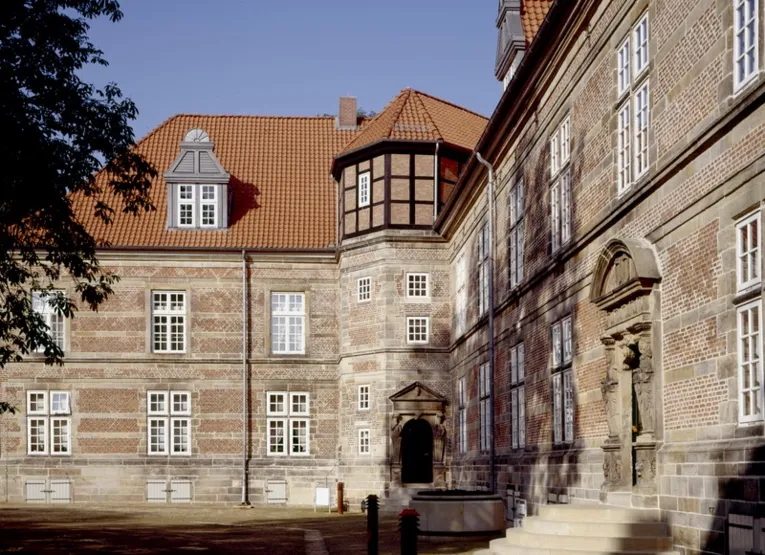
Landestrost Palace in Neustadt