
 Deutsch
 English
 中文
中文
 Danish
 Eesti
Eesti
 Español
 Suomi
Suomi
 Français
 Italiano
 日本語
日本語
 한국
한국
 Nederlands
 Norge
Norge
 Polski
 Portugues
 Русский
 Svenska
 Türkçe
 العربية
 Română
 български
Ahlem-Badenstedt-Davenstedt
The 11th district is characterized by recreational areas and a special culture of remembrance.
The 11th city district comprises the three neighborhoods of Ahlem, Badenstedt, and Davenstedt in the southwestern part of the city of Hannover. With an area of 9.85 km², the district is home to nearly 34,000 residents (as of 2021). Ahlem-Badenstedt-Davenstedt is known for its green spaces, such as Willy-Spahn Park, the Fösse Green Corridor, and Benther Berg. There is also no shortage of recreational opportunities here; youth centers and cultural institutions, in particular, play a central role in community life.
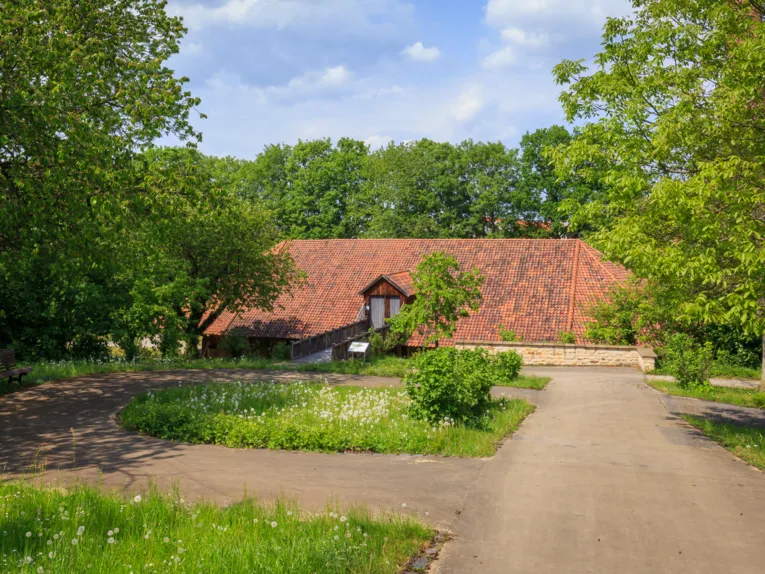
Willy-Spahn-Park / lime kiln
775 Years - Discover Your Hannover
The current site of Willy Spahn Park was originally a lime quarry, which was used from 1850 for the production of quicklime (mortar) and slaked lime (fertilizer). The existing lime kiln, a 35 m long, 13 m wide and 9.5 m high Hoffmann ring kiln, was built in 1925 and could be preserved. It only remained in operation until 1930. In 1938, the businessman Willy Spahn acquired the site and planted an orchard on the terraces for the production of fruit and fruit juice drinks under the "Sprudella" brand. The fruit juice business was discontinued in the 1960s. When his widow died in 1996, the site was redesigned as a public park and the only listed circular oven in the region was restored. The recreational park, which is popular with young and old, has been open since 2004.
In addition to cultural institutions such as the local history museum, the Ahlem neighborhood is also home to several memorials and sites commemorating World War II.
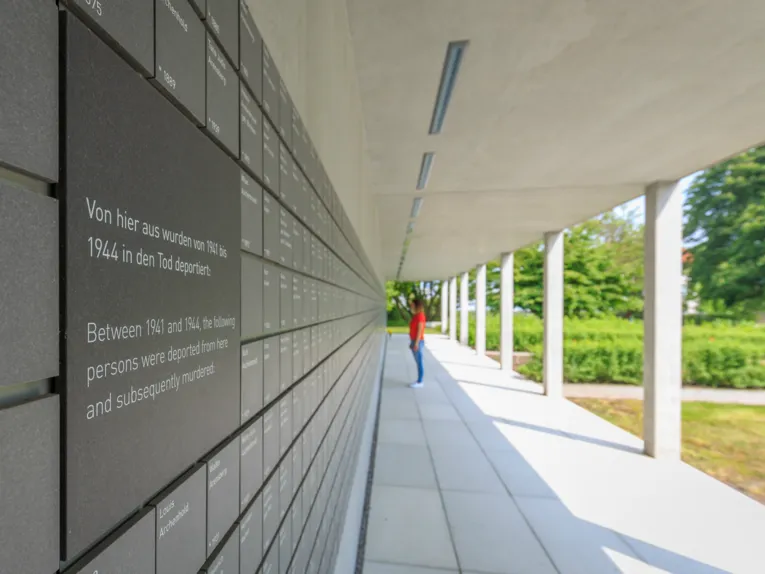
Israelite Garden School / Ahlem Memorial
775 Years - Discover Your Hannover
The Israelite Garden School Ahlem at Heisterbergallee 8, initially called the Israelite Educational Institution, was founded in 1893 by the Hanoverian banker Moritz Simon with the aim of providing Jewish children and young people with an elementary school education followed by an apprenticeship in horticulture. The pupils came from all over Germany and Eastern Europe. The director's house, girls' house and gatekeeper's house have been preserved. The architecture of the red brick strips and plastered walls with arched windows is reminiscent of school buildings of the time. The school was closed in 1942, and in the fall of 1941 the gardener's house became the "Jews' house", from which more than 2,000 men, women and children were transported to concentration camps and ghettos in Eastern Europe by 1944. The Ahlem Memorial has been located here since 1987, documenting the history of the site and its residents.
The lime kiln (1925) and the asphalt pits (since 1842) still bear witness to this today. During the Second World War, goods essential to the war effort were produced in the asphalt pits using concentration camp prisoners. A unique facility was founded in Ahlem in 1893 with the Israelite Horticultural School.